
NF-κB的神经元基因靶点及其在阿尔茨海默病中的失调
Neuronal Gene Targets of NF-κB and Their Dysregulation in Alzheimer's Disease.
作者信息
Snow Wanda M, Albensi Benedict C
机构信息
Division of Neurodegenerative Disorders, St. Boniface Hospital ResearchWinnipeg, MB, Canada; Department of Pharmacology and Therapeutics, University of ManitobaWinnipeg, MB, Canada.
出版信息
Front Mol Neurosci. 2016 Nov 9;9:118. doi: 10.3389/fnmol.2016.00118. eCollection 2016.
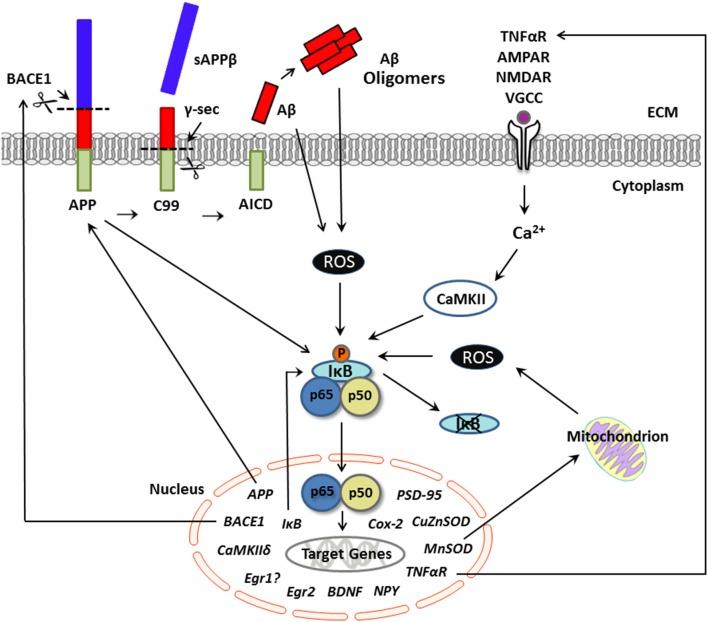
Although, better known for its role in inflammation, the transcription factor nuclear factor kappa B (NF-κB) has more recently been implicated in synaptic plasticity, learning, and memory. This has been, in part, to the discovery of its localization not just in glia, cells that are integral to mediating the inflammatory process in the brain, but also neurons. Several effectors of neuronal NF-κB have been identified, including calcium, inflammatory cytokines (i.e., tumor necrosis factor alpha), and the induction of experimental paradigms thought to reflect learning and memory at the cellular level (i.e., long-term potentiation). NF-κB is also activated after learning and memory formation . In turn, activation of NF-κB can elicit either suppression or activation of other genes. Studies are only beginning to elucidate the multitude of neuronal gene targets of NF-κB in the normal brain, but research to date has confirmed targets involved in a wide array of cellular processes, including cell signaling and growth, neurotransmission, redox signaling, and gene regulation. Further, several lines of research confirm dysregulation of NF-κB in Alzheimer's disease (AD), a disorder characterized clinically by a profound deficit in the ability to form new memories. AD-related neuropathology includes the characteristic amyloid beta plaque formation and neurofibrillary tangles. Although, such neuropathological findings have been hypothesized to contribute to memory deficits in AD, research has identified perturbations at the cellular and synaptic level that occur even prior to more gross pathologies, including transcriptional dysregulation. Indeed, synaptic disturbances appear to be a significant correlate of cognitive deficits in AD. Given the more recently identified role for NF-κB in memory and synaptic transmission in the normal brain, the expansive network of gene targets of NF-κB, and its dysregulation in AD, a thorough understanding of NF-κB-related signaling in AD is warranted and may have important implications for uncovering treatments for the disease. This review aims to provide a comprehensive view of our current understanding of the gene targets of this transcription factor in neurons in the intact brain and provide an overview of studies investigating NF-κB signaling, including its downstream targets, in the AD brain as a means of uncovering the basic physiological mechanisms by which memory becomes fragile in the disease.
转录因子核因子κB(NF-κB)虽因在炎症中的作用而更为人熟知,但最近它也与突触可塑性、学习和记忆有关。部分原因在于,人们发现它不仅存在于神经胶质细胞中(神经胶质细胞是介导大脑炎症过程不可或缺的细胞),还存在于神经元中。已确定了神经元NF-κB的几种效应物,包括钙、炎性细胞因子(如肿瘤坏死因子α),以及被认为能在细胞水平反映学习和记忆的实验范式的诱导(如长时程增强)。学习和记忆形成后NF-κB也会被激活。反过来,NF-κB的激活可以引发其他基因的抑制或激活。目前研究才刚刚开始阐明正常大脑中NF-κB众多的神经元基因靶点,但迄今为止的研究已证实其靶点涉及广泛的细胞过程,包括细胞信号传导与生长、神经传递、氧化还原信号传导和基因调控。此外,多项研究证实阿尔茨海默病(AD)中存在NF-κB失调,AD在临床上的特征是形成新记忆的能力严重受损。AD相关的神经病理学包括特征性的β淀粉样蛋白斑块形成和神经原纤维缠结。尽管有人推测这些神经病理学发现会导致AD中的记忆缺陷,但研究已确定在更明显的病理学出现之前,细胞和突触水平就存在紊乱,包括转录失调。事实上,突触紊乱似乎是AD认知缺陷的一个重要相关因素。鉴于最近发现NF-κB在正常大脑的记忆和突触传递中的作用、NF-κB广泛的基因靶点网络及其在AD中的失调,有必要全面了解AD中与NF-κB相关的信号传导,这可能对揭示该疾病的治疗方法具有重要意义。本综述旨在全面阐述我们目前对完整大脑中神经元内该转录因子基因靶点的理解,并概述研究AD大脑中NF-κB信号传导(包括其下游靶点)的研究,以此揭示疾病中记忆变得脆弱的基本生理机制。
 Zotero 插件