
用于分解健康社会经济不平等的等级依赖指标的结构方程模型:一项实证研究。
Structural equation modeling for decomposing rank-dependent indicators of socioeconomic inequality of health: an empirical study.
作者信息
Kessels Roselinde, Erreygers Guido
机构信息
Department of Economics, University of Antwerp and Flemish Research Foundation (FWO), City Campus, Prinsstraat 13, Antwerp, 2000, Belgium.
Department of Economics, University of Antwerp and Centre for Health Policy, University of Melbourne, City Campus, Prinsstraat 13, Antwerp, 2000, Belgium.
出版信息
Health Econ Rev. 2016 Dec;6(1):56. doi: 10.1186/s13561-016-0134-2. Epub 2016 Dec 7.
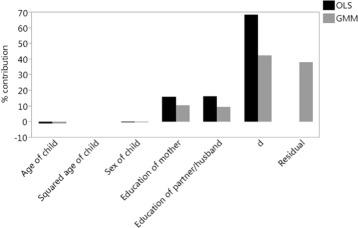
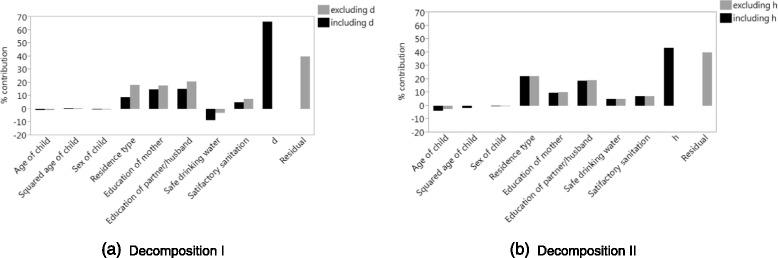
We present a flexible structural equation modeling (SEM) framework for the regression-based decomposition of rank-dependent indicators of socioeconomic inequality of health and compare it with simple ordinary least squares (OLS) regression. The SEM framework forms the basis for a proper use of the most prominent one- and two-dimensional decompositions and provides an argument for using the bivariate multiple regression model for two-dimensional decomposition. Within the SEM framework, the two-dimensional decomposition integrates the feedback mechanism between health and socioeconomic status and allows for different sets of determinants of these variables. We illustrate the SEM approach and its outperformance of OLS using data from the 2011 Ethiopian Demographic and Health Survey.
我们提出了一个灵活的结构方程模型(SEM)框架,用于基于回归的健康社会经济不平等等级相关指标分解,并将其与简单的普通最小二乘法(OLS)回归进行比较。SEM框架构成了正确使用最突出的一维和二维分解的基础,并为使用双变量多元回归模型进行二维分解提供了依据。在SEM框架内,二维分解整合了健康与社会经济地位之间的反馈机制,并允许这些变量有不同的决定因素集。我们使用2011年埃塞俄比亚人口与健康调查的数据来说明SEM方法及其优于OLS的表现。

 Zotero 插件