
绿色亚临界和超临界过程制备富含鼠尾草酸和鼠尾草酚的迷迭香提取物及其对结肠癌细胞体外抗增殖活性的比较研究
Comparative Study of Green Sub- and Supercritical Processes to Obtain Carnosic Acid and Carnosol-Enriched Rosemary Extracts with in Vitro Anti-Proliferative Activity on Colon Cancer Cells.
作者信息
Sánchez-Camargo Andrea Del Pilar, García-Cañas Virginia, Herrero Miguel, Cifuentes Alejandro, Ibáñez Elena
机构信息
Laboratory of Foodomics, Institute of Food Science Research, Instituto de Investigación en Ciencias de la Alimentación, Consejo Superior de Investigaciones Científicas, Nicolas Cabrera 9, 28049 Madrid, Spain.
出版信息
Int J Mol Sci. 2016 Dec 7;17(12):2046. doi: 10.3390/ijms17122046.
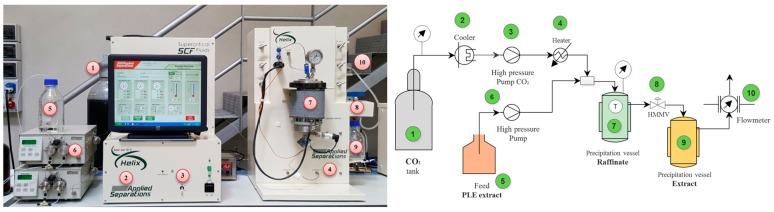
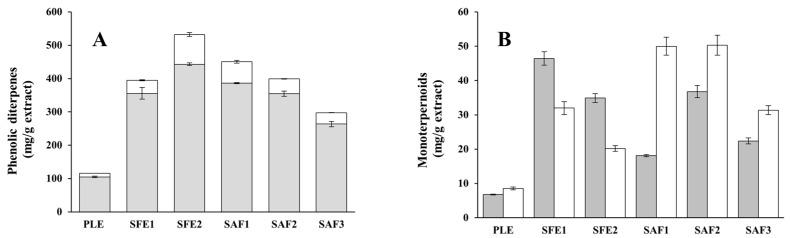
In the present work, four green processes have been compared to evaluate their potential to obtain rosemary extracts with in vitro anti-proliferative activity against two colon cancer cell lines (HT-29 and HCT116). The processes, carried out under optimal conditions, were: (1) pressurized liquid extraction (PLE, using an hydroalcoholic mixture as solvent) at lab-scale; (2) Single-step supercritical fluid extraction (SFE) at pilot scale; (3) Intensified two-step sequential SFE at pilot scale; (4) Integrated PLE plus supercritical antisolvent fractionation (SAF) at pilot scale. Although higher extraction yields were achieved by using PLE (38.46% dry weight), this extract provided the lowest anti-proliferative activity with no observed cytotoxic effects at the assayed concentrations. On the other hand, extracts obtained using the PLE + SAF process provided the most active rosemary extracts against both colon cancer cell lines, with LC ranging from 11.2 to 12.4 µg/mL and from 21.8 to 31.9 µg/mL for HCT116 and HT-29, respectively. In general, active rosemary extracts were characterized by containing carnosic acid (CA) and carnosol (CS) at concentrations above 263.7 and 33.9 mg/g extract, respectively. Some distinct compounds have been identified in the SAF extracts (rosmaridiphenol and safficinolide), suggesting their possible role as additional contributors to the observed strong anti-proliferative activity of CA and CS in SAF extracts.
在本研究中,对四种绿色工艺进行了比较,以评估其获得对两种结肠癌细胞系(HT - 29和HCT116)具有体外抗增殖活性的迷迭香提取物的潜力。在最佳条件下进行的工艺如下:(1)实验室规模的加压液体萃取(PLE,使用水醇混合物作为溶剂);(2)中试规模的单步超临界流体萃取(SFE);(3)中试规模的强化两步连续SFE;(4)中试规模的集成PLE加超临界抗溶剂分馏(SAF)。尽管使用PLE获得了更高的提取产率(干重为38.46%),但该提取物的抗增殖活性最低,在测定浓度下未观察到细胞毒性作用。另一方面,使用PLE + SAF工艺获得的提取物对两种结肠癌细胞系的活性最强,对于HCT116和HT - 29,LC分别为11.2至12.4 µg/mL和21.8至31.9 µg/mL。一般来说,活性迷迭香提取物的特征是含有浓度分别高于263.7和33.9 mg/g提取物的鼠尾草酸(CA)和鼠尾草酚(CS)。在SAF提取物中鉴定出了一些独特的化合物(迷迭香二酚和迷迭香酸内酯),表明它们可能是SAF提取物中观察到的CA和CS强大抗增殖活性的额外贡献者。

 Zotero 插件