
名人代言有影响吗?对安吉丽娜·朱莉在《纽约时报》发表社论后BRCA基因检测和乳房切除术率的观察性研究。
Do celebrity endorsements matter? Observational study of BRCA gene testing and mastectomy rates after Angelina Jolie's New York Times editorial.
作者信息
Desai Sunita, Jena Anupam B
机构信息
Department of Health Care Policy, Harvard Medical School, 180 Longwood Ave, Boston, MA 02115, USA.
Department of Health Care Policy, Harvard Medical School, 180 Longwood Ave, Boston, MA 02115, USA
出版信息
BMJ. 2016 Dec 14;355:i6357. doi: 10.1136/bmj.i6357.
OBJECTIVE
To examine the effect on BRCA testing and mastectomy rates of a widely viewed 2013 New York Times editorial by public figure Angelina Jolie that endorsed BRCA testing and announced Jolie's decision to undergo preventive mastectomy.
DESIGN
Observational study with difference-in-difference analysis.
SETTING
Commercially insured US population.
PARTICIPANTS
Women aged 18-64 years with claims in the Truven MarketScan commercial claims database (n=9 532 836).
MAIN OUTCOME MEASURES
Changes in BRCA testing rates in the 15 business days before versus after 14 May 2013 (editorial date) compared with the change in the same period in 2012; mastectomy rates in the months before and after publication, both overall and within 60 days of BRCA testing among women who were tested; national estimates of incremental tests and expenditures associated with Jolie's article in the 15 days after publication.
RESULTS
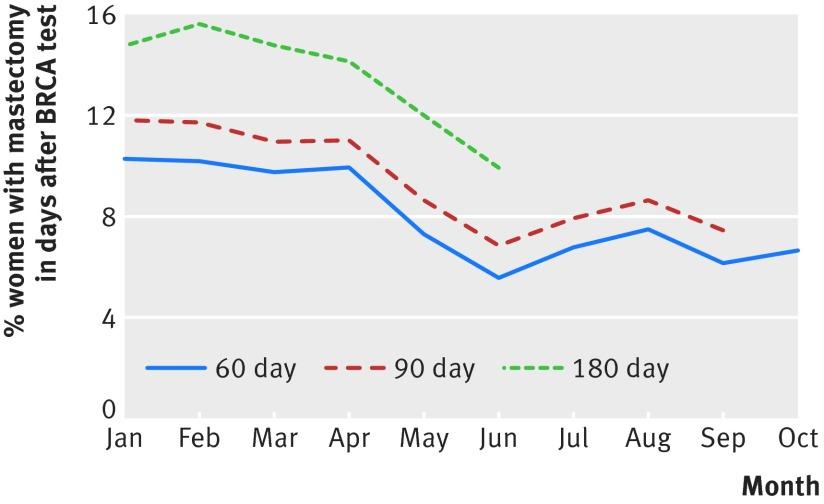
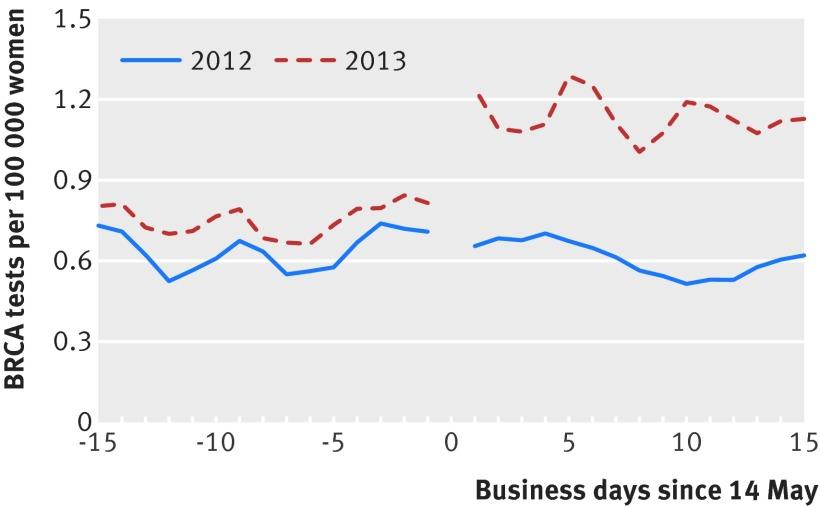
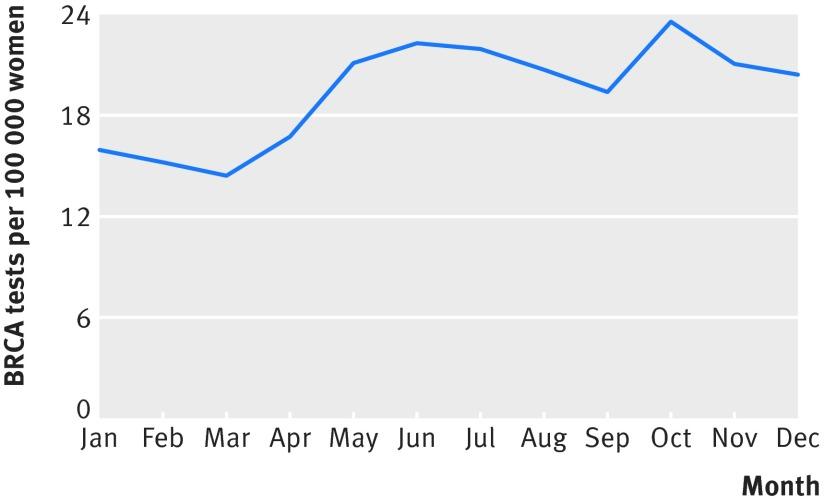
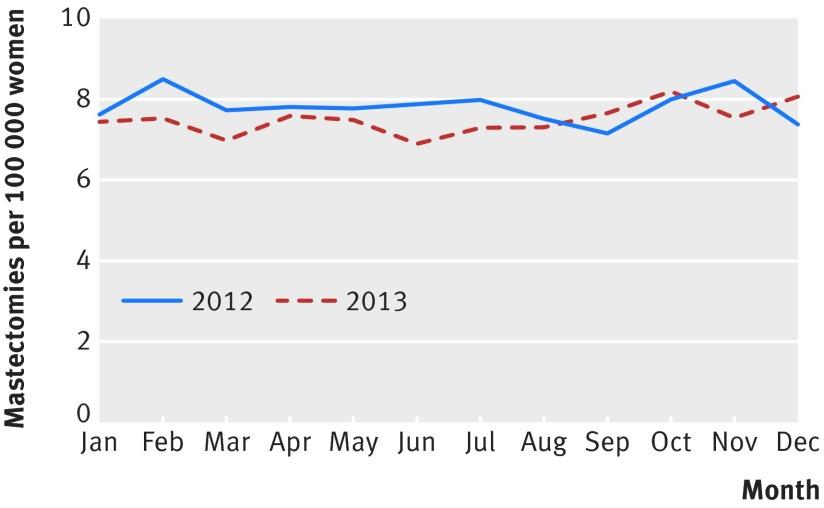
Daily BRCA test rates increased immediately after the 2013 editorial, from 0.71 tests/100 000 women in the 15 business days before to 1.13 tests/100 000 women in the 15 business days after publication. In comparison, daily test rates were similar in the same period in 2012 (0.58/100 000 women in the 15 business days before 14 May versus 0.55/100 000 women in the 15 business days after), implying a difference-in-difference absolute daily increase of 0.45 tests/100 000 women or a 64% relative increase (P<0.001). The editorial was associated with an estimated increase of 4500 BRCA tests and $13.5m (£10.8m; €12.8) expenditure nationally among commercially insured adult women in those 15 days. Increased BRCA testing rates were sustained throughout 2013. Overall mastectomy rates remained unchanged in the months after publication, but 60 day mastectomy rates among women who had a BRCA test fell from 10% in the months before publication to 7% in the months after publication, suggesting that women who underwent tests as a result of to the editorial had a lower pre-test probability of having the BRCA mutation than women tested before the editorial.
CONCLUSIONS
Celebrity endorsements can have a large and immediate effect on use of health services. Such announcements can be a low cost means of reaching a broad audience quickly, but they may not effectively target the subpopulations that are most at risk for the relevant underlying condition.
目的
探讨公众人物安吉丽娜·朱莉2013年在《纽约时报》上发表的一篇广受关注的社论对BRCA检测率和乳房切除术率的影响。该社论支持BRCA检测,并宣布朱莉决定接受预防性乳房切除术。
设计
采用差异分析的观察性研究。
背景
美国商业保险人群。
参与者
年龄在18 - 64岁、在Truven MarketScan商业索赔数据库中有索赔记录的女性(n = 9532836)。
主要观察指标
2013年5月14日(社论发表日期)前后15个工作日内BRCA检测率的变化,并与2012年同期的变化进行比较;社论发表前后几个月的乳房切除术率,包括总体情况以及检测女性中在BRCA检测后60天内的情况;对社论发表后15天内与朱莉文章相关的全国性增量检测和支出的估计。
结果
2013年社论发表后,BRCA每日检测率立即上升,从发表前15个工作日的每10万名女性0.71次检测升至发表后15个工作日的每10万名女性1.13次检测。相比之下,2012年同期的每日检测率相似(5月14日前15个工作日为每10万名女性0.58次检测,之后15个工作日为每10万名女性0.55次检测),这意味着差异分析得出的每日绝对增加量为每10万名女性0.45次检测,相对增加了64%(P < 0.001)。该社论估计在这15天内,全国商业保险成年女性中BRCA检测增加了4500次,支出增加了1350万美元(1080万英镑;1280万欧元)。2013年全年BRCA检测率持续上升。总体乳房切除术率在社论发表后的几个月中保持不变,但进行BRCA检测的女性中,60天内乳房切除术率从发表前几个月的10%降至发表后几个月的7%,这表明因社论而接受检测的女性在检测前携带BRCA突变的概率低于社论发表前接受检测的女性。
结论
名人代言对医疗服务的使用可产生重大且即时的影响。此类声明可能是一种低成本、能迅速覆盖广大受众的方式,但可能无法有效针对最易患相关潜在疾病的亚人群。
 Zotero 插件