
天圣源-1(TSY-1)通过端粒酶逆转录酶(TERT)启动子的甲基化来调节细胞端粒酶活性。
Tianshengyuan-1 (TSY-1) regulates cellular Telomerase activity by methylation of TERT promoter.
作者信息
Yu Weibo, Qin Xiaotian, Jin Yusheng, Li Yawei, Santiskulvong Chintda, Vu Victor, Zeng Gang, Zhang Zuofeng, Chow Michelle, Rao Jianyu
机构信息
Department of Pathology and Laboratory Medicine, David Geffen School of Medicine, University of California at Los Angeles, Los Angeles, CA, USA.
Beijing Boyuantaihe Biological Technology Co., Ltd., Beijing, China.
出版信息
Oncotarget. 2017 Jan 31;8(5):7977-7988. doi: 10.18632/oncotarget.13939.
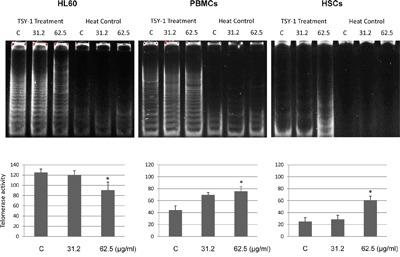
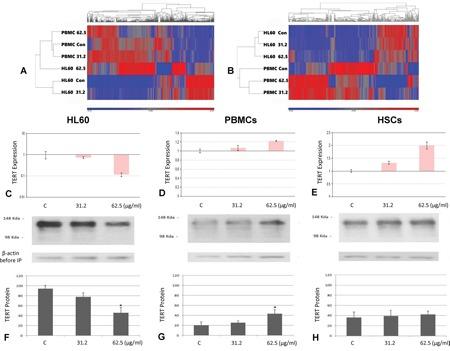
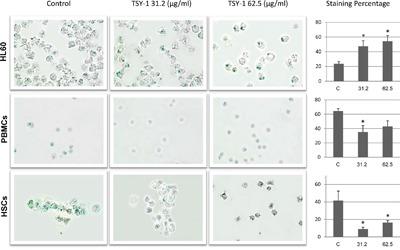
Telomere and Telomerase have recently been explored as anti-aging and anti-cancer drug targets with only limited success. Previously we showed that the Chinese herbal medicine Tianshengyuan-1 (TSY-1), an agent used to treat bone marrow deficiency, has a profound effect on stimulating Telomerase activity in hematopoietic cells. Here, the mechanism of TSY-1 on cellular Telomerase activity was further investigated using HL60, a promyelocytic leukemia cell line, normal peripheral blood mononuclear cells, and CD34+ hematopoietic stem cells derived from umbilical cord blood. TSY-1 increases Telomerase activity in normal peripheral blood mononuclear cells and CD34+ hematopoietic stem cells with innately low Telomerase activity but decreases Telomerase activity in HL60 cells with high intrinsic Telomerase activity, both in a dose-response manner. Gene profiling analysis identified Telomerase reverse transcriptase (TERT) as the potential target gene associated with the TSY-1 effect, which was verified by both RT-PCR and western blot analysis. The β-galactosidase reporter staining assay showed that the effect of TSY-1 on Telomerase activity correlates with cell senescence. TSY-1 induced hypomethylation within TERT core promoter in HL60 cells but induced hypermethylation within TERT core promoter in normal peripheral blood mononuclear cells and CD34+ hematopoietic stem cells. TSY-1 appears to affect the Telomerase activity in different cell lines differently and the effect is associated with TERT expression, possibly via the methylation of TERT promoter.
端粒和端粒酶最近已被作为抗衰老和抗癌药物靶点进行研究,但成效有限。此前我们表明,用于治疗骨髓亏虚的中药天参元-1(TSY-1)对刺激造血细胞中的端粒酶活性有显著作用。在此,使用早幼粒细胞白血病细胞系HL60、正常外周血单个核细胞以及源自脐带血的CD34+造血干细胞,进一步研究了TSY-1对细胞端粒酶活性的作用机制。TSY-1以剂量反应方式增加了端粒酶活性本就较低的正常外周血单个核细胞和CD34+造血干细胞中的端粒酶活性,但降低了具有高内源性端粒酶活性的HL60细胞中的端粒酶活性。基因谱分析确定端粒酶逆转录酶(TERT)为与TSY-1作用相关的潜在靶基因,这通过RT-PCR和蛋白质印迹分析得到了验证。β-半乳糖苷酶报告基因染色试验表明,TSY-1对端粒酶活性的作用与细胞衰老相关。TSY-1诱导HL60细胞中TERT核心启动子内的低甲基化,但诱导正常外周血单个核细胞和CD34+造血干细胞中TERT核心启动子内的高甲基化。TSY-1似乎对不同细胞系中的端粒酶活性有不同影响,且该作用与TERT表达相关,可能是通过TERT启动子的甲基化实现的。


 Zotero 插件