
肝脏再生增强因子通过促进小鼠自噬来保护其免受四氯化碳诱导的肝损伤。
Augmenter of liver regeneration protects against carbon tetrachloride-induced liver injury by promoting autophagy in mice.
作者信息
Shi Hongbo, Han Weijia, Shi Honglin, Ren Feng, Chen Dexi, Chen Yu, Duan Zhongping
机构信息
Beijing Youan Hospital, Capital Medical University, Beijing, China.
Beijing Institute of Hepatology, Capital Medical University, Beijing, China.
出版信息
Oncotarget. 2017 Feb 21;8(8):12637-12648. doi: 10.18632/oncotarget.14478.
BACKGROUND
Augmenter of liver regeneration (ALR) exerts strong hepatoprotective properties in various animal models of liver injury, but its protective mechanisms have not yet been explored. Autophagy is a recently recognized rudimentary cellular response to inflammation and injury. The aim of this study was to test the hypothesis that ALR may protect against acute liver injury through the autophagic pathway.
METHODS
The level and role of ALR in liver injury were studied in a mouse model of acute liver injury induced by carbon tetrachloride (CCl4). The effect of ALR on autophagy was analyzed in vitro and in vivo. After autophagy was inhibited by 3-methyladenine (3-MA), apoptosis and proliferation were detected in the mouse model with acute liver injury. The ALR and autophagic levels were measured in patients with liver cirrhosis (LC) and acute liver failure (ALF), respectively.
RESULTS
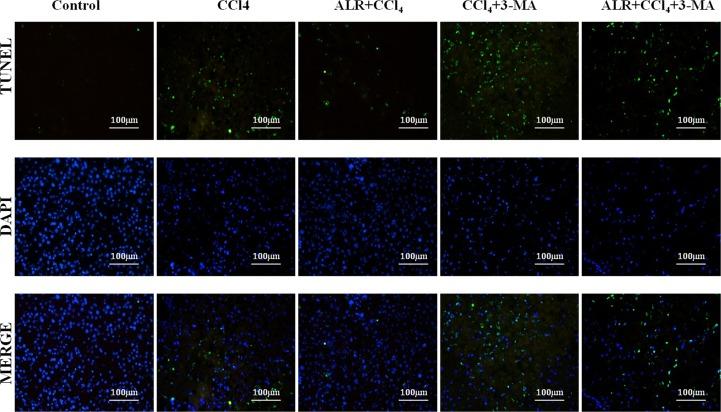
During the progression of acute liver injury, the ALR levels increased slightly in early stage and significantly decreased in late stage in mice. Treatment with an ALR plasmid via tail vein injection protected mice against acute liver injury. The protective effect of ALR relied on the induction of autophagy, which was supported by the following evidence: (1) ALR overexpression directly induced autophagy flux in vitro and in vivo; and (2) ALR treatment suppressed apoptosis and promoted proliferation in mice exposed to CCl4, but the inhibition of autophagy reversed these effects. More importantly, the ALR levels decreased in patients with LC and ALF compared with normal controls.
CONCLUSION
We demonstrated that ALR ameliorated liver injury via an autophagic mechanism, which indicates a potential therapeutic application for liver injury.
背景
肝再生增强因子(ALR)在多种肝损伤动物模型中具有强大的肝保护特性,但其保护机制尚未得到探索。自噬是最近被认识到的对炎症和损伤的一种基本细胞反应。本研究的目的是验证ALR可能通过自噬途径预防急性肝损伤这一假说。
方法
在四氯化碳(CCl4)诱导的急性肝损伤小鼠模型中研究ALR在肝损伤中的水平和作用。在体外和体内分析ALR对自噬的影响。在用3-甲基腺嘌呤(3-MA)抑制自噬后,检测急性肝损伤小鼠模型中的细胞凋亡和增殖情况。分别测定肝硬化(LC)和急性肝衰竭(ALF)患者的ALR和自噬水平。
结果
在急性肝损伤进展过程中,小鼠早期ALR水平略有升高,晚期显著降低。通过尾静脉注射ALR质粒治疗可保护小鼠免受急性肝损伤。ALR的保护作用依赖于自噬的诱导,以下证据支持这一点:(1)ALR过表达在体外和体内直接诱导自噬流;(2)ALR治疗可抑制CCl4处理小鼠的细胞凋亡并促进增殖,但抑制自噬可逆转这些作用。更重要的是,与正常对照组相比,LC和ALF患者的ALR水平降低。
结论
我们证明ALR通过自噬机制改善肝损伤,这表明其在肝损伤治疗中具有潜在应用价值。



 Zotero 插件