
人隐孢子虫基因目录:一种用于筛选新型隐孢子虫疫苗候选物的资源。
Cryptosporidium hominis gene catalog: a resource for the selection of novel Cryptosporidium vaccine candidates.
作者信息
Ifeonu Olukemi O, Simon Raphael, Tennant Sharon M, Sheoran Abhineet S, Daly Maria C, Felix Victor, Kissinger Jessica C, Widmer Giovanni, Levine Myron M, Tzipori Saul, Silva Joana C
机构信息
Institute for Genome Sciences, University of Maryland School of Medicine, 801 West Baltimore Street, Baltimore, MD 21201, USA.
School of Systems Biology, George Mason University, 10900 University Boulevard, Manassas, VA 20110, USA.
出版信息
Database (Oxford). 2016 Oct 19;2016. doi: 10.1093/database/baw137. Print 2016.
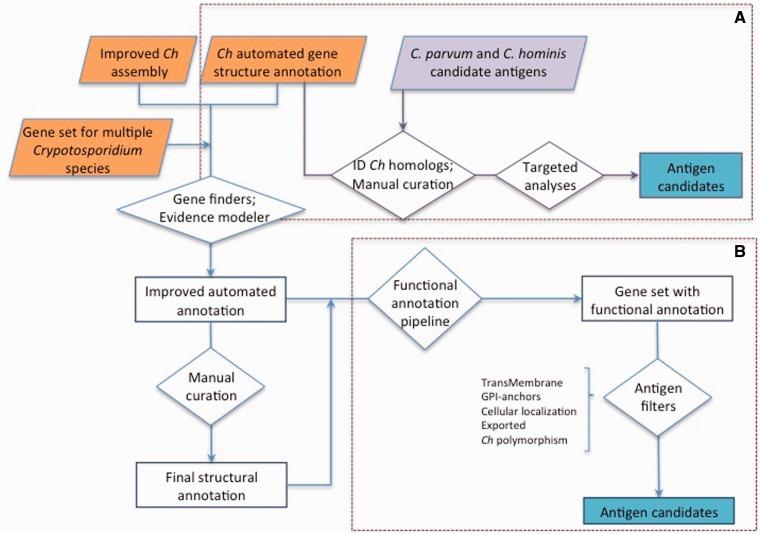
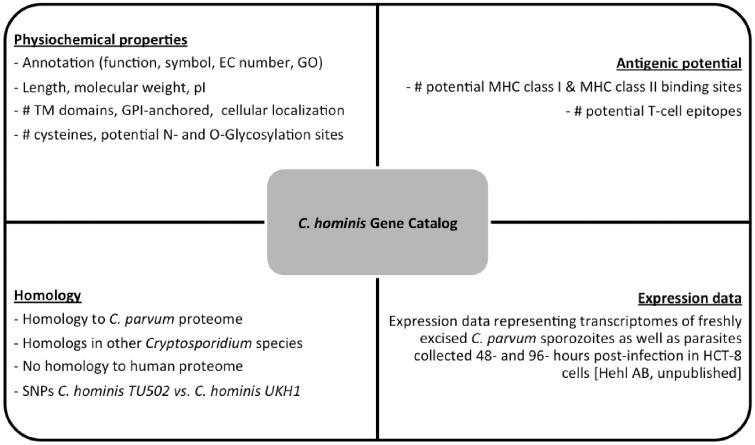
Human cryptosporidiosis, caused primarily by Cryptosporidium hominis and a subset of Cryptosporidium parvum, is a major cause of moderate-to-severe diarrhea in children under 5 years of age in developing countries and can lead to nutritional stunting and death. Cryptosporidiosis is particularly severe and potentially lethal in immunocompromised hosts. Biological and technical challenges have impeded traditional vaccinology approaches to identify novel targets for the development of vaccines against C. hominis, the predominant species associated with human disease. We deemed that the existence of genomic resources for multiple species in the genus, including a much-improved genome assembly and annotation for C. hominis, makes a reverse vaccinology approach feasible. To this end, we sought to generate a searchable online resource, termed C. hominis gene catalog, which registers all C. hominis genes and their properties relevant for the identification and prioritization of candidate vaccine antigens, including physical attributes, properties related to antigenic potential and expression data. Using bioinformatic approaches, we identified ∼400 C. hominis genes containing properties typical of surface-exposed antigens, such as predicted glycosylphosphatidylinositol (GPI)-anchor motifs, multiple transmembrane motifs and/or signal peptides targeting the encoded protein to the secretory pathway. This set can be narrowed further, e.g. by focusing on potential GPI-anchored proteins lacking homologs in the human genome, but with homologs in the other Cryptosporidium species for which genomic data are available, and with low amino acid polymorphism. Additional selection criteria related to recombinant expression and purification include minimizing predicted post-translation modifications and potential disulfide bonds. Forty proteins satisfying these criteria were selected from 3745 proteins in the updated C. hominis annotation. The immunogenic potential of a few of these is currently being tested.Database URL: http://cryptogc.igs.umaryland.edu.
人类隐孢子虫病主要由人隐孢子虫和一小部分微小隐孢子虫引起,是发展中国家5岁以下儿童中重度腹泻的主要原因,可导致营养发育迟缓甚至死亡。隐孢子虫病在免疫功能低下的宿主中尤为严重,甚至可能致命。生物学和技术方面的挑战阻碍了传统疫苗学方法去识别针对人隐孢子虫(与人类疾病相关的主要物种)开发疫苗的新靶点。我们认为,该属多个物种基因组资源的存在,包括大幅改进的人隐孢子虫基因组组装和注释,使得反向疫苗学方法可行。为此,我们试图创建一个可搜索的在线资源,称为人隐孢子虫基因目录,该目录登记所有人隐孢子虫基因及其与候选疫苗抗原识别和优先级相关的特性,包括物理属性、与抗原潜力相关的特性以及表达数据。通过生物信息学方法,我们鉴定出约400个人隐孢子虫基因,这些基因具有表面暴露抗原的典型特性,如预测的糖基磷脂酰肌醇(GPI)锚定基序、多个跨膜基序和/或将编码蛋白靶向分泌途径的信号肽。这个集合可以进一步缩小范围,例如专注于在人类基因组中缺乏同源物,但在有基因组数据的其他隐孢子虫物种中有同源物且氨基酸多态性低的潜在GPI锚定蛋白。与重组表达和纯化相关的其他选择标准包括尽量减少预测的翻译后修饰和潜在的二硫键。从更新后的人隐孢子虫注释中的3745种蛋白质中选择了40种满足这些标准的蛋白质。目前正在测试其中一些蛋白质的免疫原性潜力。数据库网址:http://cryptogc.igs.umaryland.edu



 Zotero 插件