
顶复门寄生虫的基因组重建及糖基化途径特征
Genomic reconstruction and features of glycosylation pathways in the apicomplexan parasites.
作者信息
Wang Dongqiang, Wang Chenchen, Zhu Guan
机构信息
Key Laboratory of Zoonosis Research of the Ministry of Education, Institute of Zoonosis, College of Veterinary Medicine, Jilin University, Changchun, China.
出版信息
Front Mol Biosci. 2022 Nov 17;9:1051072. doi: 10.3389/fmolb.2022.1051072. eCollection 2022.
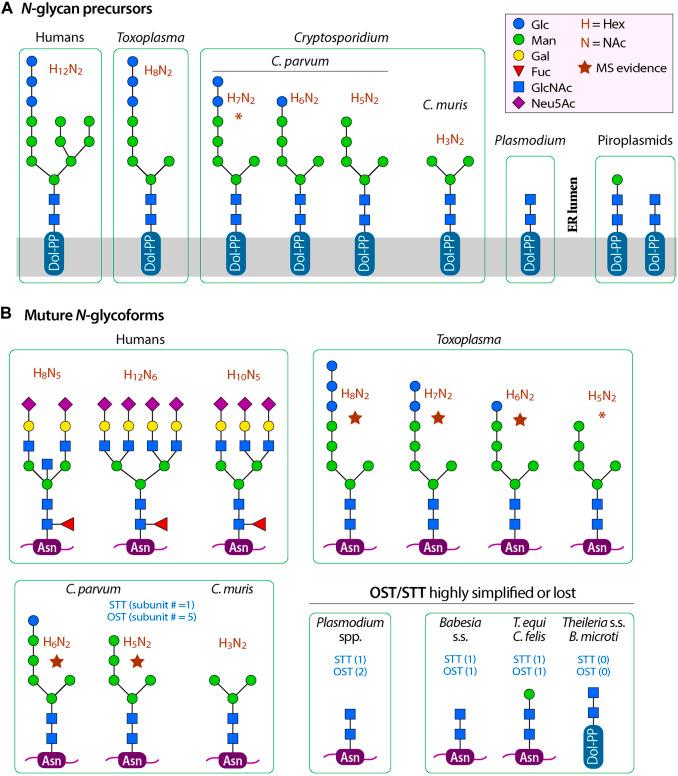
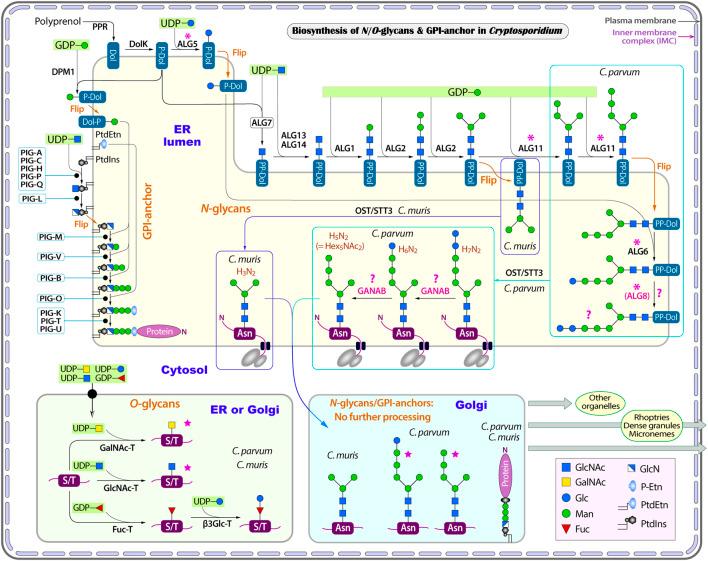
is a genus of apicomplexan parasites infecting humans or other vertebrates. The majority of the species live in host intestines (e.g., , and ), but there are a few gastric species (e.g., and ). Among them, is the most important zoonotic species, for which a number of glycoproteins have been reported for being involved in the interacting with host cells. However, little is known on the cryptosporidium glycobiology. Information on the glycosylation pathways in parasites remains sketchy and only a few studies have truly determined the glycoforms in the parasites. Here we reanalyzed the genomes and reconstructed the glycosylation pathways, including the synthesis of - and -linked glycans and GPI-anchors. In -glycosylation, intestinal possesses enzymes to make a simple precursor with two terminal glucoses on the long arm (i.e., GlcManGlcNAc vs. GlcManGlcNAc in humans), but gastric species only makes a simpler precursor containing only the "core" structure (i.e., ManGlcNAc). There is an ortholog of glucosidase II (GANAB) in all species, for which the authenticity is questioned because it contains no signal peptide and exist in gastric species lacking terminal glucoses for the enzyme to act on. In -linked glycosylation, all species may attach one-unit HexNAc (GalNAc and GlcNAc) and two-unit Fuc-type (Man-Fuc) glycans to the target proteins. lacks enzymes to further process - and -glycans in the Golgi. The glycosylphosphatidylinositol (GPI)-anchor in is predicted to be unbranched and unprocessed further in the Golgi. can synthesize limited nucleotide sugars, but possesses at least 12 transporters to scavenge nucleotide sugars or transport them across the ER/Golgi membranes. Overall, makes much simpler glycans than the hosts, and the glycoforms further differ between intestinal and gastric species. The - and -glycans are neutrally charged and have limited capacity to absorb water molecules in comparison to the host intestinal mucins that are negatively charged and highly expandable in waters.
是一种感染人类或其他脊椎动物的顶复门寄生虫属。大多数物种生活在宿主肠道中(例如,、和),但也有一些寄生于胃部的物种(例如,和)。其中,是最重要的人畜共患病原体,已有多项研究报道了一些糖蛋白参与其与宿主细胞的相互作用。然而,关于隐孢子虫糖生物学的了解却很少。关于隐孢子虫寄生虫糖基化途径的信息仍然很粗略,只有少数研究真正确定了寄生虫中的糖型。在这里,我们重新分析了隐孢子虫基因组并重建了糖基化途径,包括O-和N-连接聚糖以及糖基磷脂酰肌醇(GPI)锚的合成。在O-糖基化中,肠道隐孢子虫拥有酶来合成一种长臂上带有两个末端葡萄糖的简单前体(即GlcManGlcNAc,而人类为GlcManGlcNAc),但胃部物种只合成一种仅包含“核心”结构的更简单前体(即ManGlcNAc)。所有隐孢子虫物种中都存在一种葡糖苷酶II(GANAB)的直系同源物,但其真实性受到质疑,因为它没有信号肽,且存在于缺乏该酶作用所需末端葡萄糖的胃部物种中。在N-连接糖基化中,所有隐孢子虫物种可能会将一个单位的己糖胺(GalNAc和GlcNAc)和两个单位的岩藻糖型(Man-Fuc)聚糖连接到目标蛋白上。隐孢子虫缺乏在高尔基体中进一步加工O-和N-聚糖的酶。隐孢子虫中的糖基磷脂酰肌醇(GPI)锚预计是无分支的,且在高尔基体中不会进一步加工。隐孢子虫可以合成有限的核苷酸糖,但拥有至少12种转运蛋白来清除核苷酸糖或将它们转运穿过内质网/高尔基体膜。总体而言,隐孢子虫产生的聚糖比宿主简单得多,并且糖型在肠道和胃部物种之间也有所不同。与带负电荷且在水中高度可膨胀的宿主肠道粘蛋白相比,O-和N-聚糖呈中性电荷,吸收水分子的能力有限。

 Zotero 插件