
癌症相关成纤维细胞促进胰腺导管腺癌中巨噬细胞的M2极化。
Cancer-associated fibroblasts promote M2 polarization of macrophages in pancreatic ductal adenocarcinoma.
作者信息
Zhang Aibin, Qian Yigang, Ye Zhou, Chen Haiyong, Xie Haiyang, Zhou Lin, Shen Yan, Zheng Shusen
机构信息
Division of Hepatobiliary and Pancreatic Surgery, Department of Surgery, First Affiliated Hospital, School of Medicine, Zhejiang University, Hangzhou, China.
Key Laboratory of Combined Multi-Organ Transplantation, Ministry of Public Health, Hangzhou, China.
出版信息
Cancer Med. 2017 Feb;6(2):463-470. doi: 10.1002/cam4.993. Epub 2017 Jan 18.
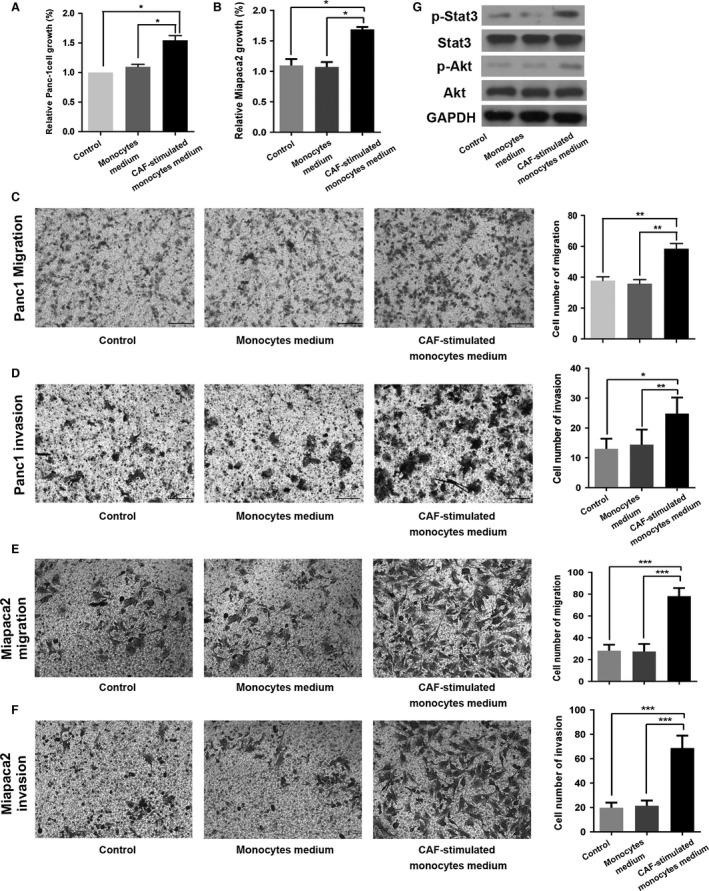
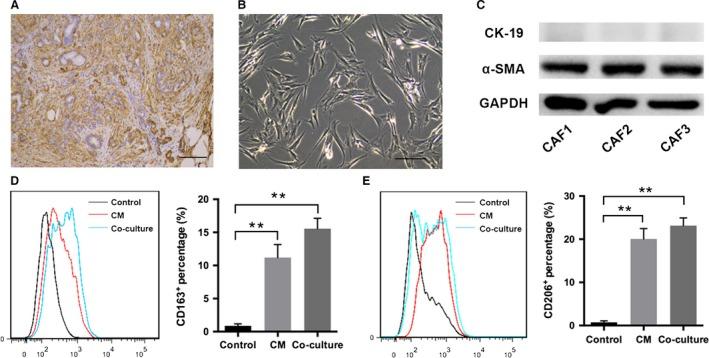
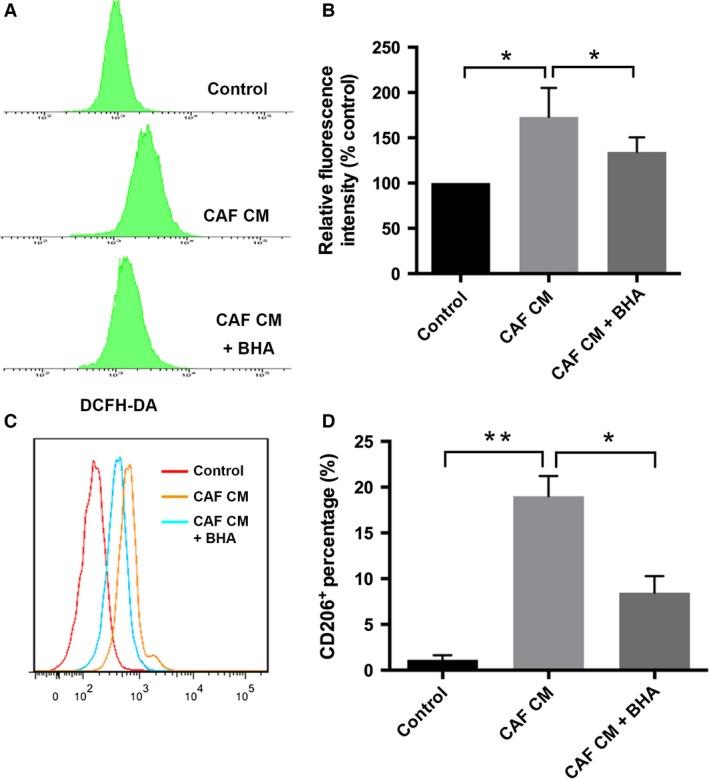
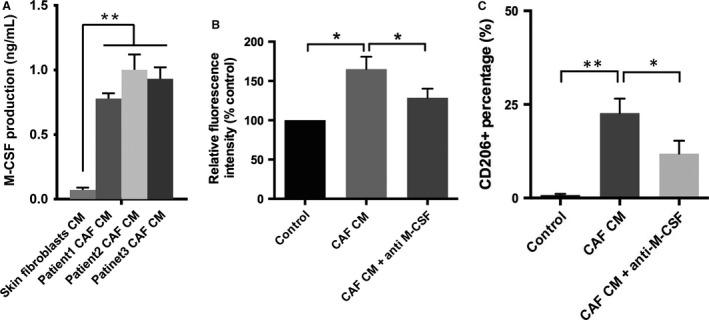
Pancreatic ductal adenocarcinoma (PDAC) is characterized by remarkable desmoplasia with infiltration of distinct cellular components. Cancer-associated fibroblasts (CAFs) has been shown to be among the most prominent cells and played a significant role in shaping the tumor microenvironment by interacting with other type of cells. Here, we aimed to investigate the effect of CAFs in modulating phenotype of tumor-associated macrophages (TAM). Under treatment of CAFs conditioned medium (CM) or direct co-culture with CAFs, monocytes exhibited enhanced expression of CD206 and CD163 compared with control group (P < 0.01). The induction of M2 polarization was mediated by increased reactive oxygen species (ROS) production in monocytes as ROS elimination abolished the effect of CAFs (P < 0.05). The supernatant analysis showed that pancreatic CAFs produced increased macrophage colony-stimulating factor (M-CSF). Upon treatment of M-CSF neutralizing antibody, the ROS generation and M2 polarization of CAFs CM-stimulated monocytes were significantly inhibited (P < 0.05). In addition, the CAFs-induced M2 macrophages significantly enhanced pancreatic tumor cell growth, migration, and invasion. Collectively, our data revealed that pancreatic CAFs were able to induce a tumor-promoting TAM phenotype partly through secreted M-CSF and enhanced ROS production in monocytes, indicating possible treatment strategies by targeting stromal cell interaction within PDAC microenvironment.
胰腺导管腺癌(PDAC)的特征是显著的促结缔组织增生反应以及不同细胞成分的浸润。癌症相关成纤维细胞(CAFs)已被证明是最突出的细胞类型之一,通过与其他类型的细胞相互作用,在塑造肿瘤微环境中发挥着重要作用。在此,我们旨在研究CAFs对肿瘤相关巨噬细胞(TAM)表型的调节作用。在CAFs条件培养基(CM)处理或与CAFs直接共培养的情况下,与对照组相比,单核细胞中CD206和CD163的表达增强(P < 0.01)。单核细胞中活性氧(ROS)生成增加介导了M2极化的诱导,因为ROS清除消除了CAFs的作用(P < 0.05)。上清液分析表明,胰腺CAFs产生的巨噬细胞集落刺激因子(M-CSF)增加。用M-CSF中和抗体处理后,CAFs CM刺激的单核细胞的ROS生成和M2极化受到显著抑制(P < 0.05)。此外,CAFs诱导的M2巨噬细胞显著增强了胰腺肿瘤细胞的生长、迁移和侵袭。总的来说,我们的数据表明,胰腺CAFs能够部分通过分泌M-CSF和增强单核细胞中的ROS生成来诱导促肿瘤的TAM表型,这表明靶向PDAC微环境中基质细胞相互作用可能是一种治疗策略。
 Zotero 插件