
多重耐药的哈氏假丝酵母菌和耳念珠菌,以色列特拉维夫
Multidrug-Resistant Candida haemulonii and C. auris, Tel Aviv, Israel.
作者信息
Ben-Ami Ronen, Berman Judith, Novikov Ana, Bash Edna, Shachor-Meyouhas Yael, Zakin Shiri, Maor Yasmin, Tarabia Jalal, Schechner Vered, Adler Amos, Finn Talya
出版信息
Emerg Infect Dis. 2017 Feb;23(1):195-203. doi: 10.3201/eid2302.161486.
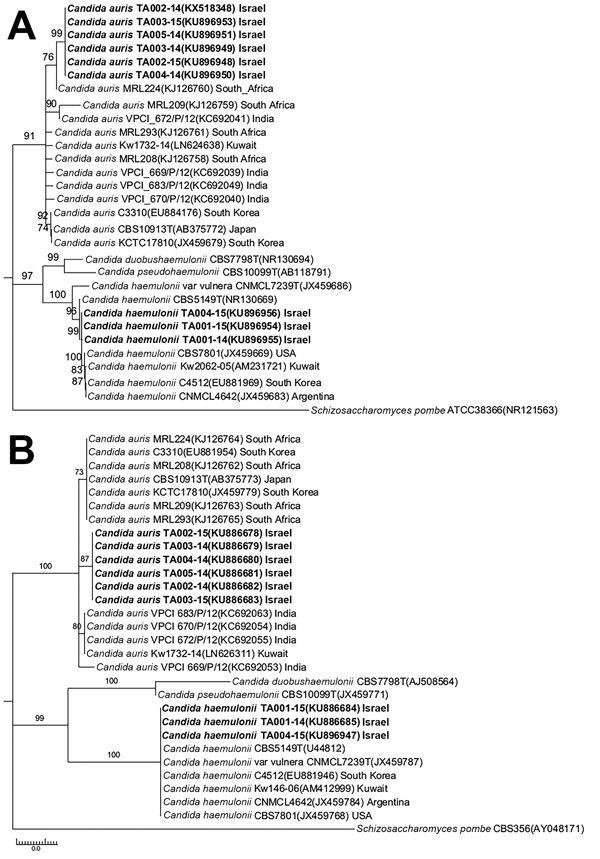
Candida auris and C. haemulonii are closely related, multidrug-resistant emerging fungal pathogens that are not readily distinguishable with phenotypic assays. We studied C. auris and C. haemulonii clinical isolates from 2 hospitals in central Israel. C. auris was isolated in 5 patients with nosocomial bloodstream infection, and C. haemulonii was found as a colonizer of leg wounds at a peripheral vascular disease clinic. Liberal use of topical miconazole and close contact among patients were implicated in C. haemulonii transmission. C. auris exhibited higher thermotolerance, virulence in a mouse infection model, and ATP-dependent drug efflux activity than C. haemulonii. Comparison of ribosomal DNA sequences found that C. auris strains from Israel were phylogenetically distinct from isolates from East Asia, South Africa and Kuwait, whereas C. haemulonii strains from different countries were closely interrelated. Our findings highlight the pathogenicity of C. auris and underscore the need to limit its spread.
耳念珠菌和哈氏念珠菌是密切相关的、多重耐药的新兴真菌病原体,通过表型分析不易区分。我们研究了来自以色列中部两家医院的耳念珠菌和哈氏念珠菌临床分离株。耳念珠菌在5例医院血流感染患者中分离得到,哈氏念珠菌则在一家外周血管疾病诊所被发现为腿部伤口的定植菌。局部大量使用咪康唑以及患者之间的密切接触与哈氏念珠菌的传播有关。与哈氏念珠菌相比,耳念珠菌表现出更高的耐热性、在小鼠感染模型中的毒力以及ATP依赖性药物外排活性。核糖体DNA序列比较发现,来自以色列的耳念珠菌菌株在系统发育上与来自东亚、南非和科威特的分离株不同,而来自不同国家的哈氏念珠菌菌株密切相关。我们的研究结果突出了耳念珠菌的致病性,并强调了限制其传播的必要性。



 Zotero 插件