
急性白血病中未处理的单倍体相合供者与无关供者的异基因干细胞移植比较。
A comparison between allogeneic stem cell transplantation from unmanipulated haploidentical and unrelated donors in acute leukemia.
作者信息
Piemontese Simona, Ciceri F, Labopin M, Arcese W, Kyrcz-Krzemien S, Santarone S, Huang H, Beelen D, Gorin N C, Craddock C, Gulbas Z, Bacigalupo A, Mohty M, Nagler A
机构信息
Hematology and Bone Marrow Transplant Unit, San Raffaele Scientific Institute, Milan, Italy.
EBMT ALWP Office, Hospital Saint Antoine, Paris, France.
出版信息
J Hematol Oncol. 2017 Jan 19;10(1):24. doi: 10.1186/s13045-017-0394-2.
BACKGROUND
In the absence of a HLA-matched related or matched unrelated donor, allogeneic stem cell transplantation (allo-SCT) from mismatched unrelated donors or haploidentical donors are potential alternatives for patients with acute leukemia with an indication to allo-SCT. The objective of this study was to compare the outcome of allo-SCT from T cell-replete haploidentical (Haplo) versus matched (MUD 10/10) or mismatched unrelated donor at a single HLA-locus (MMUD 9/10) for patients with acute leukemia in remission.
METHODS
Two hundred sixty-five adult patients with de novo acute leukemia in first or second remission that received a Haplo-SCT between January 2007 and December 2013 were compared with 2490 patients receiving a MUD 10/10 and 813 receiving a MMUD 9/10. Propensity score weighted analysis was conducted in order to control for disease risk imbalances between the groups.
RESULTS
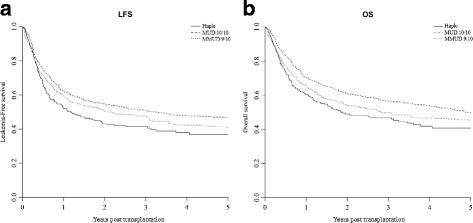
The weighted 3-year non-relapse mortality and relapse incidence were 29 and 30% for Haplo, 21 and 29% for MUD 10/10, and 29 and 25% for MMUD 9/10, respectively. The weighted 3-year leukemia-free survival (LFS) and overall survival (OS) were 41 and 46% for Haplo, 50 and 56% for MUD 10/10, and 46 and 48% for MMUD 9/10, respectively. Using weighted Cox model, both LFS and OS were significantly higher in transplants from MUD 10/10 compared from those in Haplo but not different between transplants from MMUD 9/10 and Haplo. The type of donor was not significantly associated with neither acute nor chronic graft-versus-host disease.
CONCLUSIONS
Patients with acute leukemia in remission have better outcomes if transplanted from a MUD 10/10. We did not find any significant difference in outcome between transplants from MMUD 9/10 and Haplo, suggesting that both can be equally used in the absence of a 10/10 MUD. KEY POINT 1: Better outcomes using fully (10/10) matched unrelated donor for allo-SCT in acute leukemia in remission. KEY POINT 2: Similar outcomes after allo-SCT from unmanipulated haploidentical graft or mismatched (9/10) unrelated donor in acute leukemia in remission.
背景
在缺乏 HLA 匹配的相关或不匹配无关供者的情况下,来自不匹配无关供者或单倍体相合供者的异基因干细胞移植(allo-SCT)是有 allo-SCT 指征的急性白血病患者的潜在替代方案。本研究的目的是比较 T 细胞充足的单倍体相合(单倍体)与匹配(MUD 10/10)或单个 HLA 位点不匹配的无关供者(MMUD 9/10)对处于缓解期的急性白血病患者进行 allo-SCT 的疗效。
方法
将 2007 年 1 月至 2013 年 12 月期间接受单倍体-SCT 的 265 例处于首次或第二次缓解期的成年初发急性白血病患者与 2490 例接受 MUD 10/10 和 813 例接受 MMUD 9/10 的患者进行比较。进行倾向评分加权分析以控制组间疾病风险不平衡。
结果
加权 3 年非复发死亡率和复发率分别为:单倍体组 29%和 30%,MUD 10/10 组 21%和 29%,MMUD 9/10 组 29%和 25%。加权 3 年无白血病生存率(LFS)和总生存率(OS)分别为:单倍体组 41%和 46%,MUD 10/10 组 50%和 56%,MMUD 9/10 组 46%和 48%。使用加权 Cox 模型,与单倍体移植相比,MUD 10/10 移植的 LFS 和 OS 均显著更高,但 MMUD 9/10 移植与单倍体移植之间无差异。供者类型与急性或慢性移植物抗宿主病均无显著相关性。
结论
处于缓解期的急性白血病患者若接受 MUD 10/10 移植,疗效更佳。我们未发现 MMUD 9/10 移植与单倍体移植在疗效上有任何显著差异,这表明在没有 10/10 MUD 的情况下,两者均可同等使用。关键点 1:在缓解期的急性白血病中,使用完全(10/10)匹配的无关供者进行 allo-SCT 疗效更佳。关键点 2:在缓解期的急性白血病中,未处理的单倍体相合移植物或不匹配(9/10)无关供者进行 allo-SCT 后疗效相似。

 Zotero 插件