
重建缺失部分——光感受器移植综述
Rebuilding the Missing Part-A Review on Photoreceptor Transplantation.
作者信息
Santos-Ferreira Tiago F, Borsch Oliver, Ader Marius
机构信息
DFG-Center for Regenerative Therapies Dresden, Cluster of Excellence, Technische Universität Dresden Dresden, Germany.
出版信息
Front Syst Neurosci. 2017 Jan 5;10:105. doi: 10.3389/fnsys.2016.00105. eCollection 2016.
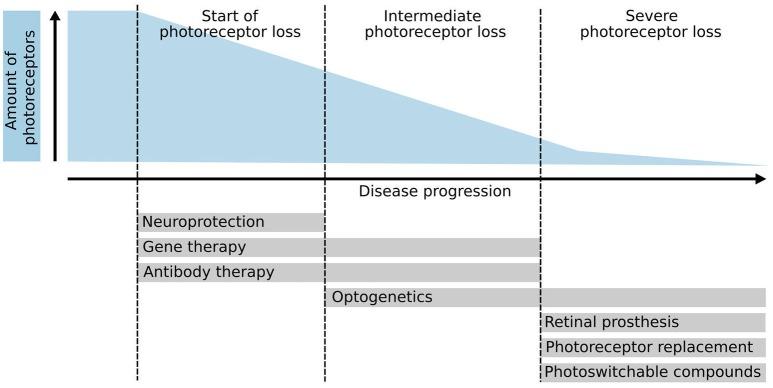
Vision represents one of the main senses for humans to interact with their environment. Our sight relies on the presence of fully functional light sensitive cells - rod and cone photoreceptors - allowing us to see under dim (rods) and bright (cones) light conditions. Photoreceptor degeneration is one of the major causes for vision impairment in industrialized countries and it is highly predominant in the population above the age of 50. Thus, with the continuous increase in life expectancy it will make retinal degeneration reach an epidemic proportion. To date, there is no cure established for photoreceptor loss, but several therapeutic approaches, spanning from neuroprotection, pharmacological drugs, gene therapy, retinal prosthesis, and cell (RPE or photoreceptor) transplantation, have been developed over the last decade with some already introduced in clinical trials. In this review, we focus on current developments in photoreceptor transplantation strategies, its major breakthroughs, current limitations and the next challenges to translate such cell-based approaches toward clinical application.
视觉是人类与环境互动的主要感官之一。我们的视力依赖于完全功能化的光敏感细胞——视杆和视锥光感受器的存在,使我们能够在昏暗(视杆细胞)和明亮(视锥细胞)的光照条件下看见东西。光感受器退化是工业化国家视力受损的主要原因之一,在50岁以上人群中尤为普遍。因此,随着预期寿命的不断增加,视网膜退化将达到流行程度。迄今为止,尚无针对光感受器丧失的确切治疗方法,但在过去十年中已开发出几种治疗方法,包括神经保护、药物治疗、基因治疗、视网膜假体以及细胞(视网膜色素上皮细胞或光感受器)移植,其中一些已进入临床试验阶段。在本综述中,我们重点关注光感受器移植策略的当前进展、其主要突破、当前局限性以及将这种基于细胞的方法转化为临床应用面临的下一个挑战。


 Zotero 插件