
衰老对带状疱疹负担的时间影响。
The temporal impact of aging on the burden of herpes zoster.
作者信息
Varghese Lijoy, Standaert Baudouin, Olivieri Antonio, Curran Desmond
机构信息
GSK R&D - Asia-Pacific & North Asia, 150 Beach Road, #22-00 Gateway West, Singapore, 189720, Singapore.
GSK, Wavre, Belgium.
出版信息
BMC Geriatr. 2017 Jan 23;17(1):30. doi: 10.1186/s12877-017-0420-9.
BACKGROUND
The risk of Herpes Zoster (HZ) increases with age and various studies have also demonstrated an increasing HZ incidence globally. Simultaneously, the global trend of an aging population has placed a greater burden on the healthcare system. This study aims to estimate the potential burden of HZ over time accounting for the increasing trends of both HZ incidence and global aging.
METHODS
A recent systematic review on HZ incidence identified studies that evaluated the temporal effects of HZ incidence. Data from the identified studies were extracted to estimate the trend of HZ incidence in the ≥65-year-old age cohort. The incidence rates were estimated up to the year 2030 using two scenarios: a linear extrapolation and a last observation carried forward. Three countries were chosen to perform the analysis on: Australia, Japan and the United States.
RESULTS
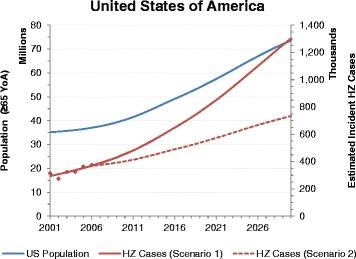
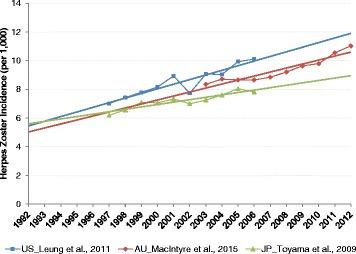
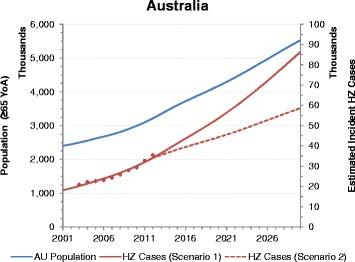
The incidence data from the three countries showed an average annual increase between 2.35 and 3.74% over the time period of the studies selected. The elderly population for the US, Japan and Australia are expected to increase by 55, 10 and 53% respectively by the year 2030 compared to the levels in 2015. Under the first scenario between 2001 and 2030, the number of annual incident cases of HZ in those aged ≥65 years is expected to increase by +343% (293,785 to 1,303,328), +176% (158,616 to 437,867) and +376% (18,105 to 86,268) in the US, Japan and Australia respectively while those for the second scenario are +150%, +83% and +223% respectively. In the US alone, the estimated annual cost of HZ-related cases in the ≥65 age cohort is approximately 4.74 Billion US$ in 2030.
CONCLUSIONS
The increasing incidence of HZ coupled with the demographic trends (i.e., aging population and greater life expectancy) in many countries are likely to imply a rising economic burden of HZ on already constrained healthcare budgets.
背景
带状疱疹(HZ)的风险随年龄增长而增加,多项研究也表明全球HZ发病率呈上升趋势。与此同时,全球人口老龄化趋势给医疗保健系统带来了更大负担。本研究旨在考虑HZ发病率上升趋势和全球老龄化趋势,估计HZ随时间推移的潜在负担。
方法
最近一项关于HZ发病率的系统评价确定了评估HZ发病率时间效应的研究。提取已确定研究的数据,以估计65岁及以上年龄队列中HZ发病率的趋势。使用两种情景估计到2030年的发病率:线性外推法和末次观察结转法。选择三个国家进行分析:澳大利亚、日本和美国。
结果
在所选研究期间,这三个国家的发病率数据显示年平均增长率在2.35%至3.74%之间。预计到2030年,美国、日本和澳大利亚的老年人口分别比2015年的水平增长55%、10%和53%。在2001年至2030年的第一种情景下,美国、日本和澳大利亚65岁及以上人群中每年HZ发病例数预计分别增加+343%(从293,785例增至1,303,328例)、+176%(从158,616例增至437,867例)和+376%(从18,105例增至86,268例),而第二种情景下分别为+

 Zotero 插件