
通过聚腺苷酸(Poly(A)) reads 映射预测聚腺苷酸(Poly(A))位点
Prediction of Poly(A) Sites by Poly(A) Read Mapping.
作者信息
Bonfert Thomas, Friedel Caroline C
机构信息
Institute for Informatics, LMU Munich, Munich, Germany.
出版信息
PLoS One. 2017 Jan 30;12(1):e0170914. doi: 10.1371/journal.pone.0170914. eCollection 2017.
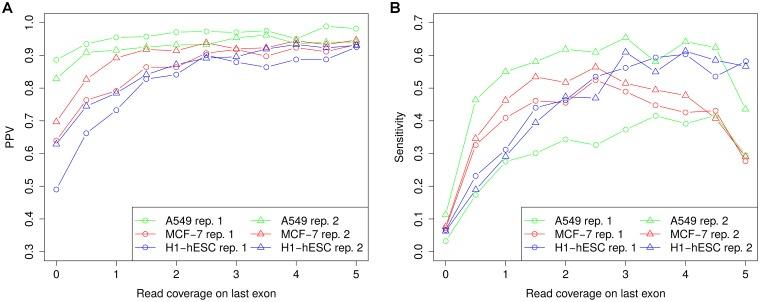
RNA-seq reads containing part of the poly(A) tail of transcripts (denoted as poly(A) reads) provide the most direct evidence for the position of poly(A) sites in the genome. However, due to reduced coverage of poly(A) tails by reads, poly(A) reads are not routinely identified during RNA-seq mapping. Nevertheless, recent studies for several herpesviruses successfully employed mapping of poly(A) reads to identify herpesvirus poly(A) sites using different strategies and customized programs. To more easily allow such analyses without requiring additional programs, we integrated poly(A) read mapping and prediction of poly(A) sites into our RNA-seq mapping program ContextMap 2. The implemented approach essentially generalizes previously used poly(A) read mapping approaches and combines them with the context-based approach of ContextMap 2 to take into account information provided by other reads aligned to the same location. Poly(A) read mapping using ContextMap 2 was evaluated on real-life data from the ENCODE project and compared against a competing approach based on transcriptome assembly (KLEAT). This showed high positive predictive value for our approach, evidenced also by the presence of poly(A) signals, and considerably lower runtime than KLEAT. Although sensitivity is low for both methods, we show that this is in part due to a high extent of spurious results in the gold standard set derived from RNA-PET data. Sensitivity improves for poly(A) sites of known transcripts or determined with a more specific poly(A) sequencing protocol and increases with read coverage on transcript ends. Finally, we illustrate the usefulness of the approach in a high read coverage scenario by a re-analysis of published data for herpes simplex virus 1. Thus, with current trends towards increasing sequencing depth and read length, poly(A) read mapping will prove to be increasingly useful and can now be performed automatically during RNA-seq mapping with ContextMap 2.
包含转录本部分聚腺苷酸尾巴的RNA测序读数(称为聚腺苷酸读数)为基因组中聚腺苷酸位点的位置提供了最直接的证据。然而,由于读数对聚腺苷酸尾巴的覆盖减少,在RNA测序映射过程中通常不会识别聚腺苷酸读数。尽管如此,最近针对几种疱疹病毒的研究成功地采用了聚腺苷酸读数映射,通过不同策略和定制程序来识别疱疹病毒聚腺苷酸位点。为了更轻松地进行此类分析而无需额外程序,我们将聚腺苷酸读数映射和聚腺苷酸位点预测集成到我们的RNA测序映射程序ContextMap 2中。所实施的方法本质上概括了先前使用的聚腺苷酸读数映射方法,并将它们与ContextMap 2基于上下文的方法相结合,以考虑与同一位置比对的其他读数提供的信息。使用ContextMap 2进行的聚腺苷酸读数映射在来自ENCODE项目的实际数据上进行了评估,并与基于转录组组装的竞争方法(KLEAT)进行了比较。这表明我们的方法具有较高的阳性预测值,聚腺苷酸信号的存在也证明了这一点,并且运行时间比KLEAT短得多。尽管两种方法的灵敏度都较低,但我们表明这部分是由于源自RNA-PET数据的金标准集中存在大量虚假结果。对于已知转录本的聚腺苷酸位点或使用更特异的聚腺苷酸测序方案确定的位点,灵敏度会提高,并且随着转录本末端读数覆盖度的增加而增加。最后,我们通过重新分析已发表的单纯疱疹病毒1数据,说明了该方法在高读数覆盖情况下的有用性。因此,随着当前测序深度和读数长度增加的趋势,聚腺苷酸读数映射将被证明越来越有用,现在可以在使用ContextMap 2进行RNA测序映射期间自动执行。





 Zotero 插件