
一项关于HMGB1和RAGE基因的7种多态性对肝细胞癌风险预测的多中心配对病例对照分析。
A multicenter matched case-control analysis on seven polymorphisms from HMGB1 and RAGE genes in predicting hepatocellular carcinoma risk.
作者信息
Wang Dan, Qi Xiaoying, Liu Fang, Yang Chuanhua, Jiang Wenguo, Wei Xiaodan, Li Xuri, Mi Jia, Tian Geng
机构信息
Medicine and Pharmacy Research Center, Binzhou Medical University, Yantai, Shandong, China.
出版信息
Oncotarget. 2017 Jul 25;8(30):50109-50116. doi: 10.18632/oncotarget.15202.
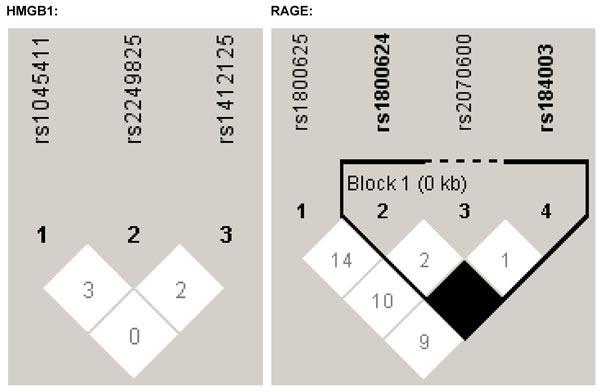
Based on 540 hepatocellular carcinoma patients and 540 age- and gender-matched controls, we tested the hypothesis that high mobility group protein box1 (HMGB1) and the receptor for advanced glycation end products (RAGE) genes are two potential candidate susceptibility genes for hepatocellular carcinoma in a multicenter hospital-based case-control analysis. The genotypes of seven widely-studied polymorphisms were determined, and their distributions respected the Hardy-Weinberg equilibrium. The mutant alleles of two polymorphisms, rs1045411 in HMGB1 gene and rs2070600 in RAGE gene, had significantly higher frequencies in patients than in controls (P < 0.001), with the power to detect this significance of being over 99.9%. Moreover, the above two polymorphisms increased the risk of developing hepatocellular carcinoma significantly, particularly for rs2070600 under the additive (odds ratio [OR] = 1.77; 95% confidence interval [CI]: 1.34-2.32; P < 0.001) and dominant (OR = 1.75; 95% CI: 1.23-2.50; P = 0.002) models after adjusting for body mass index, smoking and drinking. Haplotype analysis showed that the T-C-T haplotype (rs1045411-rs2249825-rs1415125) in HMGB1 gene was associated with a 2.47-fold (95% CI: 1.41-4.34; P = 0.002) increased risk of hepatocellular carcinoma compared with the commonest C-C-T haplotype after adjustment. In RAGE gene, the T-T-A-G (rs1800625-rs1800624-rs2070600-rs184003) (adjusted OR; 95% CI; P: 1.75; 1.02-3.03; 0.045) and T-T-A-T (adjusted OR; 95% CI; P: 1.95; 1.01-3.76; 0.048) haplotypes were associated with a marginally increased risk of hepatocellular carcinoma compared with the commonest T-T-G-G haplotype. In summary, we identified two risk-associated polymorphisms (rs1045411 and rs2070600), and more importantly a joint impact of seven polymorphisms from the HMGB1/RAGE axis in susceptibility to hepatocellular carcinoma.
基于540例肝细胞癌患者及540例年龄和性别匹配的对照,我们在一项多中心基于医院的病例对照分析中检验了如下假设:高迁移率族蛋白盒1(HMGB1)基因和晚期糖基化终产物受体(RAGE)基因是肝细胞癌的两个潜在候选易感基因。测定了7个广泛研究的多态性的基因型,其分布符合哈迪-温伯格平衡。HMGB1基因中的rs1045411和RAGE基因中的rs2070600这两个多态性的突变等位基因在患者中的频率显著高于对照(P < 0.001),检测到这种显著性的效能超过99.9%。此外,上述两个多态性显著增加了发生肝细胞癌的风险,尤其是rs2070600在调整体重指数、吸烟和饮酒因素后,在相加模型(比值比[OR] = 1.77;95%置信区间[CI]:1.34 - 2.32;P < 0.001)和显性模型(OR = 1.75;95% CI:1.23 - 2.50;P = 0.002)下。单倍型分析显示,与最常见的C - C - T单倍型相比,调整后HMGB1基因中的T - C - T单倍型(rs1045411 - rs2249825 - rs1415125)使肝细胞癌风险增加2.47倍(95% CI:1.41 - 4.34;P = 0.002)。在RAGE基因中,与最常见的T - T - G - G单倍型相比,T - T - A - G(rs1800625 - rs1800624 - rs2070600 - rs184003)(调整后OR;95% CI;P:1.75;1.02 - 3.03;0.045)和T - T - A - T(调整后OR;95% CI;P:1.95;1.01 - 3.76;0.048)单倍型与肝细胞癌风险略有增加相关。总之,我们鉴定出两个与风险相关的多态性(rs1045411和rs2070600),更重要的是,发现了HMGB1/RAGE轴上7个多态性对肝细胞癌易感性的联合影响。
 Zotero 插件