
HMGB1基因中miRNA结合位点的一个功能性变体与口腔鳞状细胞癌风险相关。
A functional variant at the miRNA binding site in HMGB1 gene is associated with risk of oral squamous cell carcinoma.
作者信息
Lin Chiao-Wen, Chou Ying-Erh, Yeh Chia-Ming, Yang Shun-Fa, Chuang Chun-Yi, Liu Yu-Fan
机构信息
Institute of Oral Sciences, Chung Shan Medical University, Taichung, Taiwan.
Department of Dentistry, Chung Shan Medical University Hospital, Taichung, Taiwan.
出版信息
Oncotarget. 2017 May 23;8(21):34630-34642. doi: 10.18632/oncotarget.16120.
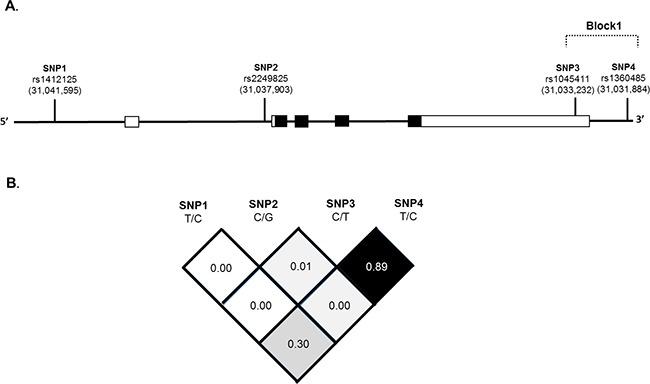
Oral squamous cell carcinoma (OSCC) is a common malignancy that has been causally associated with both hereditary and acquired factors. The high mobility group box 1 (HMGB1) gene plays an important role as a DNA chaperone to help maintain nuclear homeostasis. Altered expression of HMGB1 has been implicated in a wide range of pathological processes, including inflammation and cancer. The present study explores the impact of HMGB1 gene polymorphisms, combined with environmental risks regarding susceptibility to oral tumorigenesis. Four single-nucleotide polymorphisms (SNPs) of the HMGB1 gene, rs1412125, rs2249825, rs1045411, and rs1360485, were evaluated in 1,200 normal controls and 772 patients with OSCC. We found an association between the wild-type allele of rs1045411 and genotypes CT and CT/TT (AOR=0.754, 95% CI=0.582-0.978 and AOR=0.778, 95% CI=0.609-0.995, respectively). Additionally, bioinformatics analysis was used to characterize the functional relevance of these variants for the miRNA-505-5p binding site and transcriptional regulation by the HMGB1 3'-UTR and promoter regions. Moreover, in considering behavioral exposure to environmental carcinogens, the presence of the four HMGB1 SNPs, combined with/without betel quid chewing and smoking showed, profoundly synergistic effects on the risk of OSCC. In conclusion, we present a potential clinical relevance for HMGB1 variants in OSCC, as well as associations between HMGB1 polymorphisms, haplotypes and environmental risk factors. The finding may help in development of optimal therapeutic approaches for OSCC patients.
口腔鳞状细胞癌(OSCC)是一种常见的恶性肿瘤,与遗传和后天因素均有因果关联。高迁移率族蛋白B1(HMGB1)基因作为一种DNA伴侣蛋白,在帮助维持核内稳态方面发挥着重要作用。HMGB1表达的改变与包括炎症和癌症在内的多种病理过程有关。本研究探讨了HMGB1基因多态性以及环境风险因素对口腔肿瘤发生易感性的综合影响。在1200名正常对照者和772例OSCC患者中评估了HMGB1基因的4个单核苷酸多态性(SNP),即rs1412125、rs2249825、rs1045411和rs1360485。我们发现rs1045411的野生型等位基因与CT和CT/TT基因型之间存在关联(优势比分别为0.754,95%可信区间为0.582 - 0.978;优势比为0.778,95%可信区间为0.609 - 0.995)。此外,利用生物信息学分析来表征这些变异体与miRNA - 505 - 5p结合位点以及HMGB1 3'-非翻译区和启动子区域转录调控的功能相关性。此外,在考虑行为暴露于环境致癌物的情况下,这4个HMGB1 SNP的存在,无论是否与嚼槟榔和吸烟相结合,均对OSCC风险显示出显著的协同作用。总之,我们揭示了HMGB1变异体在OSCC中的潜在临床相关性,以及HMGB1多态性、单倍型与环境风险因素之间的关联。这一发现可能有助于为OSCC患者开发最佳治疗方法。


 Zotero 插件