
具有干性特征的人U87胶质母细胞瘤细胞通过改变NKG2D配体的表达,对自然杀伤细胞的细胞毒性表现出更高的敏感性。
Human U87 glioblastoma cells with stemness features display enhanced sensitivity to natural killer cell cytotoxicity through altered expression of NKG2D ligand.
作者信息
Oh Se-Jeong, Yang Jung-In, Kim Ok, Ahn Eun-Jung, Kang Woo Dae, Lee Jae-Hyuk, Moon Kyung-Sub, Lee Kyung-Hwa, Cho Duck
机构信息
Department of Pathology, Chonnam National University Hwasun Hospital and Medical School, Hwasun, Jeollanam-do South Korea.
Department of Neurosurgery, Chonnam National University Hwasun Hospital and Medical School, Hwasun, Jeollanam-do South Korea.
出版信息
Cancer Cell Int. 2017 Feb 10;17:22. doi: 10.1186/s12935-017-0397-7. eCollection 2017.
BACKGROUND
Glioblastoma (GBM) is one of the most lethal tumors with a poor prognosis. Its inevitable recurrence is frequently explained by the presence of cancer stem cells. We aimed to show that human GBM cells with stemness features are more sensitive to natural killer (NK) cells than GBM cells without stemness characteristics.
METHODS
Natural killer cell cytotoxicity was measured using flow cytometry in neurosphere-forming U87 GBM cells cultured with neurobasal media (NBE condition) and compared with that in serum-cultured U87 GBM cells (serum condition). Cytotoxicity was examined after addition of blocking NKG2D monoclonal antibodies. The expression profile of NK ligands of NK cells were investigated by reverse transcription polymerase chain reaction and western blot analysis in the U87 GBM cells in both conditions.
RESULTS
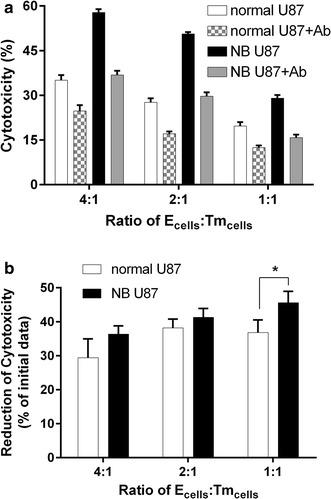
NBE U87 cells showed higher cytotoxicity to NK cells than serum U87 cells did (55 vs 35% at an effector to target cell ratio of 5:1). The increased cytotoxicity was diminished in NBE U87 cells by a larger gap than in serum U87 cells by adding NKG2D blocking antibodies. Of the NKG2D ligands, the expression of ULBP1 and ULBP3 was relatively increased in NBE U87 cells compared to serum U87 cells.
CONCLUSIONS
U87 GBM cells with stemness features demonstrate increased cytotoxicity to NK cells in association with altered NKG2D ligand expression of NK cell activating receptor. Applying immune modulation to GBM treatment may be a promising adjuvant therapy in patients with intractable GBM.
背景
胶质母细胞瘤(GBM)是预后最差的致死性肿瘤之一。其不可避免的复发常被认为是癌症干细胞存在所致。我们旨在证明具有干性特征的人GBM细胞比无干性特征的GBM细胞对自然杀伤(NK)细胞更敏感。
方法
使用流式细胞术检测在神经基础培养基中培养的形成神经球的U87 GBM细胞(NBE条件)的NK细胞毒性,并与血清培养的U87 GBM细胞(血清条件)进行比较。加入阻断NKG2D单克隆抗体后检测细胞毒性。通过逆转录聚合酶链反应和蛋白质免疫印迹分析研究两种条件下U87 GBM细胞中NK细胞配体的表达谱。
结果
NBE U87细胞对NK细胞的细胞毒性高于血清U87细胞(效应细胞与靶细胞比例为5:1时分别为55%和35%)。加入NKG2D阻断抗体后,NBE U87细胞的细胞毒性增加幅度大于血清U87细胞。在NKG2D配体中,与血清U87细胞相比,NBE U87细胞中ULBP1和ULBP3的表达相对增加。
结论
具有干性特征的U87 GBM细胞对NK细胞的细胞毒性增加,与NK细胞激活受体NKG2D配体表达改变有关。对GBM治疗应用免疫调节可能是难治性GBM患者一种有前景的辅助治疗方法。



 Zotero 插件