
突变对流行菌株R20291孢子形成的影响。
Effect of Mutation on Sporulation in the Epidemic Strain R20291.
作者信息
Girinathan Brintha P, Monot Marc, Boyle Daniel, McAllister Kathleen N, Sorg Joseph A, Dupuy Bruno, Govind Revathi
机构信息
Division of Biology, Kansas State University, Manhattan, Kansas, USA.
Department of Microbiology, Laboratoire Pathogenèse des Bactéries Anaérobies, Institut Pasteur, Paris, France.
出版信息
mSphere. 2017 Feb 15;2(1). doi: 10.1128/mSphere.00383-16. eCollection 2017 Jan-Feb.
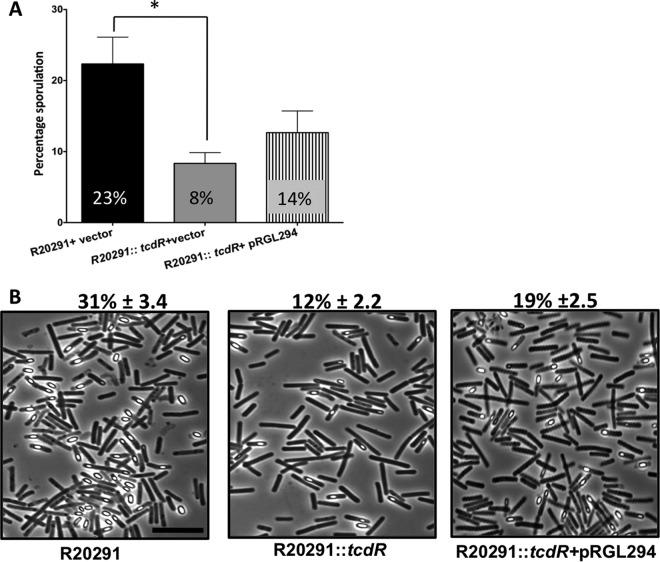
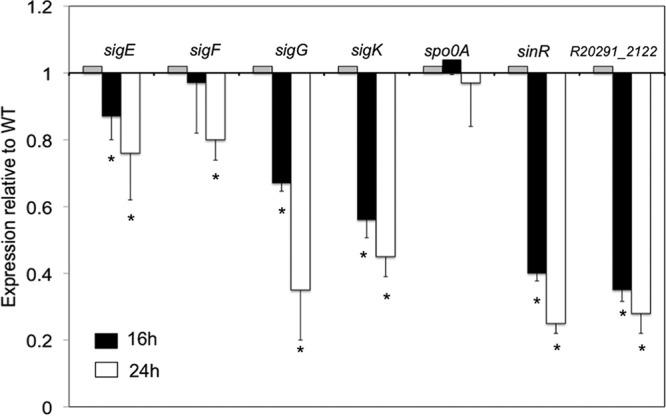
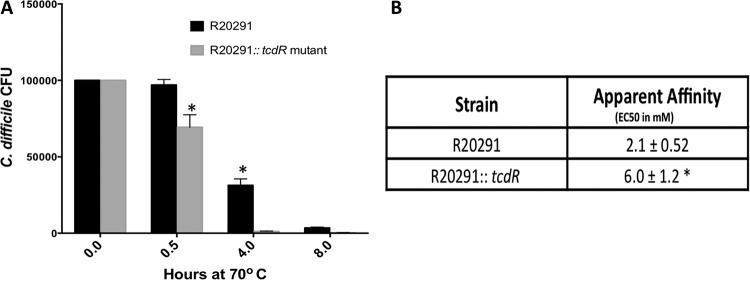
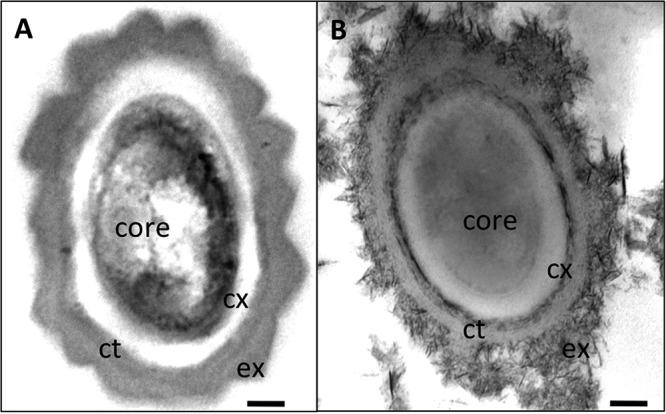
is an important nosocomial pathogen and the leading cause of hospital-acquired diarrhea. Antibiotic use is the primary risk factor for the development of -associated disease because it disrupts normally protective gut flora and enables to colonize the colon. damages host tissue by secreting toxins and disseminates by forming spores. The toxin-encoding genes, and , are part of a pathogenicity locus, which also includes the gene that codes for TcdR, an alternate sigma factor that initiates transcription of and genes. We created a mutant in epidemic-type strain R20291 in an attempt to identify the global role of . A site-directed mutation in affected both toxin production and sporulation in R20291. Spores of the mutant were more heat sensitive than the wild type (WT). Nearly 3-fold more taurocholate was needed to germinate spores from the mutant than to germinate the spores prepared from the WT strain. Transmission electron microscopic analysis of the spores also revealed a weakly assembled exosporium on the mutant spores. Accordingly, comparative transcriptome analysis showed many differentially expressed sporulation genes in the mutant compared to the WT strain. These data suggest that regulatory networks of toxin production and sporulation in strain R20291 re linked with each other. infects thousands of hospitalized patients every year, causing significant morbidity and mortality. spores play a pivotal role in the transmission of the pathogen in the hospital environment. During infection, the spores germinate, and the vegetative bacterial cells produce toxins that damage host tissue. Thus, sporulation and toxin production are two important traits of . In this study, we showed that a mutation in , the toxin gene regulator, affects both toxin production and sporulation in epidemic-type strain R20291.
是一种重要的医院病原体,也是医院获得性腹泻的主要原因。抗生素的使用是与相关疾病发生的主要危险因素,因为它会破坏正常的保护性肠道菌群,使能够在结肠定植。通过分泌毒素损害宿主组织,并通过形成孢子进行传播。毒素编码基因和是致病位点的一部分,该位点还包括编码TcdR的基因,TcdR是一种替代西格玛因子,可启动和基因的转录。我们在流行型菌株R20291中创建了一个突变体,试图确定的全局作用。中的定点突变影响了R20291中的毒素产生和孢子形成。突变体的孢子比野生型(WT)对热更敏感。使突变体的孢子发芽所需的牛磺胆酸盐比使野生型菌株制备的孢子发芽所需的牛磺胆酸盐多近3倍。对孢子的透射电子显微镜分析还显示,突变体孢子上的芽孢外壁组装较弱。因此,比较转录组分析表明,与野生型菌株相比,突变体中有许多差异表达的孢子形成基因。这些数据表明,R20291菌株中毒素产生和孢子形成的调控网络相互关联。每年感染数千名住院患者,导致显著的发病率和死亡率。孢子在医院环境中病原体的传播中起关键作用。在感染过程中,孢子发芽,营养细菌细胞产生毒素,损害宿主组织。因此,孢子形成和毒素产生是的两个重要特征。在这项研究中,我们表明,毒素基因调节因子中的突变影响了流行型菌株R20291中的毒素产生和孢子形成。


 Zotero 插件