
在共培养模型中,薄镁层被确认为一种抗菌且具有生物相容性的植入物涂层。
Thin magnesium layer confirmed as an antibacterial and biocompatible implant coating in a co‑culture model.
作者信息
Zaatreh Sarah, Haffner David, Strauss Madlen, Dauben Thomas, Zamponi Christiane, Mittelmeier Wolfram, Quandt Eckhard, Kreikemeyer Bernd, Bader Rainer
机构信息
Biomechanics and Implant Technology Research Laboratory, Department of Orthopaedics, University Medicine Rostock, D‑18057 Rostock, Germany.
Institute for Materials Science, Faculty of Engineering, University of Kiel, D‑24143 Kiel, Germany.
出版信息
Mol Med Rep. 2017 Apr;15(4):1624-1630. doi: 10.3892/mmr.2017.6218. Epub 2017 Feb 17.
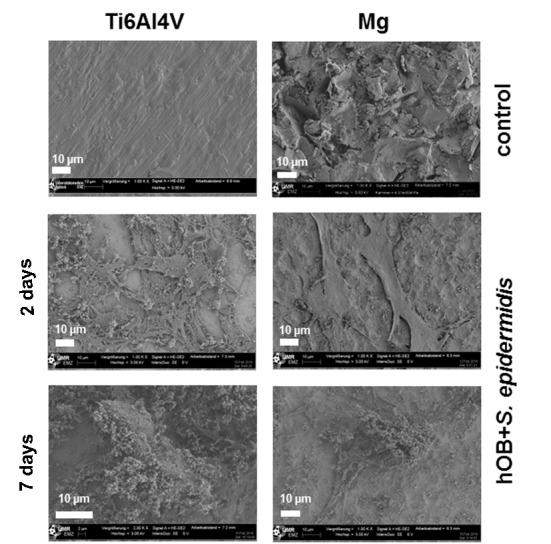
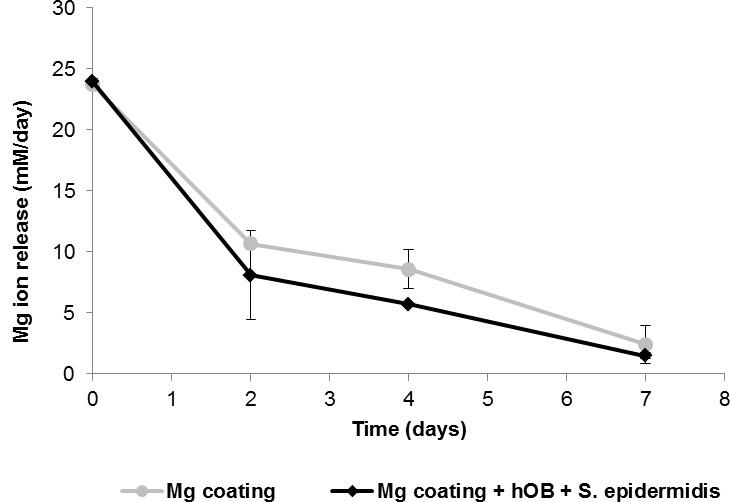
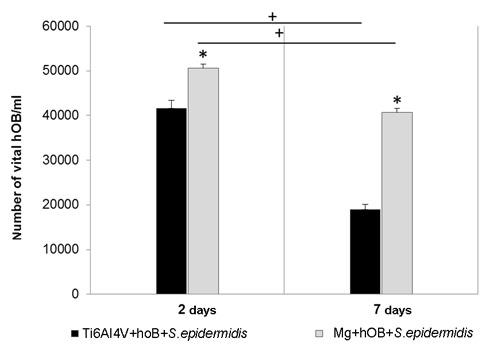
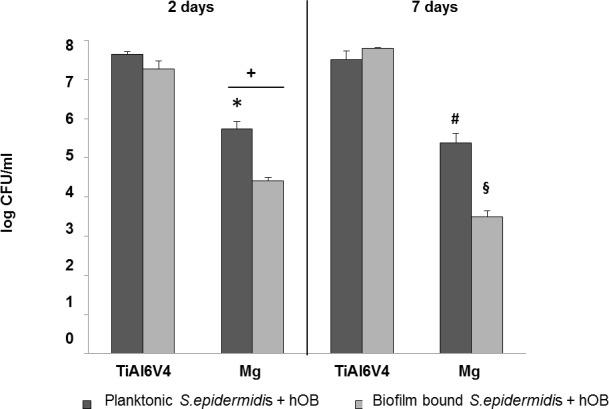
Implant-associated infections commonly result from biofilm‑forming bacteria and present severe complications in total joint arthroplasty. Therefore, there is a requirement for the development of biocompatible implant surfaces that prevent bacterial biofilm formation. The present study coated titanium samples with a thin, rapidly corroding layer of magnesium, which were subsequently investigated with respect to their antibacterial and cytotoxic surface properties using a Staphylococcus epidermidis (S. epidermidis) and human osteoblast (hOB) co‑culture model. Primary hOBs and S. epidermidis were co‑cultured on cylindrical titanium samples (Ti6Al4V) coated with pure magnesium via magnetron sputtering (5 µm thickness) for 7 days. Uncoated titanium test samples served as controls. Vital hOBs were identified by trypan blue staining at days 2 and 7. Planktonic S. epidermidis were quantified by counting the number of colony forming units (CFU). The quantification of biofilm‑bound S. epidermidis on the surfaces of test samples was performed by ultrasonic treatment and CFU counting at days 2 and 7. The number of planktonic and biofilm‑bound S. epidermidis on the magnesium‑coated samples decreased by four orders of magnitude when compared with the titanium control following 7 days of co‑culture. The number of vital hOBs on the magnesium‑coated samples was observed to increase (40,000 cells/ml) when compared with the controls (20,000 cells/ml). The results of the present study indicate that rapidly corroding magnesium‑coated titanium may be a viable coating material that possesses antibacterial and biocompatible properties. A co‑culture test is more rigorous than a monoculture study, as it accounts for confounding effects and assesses additional interactions that are more representative of in vivo situations. These results provide a foundation for the future testing of this type of surface in animals.
植入物相关感染通常由形成生物膜的细菌引起,并在全关节置换术中引发严重并发症。因此,需要开发能够防止细菌生物膜形成的生物相容性植入物表面。本研究在钛样品上涂覆了一层薄的、快速腐蚀的镁层,随后使用表皮葡萄球菌(S. epidermidis)和人成骨细胞(hOB)共培养模型对其抗菌和细胞毒性表面特性进行了研究。将原代hOBs和表皮葡萄球菌在通过磁控溅射(厚度5 µm)涂覆纯镁的圆柱形钛样品(Ti6Al4V)上共培养7天。未涂覆的钛测试样品用作对照。在第2天和第7天通过台盼蓝染色鉴定活的hOBs。通过计数菌落形成单位(CFU)的数量对浮游表皮葡萄球菌进行定量。通过超声处理并在第2天和第7天计数CFU,对测试样品表面上与生物膜结合的表皮葡萄球菌进行定量。共培养7天后,与钛对照相比,镁涂层样品上浮游和与生物膜结合的表皮葡萄球菌数量减少了四个数量级。观察到与对照(20,000个细胞/ml)相比,镁涂层样品上活的hOBs数量增加(40,000个细胞/ml)。本研究结果表明,快速腐蚀的镁涂层钛可能是一种具有抗菌和生物相容性特性的可行涂层材料。共培养试验比单培养研究更严格,因为它考虑了混杂效应并评估了更能代表体内情况的其他相互作用。这些结果为将来在动物中测试这种类型的表面提供了基础。
 Zotero 插件