
[塞内加尔达喀尔阿里斯蒂德·勒丹泰克生物化学实验室血脂异常的患病率]
[Prevalence of dyslipemia in Aristide le Dantec biochemistry laboratory in Dakar Senegal].
作者信息
Cissé Fatou, Agne Fatou Diallo, Diatta Alassane, Mbengue Abdou Salam, Ndiaye Arame, Samba Abdourahmane, Thiam Souleymane, Doupa Dominique, Sarr Gaston Ndéné, Sall Niama Diop, Touré Méissa
机构信息
Laboratoire de Biochimie et Biologie Moléculaire, Faculté de Médecine, de Pharmacie et d'Odontostomatologie, Université Cheikh Anta Diop de Dakar, Sénégal.
Université Assane SECK de Ziguinchor, Sénégal.
出版信息
Pan Afr Med J. 2016 Oct 3;25:67. doi: 10.11604/pamj.2016.25.67.7758. eCollection 2016.
INTRODUCTION
This study aims to evaluate the prevalence of dyslipidemias among patients who underwent assay of a lipid parameter at the Laboratory of Biochemistry of Aristide Le Dantec University Hospital in 2013.
METHODS
We conducted a retrospective study of 1356 patients between ages 10-94 years presenting at the laboratory of Biochemistry of CHU Le Dantec from January to December 2013. All patients who had undergone at least one lipid assay whose results were recorded in the laboratory register were enrolled in the study. Total cholesterol, HDL cholesterol, LDL cholesterol and triglycerides were measured using enzymatic methods (Cobas Integra 400 plus biochemistry analyzer - Roche Diagnostics).
RESULTS
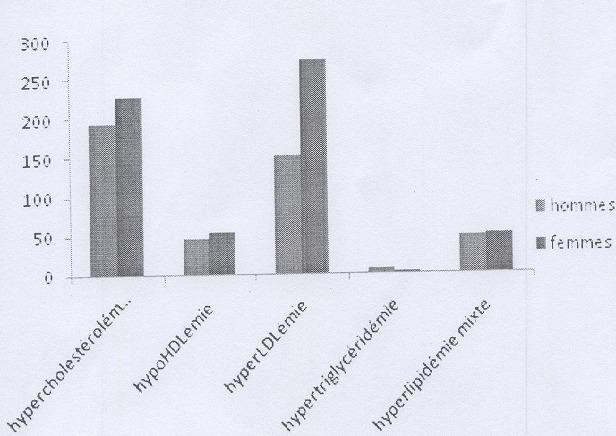
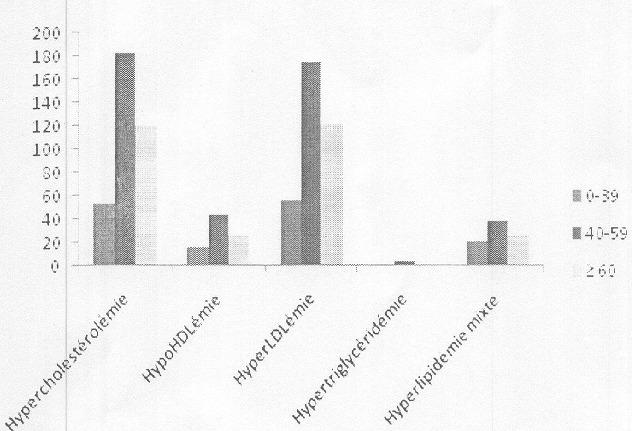
The prevalence of dyslipidemia in our study population was 39.30%. The prevalence of hypercholesterolemia, hypo-HDL-cholesterolemia, hyper-HDL-cholesterolemia, hypertriglyceridemia, mixed hyperlipidemia was 30,89% ; 7,30% ; 31,19% ; 0,51% ; 7,22% respectively. The subjects aged 40 to 59 years appeared to be more exposed. Moreover, there was a female predominance in hypercholesterolemia (54.17% vs 45.82%) the hypocholesterolemia (54.54% vs45,45%), and mixed hyperlipidemia (51.08% vs 48.97%). Dyslipidemias were strongly correlated to hypertension and obesity.
CONCLUSION
The high prevalence of dyslipidemias found in our study highlights the importance of studying the prevalence of cardiovascular risk factors, in particular dyslipidemias, in Senegalese population.
引言
本研究旨在评估2013年在阿里斯蒂德·勒丹泰克大学医院生物化学实验室接受血脂参数检测的患者中血脂异常的患病率。
方法
我们对2013年1月至12月在勒丹泰克大学医院生物化学实验室就诊的1356名年龄在10 - 94岁之间的患者进行了回顾性研究。所有至少接受过一次血脂检测且结果记录在实验室登记册中的患者均纳入本研究。总胆固醇、高密度脂蛋白胆固醇、低密度脂蛋白胆固醇和甘油三酯采用酶法检测(Cobas Integra 400 plus生化分析仪 - 罗氏诊断)。
结果
我们研究人群中血脂异常的患病率为39.30%。高胆固醇血症、低高密度脂蛋白胆固醇血症、高高密度脂蛋白胆固醇血症、高甘油三酯血症、混合性高脂血症的患病率分别为30.89%、7.30%、31.19%、0.51%、7.22%。40至59岁的受试者似乎更易患病。此外,高胆固醇血症(54.17%对45.82%)、低胆固醇血症(54.54%对45.45%)和混合性高脂血症(51.08%对48.97%)中女性占主导。血脂异常与高血压和肥胖密切相关。
结论
我们研究中发现的血脂异常高患病率凸显了在塞内加尔人群中研究心血管危险因素,特别是血脂异常患病率的重要性。
 Zotero 插件