
芽孢硫醇在革兰阳性Firmicutes 中的作用。
The Role of Bacillithiol in Gram-Positive Firmicutes.
机构信息
1 Department of Microbiology, Cornell University , Ithaca, New York.
2 Institute for Biology-Microbiology , Freie Universität Berlin, Berlin, Germany .
出版信息
Antioxid Redox Signal. 2018 Feb 20;28(6):445-462. doi: 10.1089/ars.2017.7057. Epub 2017 Apr 24.
SIGNIFICANCE
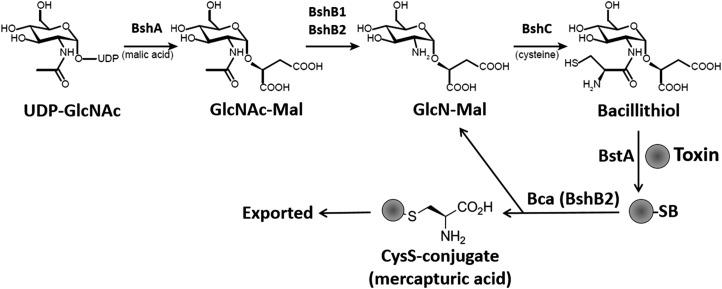
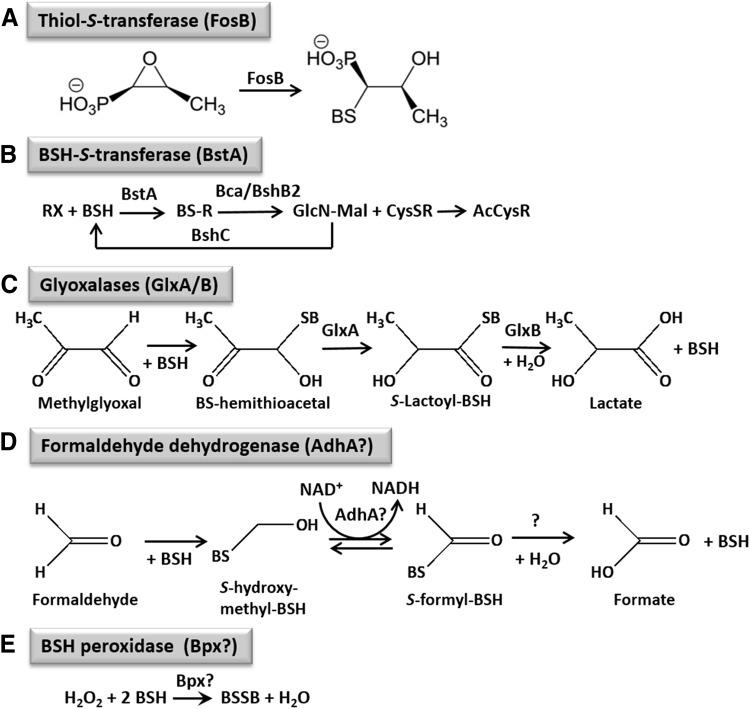
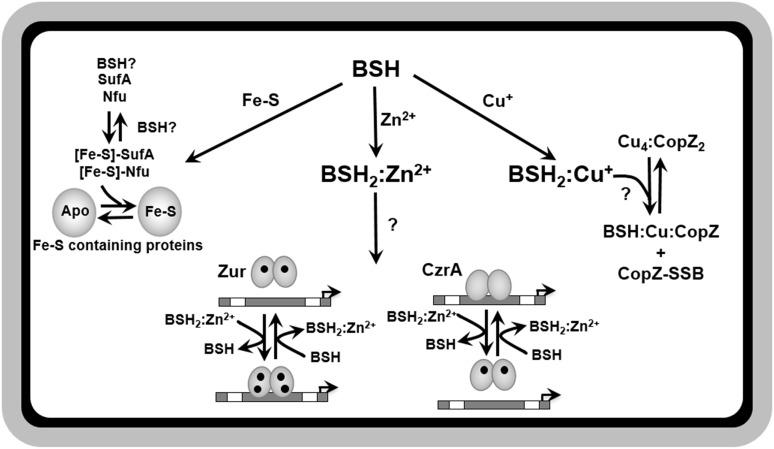
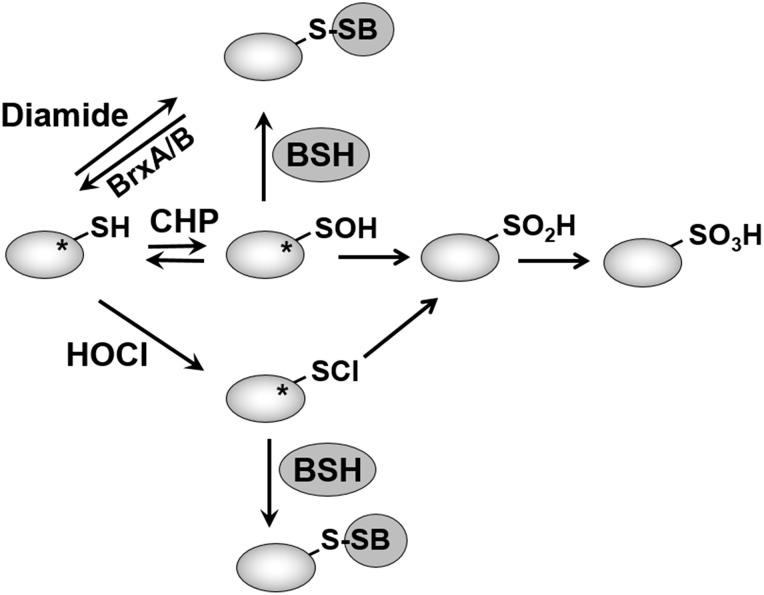
Since the discovery and structural characterization of bacillithiol (BSH), the biochemical functions of BSH-biosynthesis enzymes (BshA/B/C) and BSH-dependent detoxification enzymes (FosB, Bst, GlxA/B) have been explored in Bacillus and Staphylococcus species. It was shown that BSH plays an important role in detoxification of reactive oxygen and electrophilic species, alkylating agents, toxins, and antibiotics. Recent Advances: More recently, new functions of BSH were discovered in metal homeostasis (Zn buffering, Fe-sulfur cluster, and copper homeostasis) and virulence control in Staphylococcus aureus. Unexpectedly, strains of the S. aureus NCTC8325 lineage were identified as natural BSH-deficient mutants. Modern mass spectrometry-based approaches have revealed the global reach of protein S-bacillithiolation in Firmicutes as an important regulatory redox modification under hypochlorite stress. S-bacillithiolation of OhrR, MetE, and glyceraldehyde-3-phosphate dehydrogenase (Gap) functions, analogous to S-glutathionylation, as both a redox-regulatory device and in thiol protection under oxidative stress.
CRITICAL ISSUES
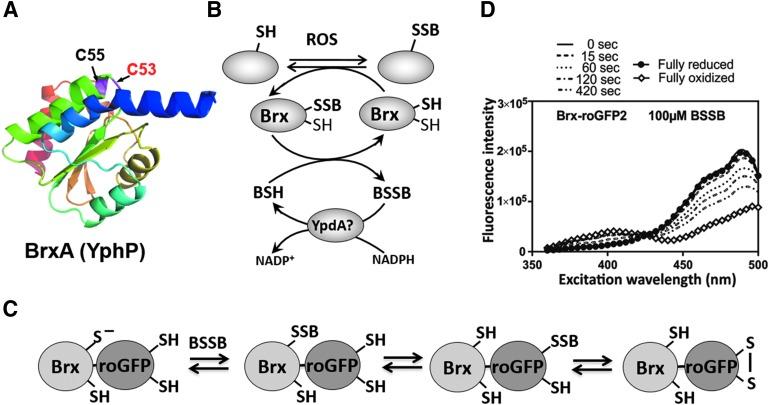
Although the functions of the bacilliredoxin (Brx) pathways in the reversal of S-bacillithiolations have been recently addressed, significantly more work is needed to establish the complete Brx reduction pathway, including the major enzyme(s), for reduction of oxidized BSH (BSSB) and the targets of Brx action in vivo.
FUTURE DIRECTIONS
Despite the large number of identified S-bacillithiolated proteins, the physiological relevance of this redox modification was shown for only selected targets and should be a subject of future studies. In addition, many more BSH-dependent detoxification enzymes are evident from previous studies, although their roles and biochemical mechanisms require further study. This review of BSH research also pin-points these missing gaps for future research. Antioxid. Redox Signal. 28, 445-462.
意义
自发现并结构表征硫辛酸(BSH)以来,BSH 生物合成酶(BshA/B/C)和 BSH 依赖性解毒酶(FosB、Bst、GlxA/B)的生化功能已在芽孢杆菌和葡萄球菌属中得到探索。研究表明,BSH 在解毒活性氧和亲电物质、烷化剂、毒素和抗生素方面发挥着重要作用。
最新进展
最近,BSH 在金黄色葡萄球菌的金属稳态(Zn 缓冲、Fe-S 簇和铜稳态)和毒力控制中的新功能被发现。出乎意料的是,金黄色葡萄球菌 NCTC8325 谱系的菌株被鉴定为天然 BSH 缺陷突变体。基于现代质谱的方法揭示了芽孢杆菌中蛋白质 S-硫辛酸化的全局范围,这是一种在次氯酸盐应激下重要的调节氧化还原修饰。OhrR、MetE 和甘油醛-3-磷酸脱氢酶(Gap)的 S-硫辛酸化功能类似于 S-谷胱甘肽化,既是一种氧化还原调节装置,也是在氧化应激下的硫醇保护。
关键问题
尽管最近已经解决了 bacilliredoxin(Brx)途径在逆转 S-硫辛酸化中的作用,但仍需要更多的工作来建立完整的 Brx 还原途径,包括主要酶(用于还原氧化的 BSH(BSSB)和 Brx 在体内的作用靶点。
未来方向
尽管已经鉴定出大量的 S-硫辛酸化蛋白,但这种氧化还原修饰的生理相关性仅在选定的靶标中得到证实,应该成为未来研究的主题。此外,以前的研究中还可以看出许多更多的 BSH 依赖性解毒酶,尽管它们的作用和生化机制需要进一步研究。BSH 研究的这篇综述也为未来的研究指出了这些缺失的空白。抗氧化。氧化还原信号。28,445-462。



 Zotero 插件