
用于在复杂基质中高灵敏度快速检测食源细菌的便携式核磁共振生物传感器及检测方法
Portable nuclear magnetic resonance biosensor and assay for a highly sensitive and rapid detection of foodborne bacteria in complex matrices.
作者信息
Luo Yilun, Alocilja Evangelyn C
机构信息
Department of Biosystems and Agricultural Engineering, Michigan State University, East Lansing, MI 48824 USA.
出版信息
J Biol Eng. 2017 Mar 27;11:14. doi: 10.1186/s13036-017-0053-8. eCollection 2017.
BACKGROUND
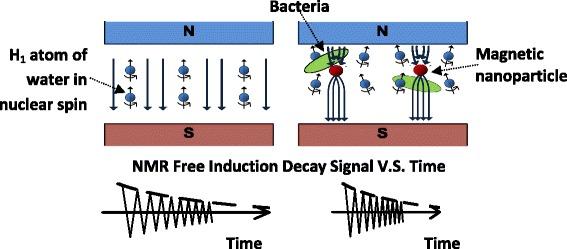
Nuclear magnetic resonance (NMR) technique is a powerful analytical tool in determining the presence of bacterial contaminants in complex biological samples. In this paper, a portable NMR-based (pNMR) biosensor and assay to detect the foodborne bacteria O157:H7 is reported. It uses antibody-functionalized polymer-coated magnetic nanoparticles as proximity biomarker of the bacteria which accelerates NMR resonance signal decay.
RESULTS
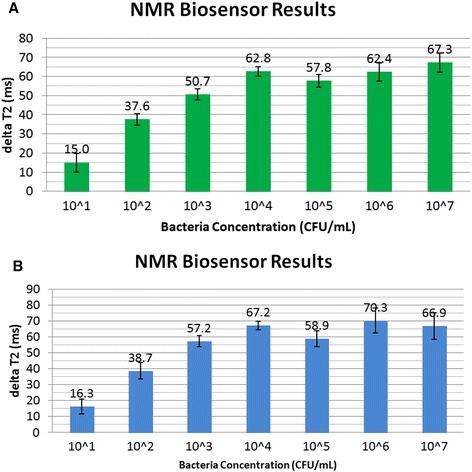
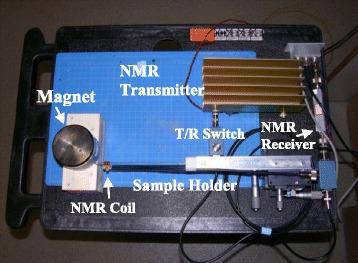
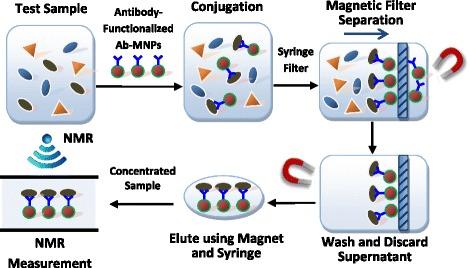
The pNMR biosensor operates at 0.47 Tesla of magnetic strength and consists of a high-power pulsed RF transmitter and an ultra-low noise sensing circuitry capable of detecting weak NMR signal at 0.1 μV. The pNMR biosensor assay and sensing mechanism is used in detecting O157:H7 bacteria in drinking water and milk samples. Experimental results demonstrate that by adding a filtration step in the assay, the pNMR biosensor is able to detect O157:H7 as low as 76 CFU/mL in water samples and as low as 92 CFU/mL in milk samples in about one min.
CONCLUSION
The pNMR biosensor assay and sensing system is innovative for foodborne bacterial detection in food matrices. The lowest detection level for O157:H7 in water and milk samples is essentially 10 CFU/mL. Although the linear range of detection is only from 10 to 10 CFU/mL, the wider detection range spans from 10 CFU/mL to 10 CFU/mL. Existing pNMR biosensors have detection limits at 10-10 CFU/mL only. The detection technique can be extended to other microbial or viral organisms by merely changing the specificity of the antibodies. Besides food safety, the pNMR biosensor described in this paper has potential to be applied as a rapid detection device in biodefense and healthcare diagnostic applications.
背景
核磁共振(NMR)技术是确定复杂生物样品中细菌污染物存在的强大分析工具。本文报道了一种基于便携式核磁共振(pNMR)的生物传感器及检测方法,用于检测食源性病原体O157:H7。它使用抗体功能化的聚合物包覆磁性纳米颗粒作为细菌的邻近生物标志物,可加速NMR共振信号衰减。
结果
pNMR生物传感器在0.47特斯拉的磁场强度下工作,由一个高功率脉冲射频发射器和一个能够检测0.1μV微弱NMR信号的超低噪声传感电路组成。pNMR生物传感器检测方法及传感机制用于检测饮用水和牛奶样品中的O157:H7细菌。实验结果表明,通过在检测中增加一个过滤步骤,pNMR生物传感器能够在约一分钟内检测出低至76 CFU/mL的水样O157:H7和低至92 CFU/mL的牛奶样品O157:H7。
结论
pNMR生物传感器检测方法及传感系统在食品基质中食源细菌检测方面具有创新性。水和牛奶样品中O157:H7的最低检测水平基本为10 CFU/mL。虽然检测线性范围仅为10至10 CFU/mL,但更宽的检测范围跨度为10 CFU/mL至10 CFU/mL。现有的pNMR生物传感器仅在10 - 10 CFU/mL时有检测限。通过仅仅改变抗体的特异性,该检测技术可扩展到其他微生物或病毒生物体。除食品安全外,本文所述的pNMR生物传感器有潜力作为生物防御和医疗诊断应用中的快速检测设备。
 Zotero 插件