
线粒体自噬在人类疾病与生理学中的新兴作用。
Emerging role of mitophagy in human diseases and physiology.
作者信息
Um Jee-Hyun, Yun Jeanho
机构信息
Department of Biochemistry, and Peripheral Neuropathy Research Center, College of Medicine, Dong-A University, Busan 49201, Korea.
出版信息
BMB Rep. 2017 Jun;50(6):299-307. doi: 10.5483/bmbrep.2017.50.6.056.
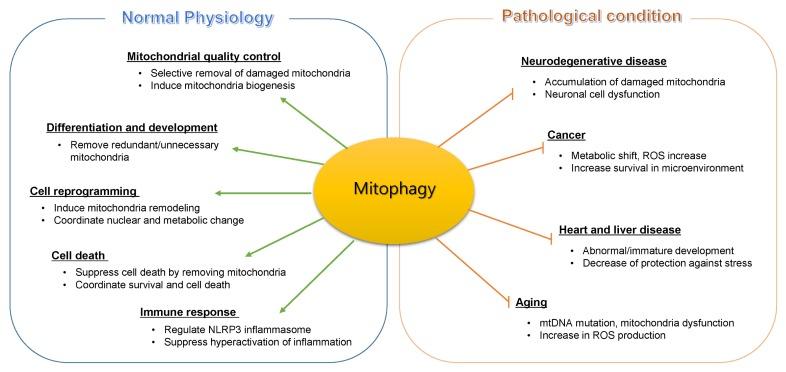
Mitophagy is a process of selective removal of damaged or unnecessary mitochondria using autophagic machinery. Mitophagy plays an essential role in maintaining mitochondrial quality control and homeostasis. Mitochondrial dysfunctions and defective mitophagy in neurodegenerative diseases, cancer, and metabolic diseases indicate a close link between human disease and mitophagy. Furthermore, recent studies showing the involvement of mitophagy in differentiation and development, suggest that mitophagy may play a more active role in controlling cellular functions. A better understanding of mitophagy will provide insights about human disease and offer novel chance for treatment. This review mainly focuses on the recent implications for mitophagy in human diseases and normal physiology. [BMB Reports 2017; 50(6): 299-307].
线粒体自噬是一个利用自噬机制选择性清除受损或多余线粒体的过程。线粒体自噬在维持线粒体质量控制和内环境稳定方面发挥着至关重要的作用。神经退行性疾病、癌症和代谢性疾病中的线粒体功能障碍和有缺陷的线粒体自噬表明人类疾病与线粒体自噬之间存在密切联系。此外,最近的研究表明线粒体自噬参与细胞分化和发育,这表明线粒体自噬可能在控制细胞功能方面发挥更积极的作用。更好地理解线粒体自噬将为人类疾病提供见解,并为治疗提供新的机会。本综述主要关注线粒体自噬在人类疾病和正常生理学中的最新意义。[《BMB报告》2017年;50(6): 299 - 307]
 Zotero 插件