
外泌体介导的线粒体调控:治疗阿尔茨海默病和帕金森病的一种有前景的治疗工具。
Exosome-Mediated Mitochondrial Regulation: A Promising Therapeutic Tool for Alzheimer's Disease and Parkinson's Disease.
作者信息
Jung Young Hyun, Jo Hyo Youn, Kim Dae Hyun, Oh Yeon Ju, Kim Minsoo, Na Seunghyun, Song Ho-Yeon, Lee Hyun Jik
机构信息
Department of Physiology, College of Medicine, Soonchunhyang University, Cheonan, 31151, Republic of Korea.
Laboratory of Veterinary Physiology, College of Veterinary Medicine and Veterinary Medicine Center, Chungbuk National University, Cheongju 28644, Republic of Korea.
出版信息
Int J Nanomedicine. 2025 Apr 17;20:4903-4917. doi: 10.2147/IJN.S513816. eCollection 2025.
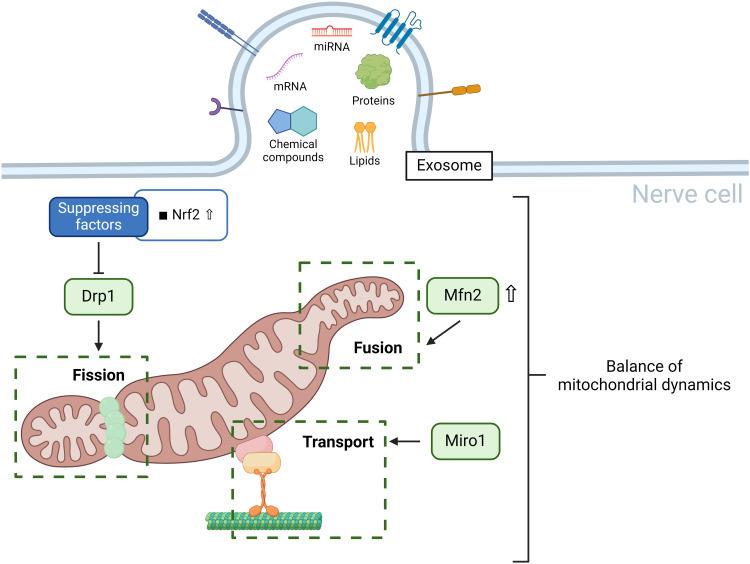
Alzheimer's disease (AD) and Parkinson's disease (PD) are representative neurodegenerative diseases with abnormal energy metabolism and altered distribution and deformation of mitochondria within neurons, particularly in brain regions such as the hippocampus and substantia nigra. Neurons have high energy demands; thus, maintaining a healthy mitochondrial population is important for their biological function. Recently, exosomes have been reported to have mitochondrial regulatory potential and antineurodegenerative properties. This review presents the mitochondrial abnormalities in brain cells associated with AD and PD and the potential of exosomes to treat these diseases. Specifically, it recapitulates research on the molecular mechanisms whereby exosomes regulate mitochondrial biogenesis, fusion/fission dynamics, mitochondrial transport, and mitophagy. Furthermore, this review discusses exosome-triggered signaling pathways that regulate nuclear factor (erythroid-derived 2)-like 2-dependent mitochondrial antioxidation and hypoxia inducible factor 1α-dependent metabolic reprogramming. In summary, this review aims to provide a profound understanding of the regulatory effect of exosomes on mitochondrial function in neurons and to propose exosome-mediated mitochondrial regulation as a promising strategy for AD and PD.
阿尔茨海默病(AD)和帕金森病(PD)是具有代表性的神经退行性疾病,其能量代谢异常,神经元内线粒体的分布和形态发生改变,尤其是在海马体和黑质等脑区。神经元对能量需求很高;因此,维持健康的线粒体群体对其生物学功能很重要。最近,有报道称外泌体具有线粒体调节潜力和抗神经退行性特性。本综述介绍了与AD和PD相关的脑细胞线粒体异常以及外泌体治疗这些疾病的潜力。具体而言,它概述了关于外泌体调节线粒体生物发生、融合/分裂动态、线粒体运输和线粒体自噬的分子机制的研究。此外,本综述讨论了外泌体触发的信号通路,这些信号通路调节核因子(红细胞衍生2)样2依赖性线粒体抗氧化和缺氧诱导因子1α依赖性代谢重编程。总之,本综述旨在深入了解外泌体对神经元线粒体功能的调节作用,并提出外泌体介导的线粒体调节作为AD和PD的一种有前景的策略。


 Zotero 插件