
过敏性气道疾病中小鼠肠道微生物群的改变与表面活性蛋白D无关。
Alterations of the murine gut microbiome in allergic airway disease are independent of surfactant protein D.
作者信息
Barfod Kenneth K, Roggenbuck Michael, Al-Shuweli Suzan, Fakih Dalia, Sørensen Søren J, Sørensen Grith L
机构信息
National Research Centre for the Working Environment, Lersø Parkallé 105, 2100 Copenhagen O, Denmark.
University of Copenhagen, Department of Biology, Microbiology, Universitetsparken 15, 2100 Copenhagen O, Denmark.
出版信息
Heliyon. 2017 Mar 16;3(3):e00262. doi: 10.1016/j.heliyon.2017.e00262. eCollection 2017 Mar.
BACKGROUND
SP-D is an important host defense lectin in innate immunity and SP-D deficient mice show several abnormal immune effects and are susceptible to allergen-induced airway disease. At the same time, host microbiome interactions play an important role in the development of allergic airway disease, and alterations to gut microbiota have been linked to airway disease through the gut-lung axis. Currently, it is unknown if the genotype () of the standard SP-D mouse model can affect the host microbiota to such an degree that it would overcome the cohousing effect on microbiota and interfere with the interpretation of immunological data from the model. Generally, little is known about the effect of the SP-D protein in itself and in combination with airway disease on the microbiota. In this study, we tested the hypothesis that microbiome composition would change with the lack of SP-D protein and presence of allergic airway disease in the widely used SP-D-deficient mouse model.
RESULTS
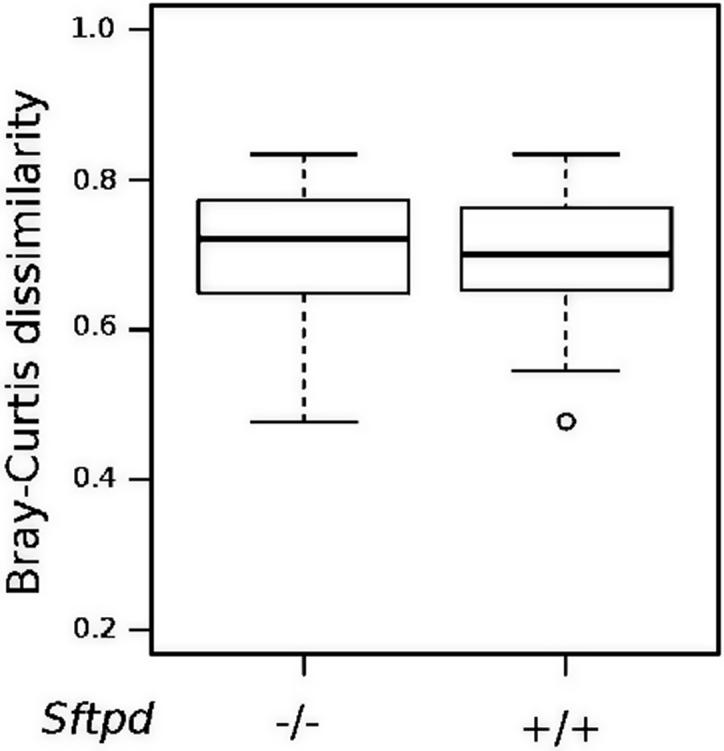
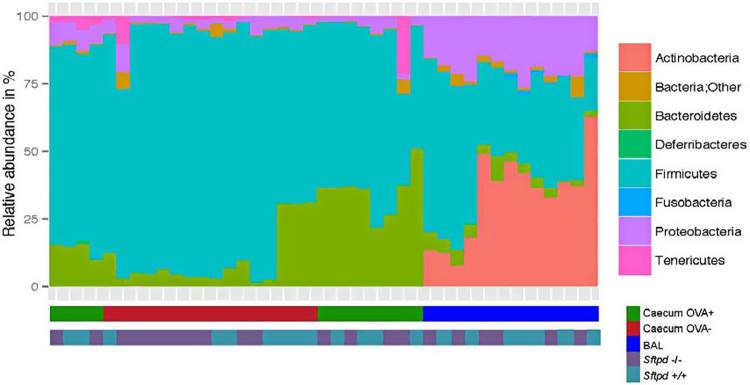
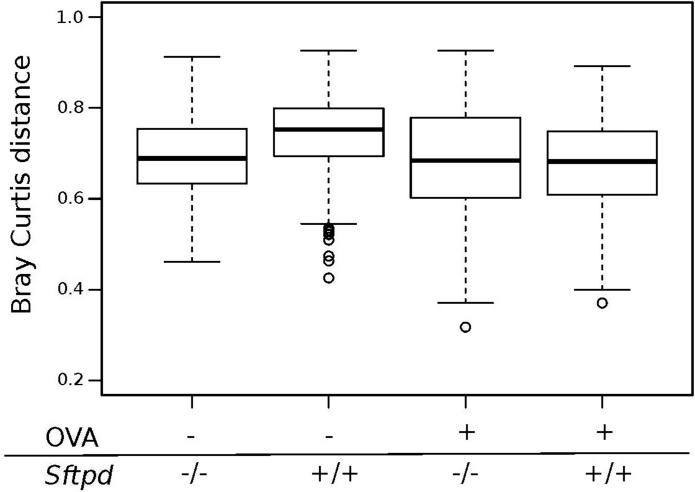
We describe here for the first time the lung and gut microbiota of the SP-D mouse model with OVA induced allergic airway disease. After the challenge animals were killed and fecal samples were taken from the caecum and lungs were subjected to bronchoalveolar lavage for comparison of gut and lung microbiota by Illumina 16S rRNA gene sequencing. A significant community shift was observed in gut microbiota after challenge with OVA. However, the microbial communities were not significantly different between SP-D deficient and wild type mice from the same cages in either naïve or OVA treated animals. Wild type animals did however show the largest variation between mice.
CONCLUSIONS
Our results show that the composition of the microbiota is not influenced by the SP-D deficient genotype under naïve or OVA induced airway disease. However, OVA sensitization and pulmonary challenge did alter the gut microbiota, supporting a bidirectional lung-gut crosstalk. Future mechanistic investigations of the influence of induced allergic airway disease on gut microbiota are warranted.
背景
表面活性蛋白D(SP-D)是天然免疫中一种重要的宿主防御凝集素,SP-D缺陷小鼠表现出多种异常免疫效应,且易患变应原诱导的气道疾病。同时,宿主微生物群相互作用在变应性气道疾病的发展中起重要作用,肠道微生物群的改变已通过肠-肺轴与气道疾病相关联。目前,尚不清楚标准SP-D小鼠模型的基因型是否会对宿主微生物群产生如此大的影响,以至于它会克服同笼饲养对微生物群的影响,并干扰该模型免疫数据的解读。一般来说,关于SP-D蛋白本身以及与气道疾病共同作用对微生物群的影响知之甚少。在本研究中,我们检验了以下假设:在广泛使用的SP-D缺陷小鼠模型中,微生物群组成会随着SP-D蛋白的缺乏和变应性气道疾病的存在而改变。
结果
我们首次描述了卵清蛋白(OVA)诱导变应性气道疾病的SP-D小鼠模型的肺和肠道微生物群。激发后处死动物,从盲肠采集粪便样本,并对肺进行支气管肺泡灌洗,通过Illumina 16S rRNA基因测序比较肠道和肺微生物群。OVA激发后,肠道微生物群出现显著的群落变化。然而,在未处理或OVA处理的动物中,来自同一笼子的SP-D缺陷小鼠和野生型小鼠之间的微生物群落没有显著差异。不过,野生型动物在小鼠之间表现出最大的变异性。
结论
我们的结果表明,在未处理或OVA诱导的气道疾病情况下,微生物群组成不受SP-D缺陷基因型的影响。然而,OVA致敏和肺部激发确实改变了肠道微生物群,支持了肺-肠双向串扰。未来有必要对诱导的变应性气道疾病对肠道微生物群的影响进行机制研究。




 Zotero 插件