
在蚂蚁农业的进化过程中,干旱栖息地是驯化的关键场所。
Dry habitats were crucibles of domestication in the evolution of agriculture in ants.
作者信息
Branstetter Michael G, Ješovnik Ana, Sosa-Calvo Jeffrey, Lloyd Michael W, Faircloth Brant C, Brady Seán G, Schultz Ted R
机构信息
Department of Biology, University of Utah, Salt Lake City, UT 84112, USA
Department of Entomology, National Museum of Natural History, Smithsonian Institution, Washington, DC 20560, USA.
出版信息
Proc Biol Sci. 2017 Apr 12;284(1852). doi: 10.1098/rspb.2017.0095.
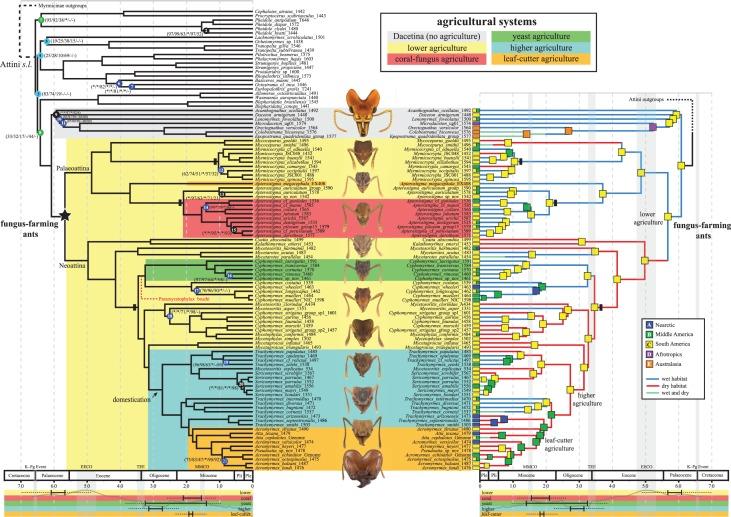
The evolution of ant agriculture, as practised by the fungus-farming 'attine' ants, is thought to have arisen in the wet rainforests of South America about 55-65 Ma. Most subsequent attine agricultural evolution, including the domestication event that produced the ancestor of higher attine cultivars, is likewise hypothesized to have occurred in South American rainforests. The 'out-of-the-rainforest' hypothesis, while generally accepted, has never been tested in a phylogenetic context. It also presents a problem for explaining how fungal domestication might have occurred, given that isolation from free-living populations is required. Here, we use phylogenomic data from ultra-conserved element (UCE) loci to reconstruct the evolutionary history of fungus-farming ants, reduce topological uncertainty, and identify the closest non-fungus-growing ant relative. Using the phylogeny we infer the history of attine agricultural systems, habitat preference and biogeography. Our results show that the out-of-the-rainforest hypothesis is correct with regard to the origin of attine ant agriculture; however, contrary to expectation, we find that the transition from lower to higher agriculture is very likely to have occurred in a seasonally dry habitat, inhospitable to the growth of free-living populations of attine fungal cultivars. We suggest that dry habitats favoured the isolation of attine cultivars over the evolutionary time spans necessary for domestication to occur.
由种植真菌的“阿蒂尼”蚂蚁所践行的蚂蚁农业的演化,被认为大约在5500万至6500万年前出现在南美洲的潮湿雨林中。随后大多数阿蒂尼蚂蚁农业的演化,包括产生高等阿蒂尼栽培品种祖先的驯化事件,同样被假设发生在南美洲的雨林中。“走出雨林”假说虽然被普遍接受,但从未在系统发育的背景下得到检验。考虑到需要与自由生活的种群隔离,这一假说在解释真菌驯化可能如何发生方面也存在问题。在这里,我们使用来自超保守元件(UCE)位点的系统发育基因组数据来重建种植真菌蚂蚁的进化历史,减少拓扑不确定性,并确定最接近的非种植真菌蚂蚁的亲缘种。利用系统发育关系我们推断阿蒂尼蚂蚁农业系统的历史、栖息地偏好和生物地理学。我们的结果表明,就阿蒂尼蚂蚁农业的起源而言,“走出雨林”假说是正确的;然而,与预期相反,我们发现从低等农业向高等农业的转变很可能发生在季节性干燥的栖息地,这种栖息地不利于阿蒂尼真菌栽培品种自由生活种群的生长。我们认为,在驯化发生所需的进化时间跨度内,干燥的栖息地有利于阿蒂尼栽培品种的隔离。
 Zotero 插件