
了解宫颈癌筛查未参与者的异质性:来自英国女性全国样本的数据。
Understanding the heterogeneity of cervical cancer screening non-participants: Data from a national sample of British women.
作者信息
Marlow Laura A V, Chorley Amanda J, Haddrell Jessica, Ferrer Rebecca, Waller Jo
机构信息
Cancer Communication & Screening Group, Research Department of Behavioural Science and Health, UCL, Gower Street, London, WC1E 6BT, UK.
Cancer Communication & Screening Group, Research Department of Behavioural Science and Health, UCL, Gower Street, London, WC1E 6BT, UK.
出版信息
Eur J Cancer. 2017 Jul;80:30-38. doi: 10.1016/j.ejca.2017.04.017. Epub 2017 May 20.
BACKGROUND
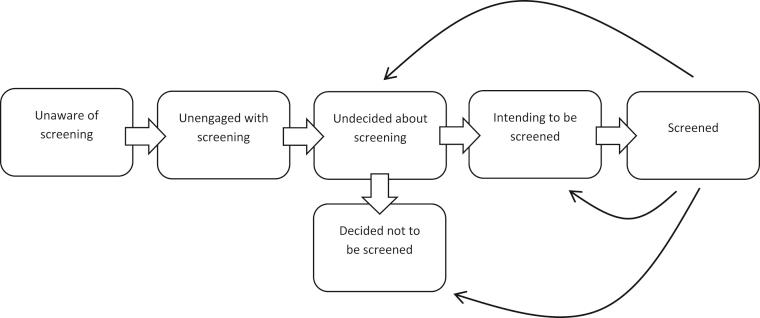
Uptake of cervical cancer screening in the United Kingdom (UK) is falling year on year, and a more sophisticated understanding of non-participation may help design interventions to reverse this trend. This study ascertained the prevalence of different non-participant types using the Precaution Adoption Process Model (PAPM).
METHODS
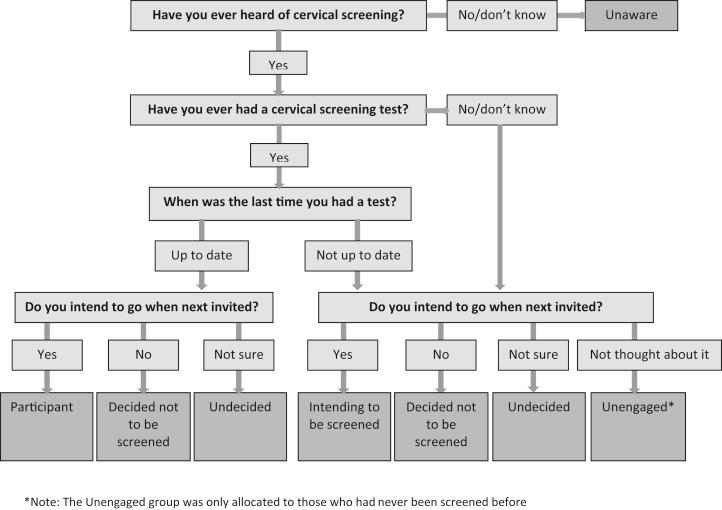
Home-based computer-assisted interviews were carried out with 3113 screening-eligible women in Britain. Survey items assessed self-reported screening uptake and intention to attend in future. Responses to these items were used to classify women into one of five different types of non-participants.
RESULTS
Of 793 non-participants, 28% were unaware of screening, 15% had decided not to attend and 51% were intending to have screening but were currently overdue. Younger women were more likely to be unaware of screening or to intend to be screened, while older women were more likely to have decided not to be screened. Women from ethnic minority backgrounds were more likely to be unaware of screening than white women. Being in a lower social grade was associated with increased odds of all three types of non-participation.
CONCLUSION
The majority of cervical cancer screening non-participants are not making an active decision not to attend but rather are either unaware or unable to act. There are clear sociodemographic differences between non-participant types, which could be used to identify where tailored interventions may be best targeted.
背景
英国宫颈癌筛查的参与率逐年下降,更深入地了解未参与的原因可能有助于设计干预措施以扭转这一趋势。本研究使用预防采纳过程模型(PAPM)确定了不同未参与类型的患病率。
方法
对英国3113名符合筛查条件的女性进行了基于家庭的计算机辅助访谈。调查项目评估了自我报告的筛查参与情况和未来参加筛查的意愿。根据对这些项目的回答,将女性分为五种不同类型的未参与者之一。
结果
在793名未参与者中,28%不知道有筛查,15%已决定不参加,51%打算进行筛查但目前已逾期。年轻女性更有可能不知道有筛查或打算接受筛查,而老年女性更有可能已决定不接受筛查。少数族裔背景的女性比白人女性更有可能不知道有筛查。社会等级较低与所有三种未参与类型的几率增加有关。
结论
大多数宫颈癌筛查未参与者并非主动决定不参加,而是要么不知道,要么无法采取行动。未参与类型之间存在明显的社会人口统计学差异,可用于确定最适合针对性干预的地方。
 Zotero 插件