
在英国宫颈癌筛查计划中向未就诊者机会性提供自我采样:一项实用的多中心实施可行性试验,随机分配整群干预开始日期(YouScreen)。
Opportunistic offering of self-sampling to non-attenders within the English cervical screening programme: a pragmatic, multicentre, implementation feasibility trial with randomly allocated cluster intervention start dates (YouScreen).
作者信息
Lim Anita W W, Deats Katie, Gambell Joanna, Lawrence Alexandra, Lei Jiayao, Lyons Mairead, North Bernard, Parmar Dharmishta, Patel Hasit, Waller Jo, Warwick Jane, Sasieni Peter D
机构信息
School of Cancer and Pharmaceutical Sciences, Faculty of Life Sciences and Medicine, King's College London, London, SE1 9RT, UK.
Centre for Cancer Screening, Prevention and Early Diagnosis, Queen Mary University of London, London, EC1M 6BQ, UK.
出版信息
EClinicalMedicine. 2024 Jul 16;73:102672. doi: 10.1016/j.eclinm.2024.102672. eCollection 2024 Jul.
BACKGROUND
Self-sampling has game-changing potential to tackle the declining participation and inequities seen in many organised cervical screening programmes. Wide variation in uptake between settings and mode of kit offer highlight the importance of local piloting. Furthermore, harnessing the benefits of self-sampling in real-world settings has been surprisingly challenging. The YouScreen study estimated the impact of offering self-sampling to non-attenders within the English Programme and evaluated large-scale opportunistic offering of self-sampling in primary care.
METHODS
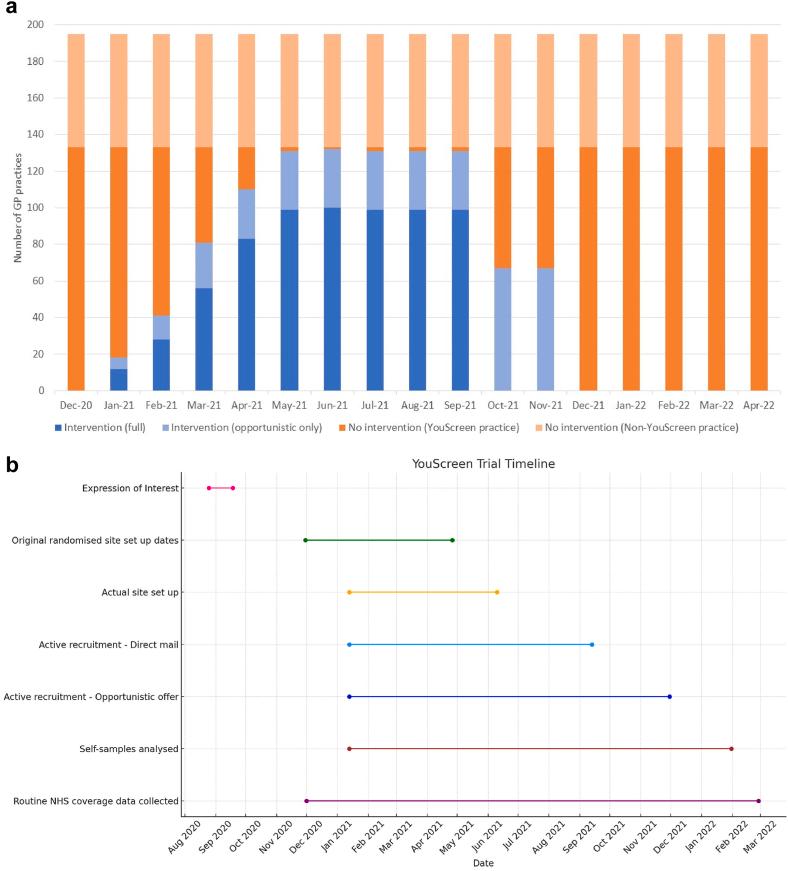
A pragmatic modified stepped-wedge implementation feasibility trial with randomly-allocated cluster intervention start dates at primary care practices in England (133 participating, 62 non-participating). Eligible women were aged 25-64 years and ≥6 months overdue for screening ("non-attenders"). Between January 13, 2021 and 30 November, 2021 self-sampling kits were distributed to non-attenders via an opportunistic offer in primary care when they consulted for any reason and direct mailout to those unscreened 15-months after routine invitation. Primary outcomes were the proportion of non-attenders screened each month; change in coverage; and uptake (90 days). YouScreen is registered with ISRCTN:12759467.
FINDINGS
8338 women provided self-samples following recruitment between January 13, 2021 and 30 November, 2021. Self-samples were returned from 65.5% (6061/9248) who accepted an opportunistically offered kit and 12.9% (2777/17,604) directly-mailed kits. Responders were representative of the ethnically diverse and deprived underlying non-attendee population (64% ethnic minority groups, 60% from the two most deprived national quintiles). The self-sampling intervention resulted in a 22% (95% CI 18-26) increase in non-attenders screened per month (per-protocol analysis) and 12% (95% CI 9-15) (intention-to-treat analysis). Change in coverage at participating (mean intervention duration 7.5 months) vs non-participating practices was 1.6% (95% CI 0.4-2.8). Adverse effects were not formally collected.
INTERPRETATION
Opportunistically offering self-sampling to under-screened women in primary care could increase coverage in England and potentially reach underserved populations.
FUNDING
North Central London and North East London Cancer Alliance.
背景
自我采样在应对许多有组织的宫颈癌筛查项目中参与率下降和不公平现象方面具有改变游戏规则的潜力。不同地区以及试剂盒提供方式之间的接受率差异很大,这凸显了本地试点的重要性。此外,在现实环境中利用自我采样的益处一直具有惊人的挑战性。YouScreen研究估计了在英国项目中向未参与者提供自我采样的影响,并评估了在初级保健中大规模机会性提供自我采样的情况。
方法
在英格兰的初级保健机构进行一项实用的改良阶梯楔形实施可行性试验,随机分配集群干预开始日期(133个参与机构,62个非参与机构)。符合条件的女性年龄在25 - 64岁之间,筛查逾期≥6个月(“未参与者”)。在2021年1月13日至2021年11月30日期间,自我采样试剂盒通过初级保健机构的机会性提供分发给未参与者,即在她们因任何原因就诊时发放,同时直接邮寄给那些在常规邀请后15个月仍未接受筛查的人。主要结局指标为每月接受筛查的未参与者比例;覆盖率变化;以及接受率(90天)。YouScreen在ISRCTN注册:12759467。
结果
在2021年1月13日至2021年11月30日招募后,8338名女性提供了自我样本。接受机会性提供试剂盒的人中,65.5%(6061/9248)返回了自我样本,直接邮寄试剂盒的人中,12.9%(2777/17604)返回了自我样本。回复者代表了种族多样且贫困的未参与者群体(64%为少数民族群体,60%来自最贫困的两个全国五分位数)。自我采样干预使每月接受筛查的未参与者增加了22%(95%置信区间18 - 26)(符合方案分析),12%(95%置信区间9 - 15)(意向性分析)。参与机构(平均干预持续时间7.5个月)与非参与机构的覆盖率变化为1.6%(95%置信区间0.4 - 2.8)。未正式收集不良反应情况。
解读
在初级保健中向筛查不足的女性机会性提供自我采样可提高英国的覆盖率,并有可能覆盖到服务不足的人群。
资金来源
北伦敦中部和东北伦敦癌症联盟。

 Zotero 插件