
非窥镜取样方法在老年女性宫颈癌筛查中的应用:随机对照试验。
Non-speculum sampling approaches for cervical screening in older women: randomised controlled trial.
机构信息
Division of Cancer Epidemiology and Genetics, National Cancer Institute, National Institutes of Health, Department of Health and Human Services, Bethesda, Maryland, US.
Whipps Cross University Hospital, Barts Health NHS Trust, London.
出版信息
Br J Gen Pract. 2021 Dec 31;72(714):e26-e33. doi: 10.3399/BJGP.2021.0350. Print 2022 Jan.
BACKGROUND
Cervical cancer disproportionately affects women ≥65 years, especially those not screened regularly. Speculum use is a key barrier.
AIM
To assess if offering non-speculum clinician-taken sampling and self-sampling increases uptake for lapsed attenders aged 50-64 years.
DESIGN AND SETTING
Pragmatic randomised control trial conducted at 10 general practices in East London, UK.
METHOD
Participants were 784 women aged 50-64 years, last screened 6-15 years before randomisation. Intervention participants received a letter offering the choice of non-speculum clinician- or self-sampling. Control participants received usual care. The main outcome measure was uptake within 4 months.
RESULTS
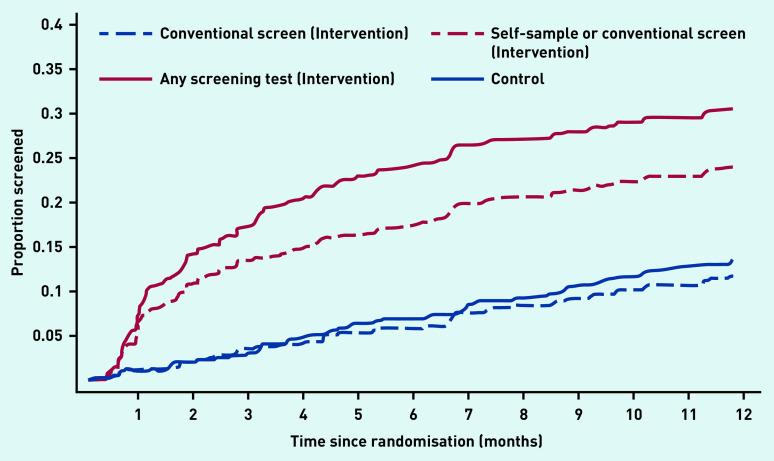
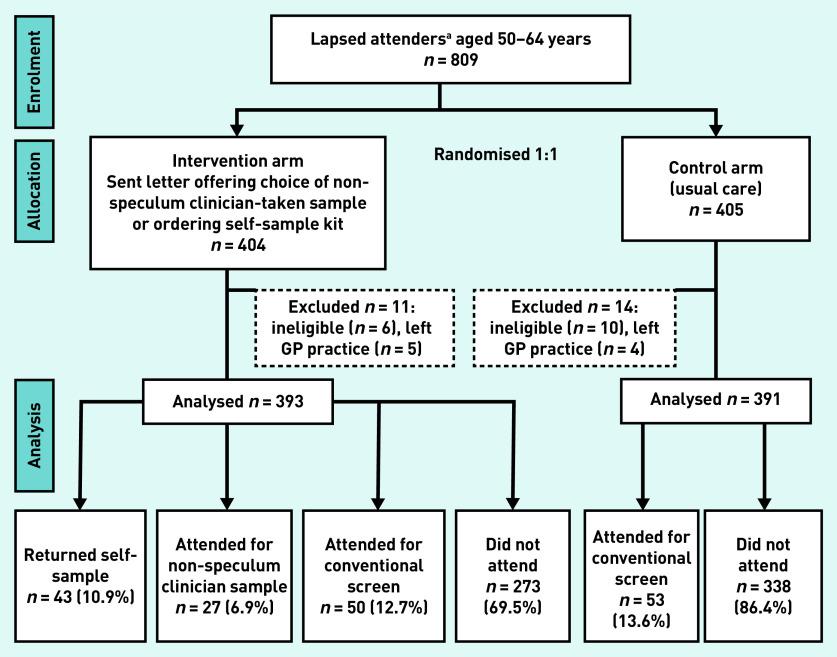
Screening uptake 4 months after randomisation was significantly higher in the intervention arm: 20.4% ( = 80/393) versus 4.9% in the control arm ( = 19/391, absolute difference 15.5%, 95% confidence interval [CI] = 11.0% to 20.0%, <0.001). This was maintained at 12 months: intervention 30.5% ( = 120/393) versus control 13.6% ( = 53/391) (absolute difference 17.0%, 95% CI = 11.3% to 22.7%, <0.001). Conventional screening attendance within 12 months was very similar for both intervention 12.7% ( = 50/393) and control 13.6% ( = 53/391) arms. Ethnic differences were seen in screening modality preference. More White women opted for self-sampling (50.7%, = 38/75), whereas most Asian and Black women and those from other ethnic backgrounds opted for conventional screening.
CONCLUSION
Offering non-speculum clinician-taken sampling and self-sampling substantially increases uptake in older lapsed attendee women. Non-speculum clinician sampling appeals to women who dislike the speculum but still prefer a clinician to take their sample. Providing a choice of screening modality may be important for optimising cervical screening uptake.
背景
宫颈癌在年龄≥65 岁的女性中发病率较高,尤其是那些未定期接受筛查的女性。使用阴道镜检查是一个主要的障碍。
目的
评估为 50-64 岁的已过筛检期的女性提供非阴道镜检查医师采集样本和自我采样是否会增加接受率。
设计和设置
在英国伦敦东部的 10 家全科医生诊所进行的实用随机对照试验。
方法
参与者为 784 名年龄在 50-64 岁、上次筛查在随机分组前 6-15 年的女性。干预组参与者收到一封信,提供非阴道镜检查医师采集样本和自我采样的选择。对照组参与者接受常规护理。主要结局测量是在 4 个月内的接受率。
结果
随机分组后 4 个月的筛查接受率在干预组显著更高:20.4%(=80/393)与对照组的 4.9%(=19/391,绝对差异 15.5%,95%置信区间[CI]为 11.0%至 20.0%,<0.001)。这一结果在 12 个月时仍然保持:干预组为 30.5%(=120/393),对照组为 13.6%(=53/391)(绝对差异 17.0%,95%CI为 11.3%至 22.7%,<0.001)。两组干预组的常规筛查出勤率在 12 个月内非常相似,分别为 12.7%(=50/393)和 13.6%(=53/391)。在筛查方式偏好方面存在种族差异。更多的白人女性选择自我采样(50.7%,=38/75),而大多数亚裔、黑人女性以及其他族裔背景的女性则选择常规筛查。
结论
为年龄较大的已过筛检期女性提供非阴道镜检查医师采集样本和自我采样可显著增加接受率。非阴道镜检查医师采集样本吸引了不喜欢阴道镜检查但仍希望由医师采集样本的女性。提供筛查方式的选择可能对优化宫颈癌筛查接受率很重要。
 Zotero 插件