
参与干预措施和建议对宫颈癌筛查未参与者进行随访-考虑到女性自身首选的检测方法-一项瑞典随机对照试验。
Participation in interventions and recommended follow-up for non-attendees in cervical cancer screening -taking the women's own preferred test method into account-A Swedish randomised controlled trial.
机构信息
Department of Obstetrics and Gynaecology and Division of Children's and Women's Health, Department of Biomedical and Clinical Sciences, Faculty of Medicine and Health Sciences, Linköping University, Linköping, Sweden.
出版信息
PLoS One. 2020 Jul 2;15(7):e0235202. doi: 10.1371/journal.pone.0235202. eCollection 2020.
BACKGROUND
Cervical cancer is a highly preventable disease. To not attend an organized cervical cancer screening program increases the risk for cervical dysplasia and cervical cancer. The aim was to investigate the participation rate in three different intervention groups for non- attendees in the Swedish national program for cervical screening. The participation in the recommended follow up, and the histology found were also examined.
METHOD
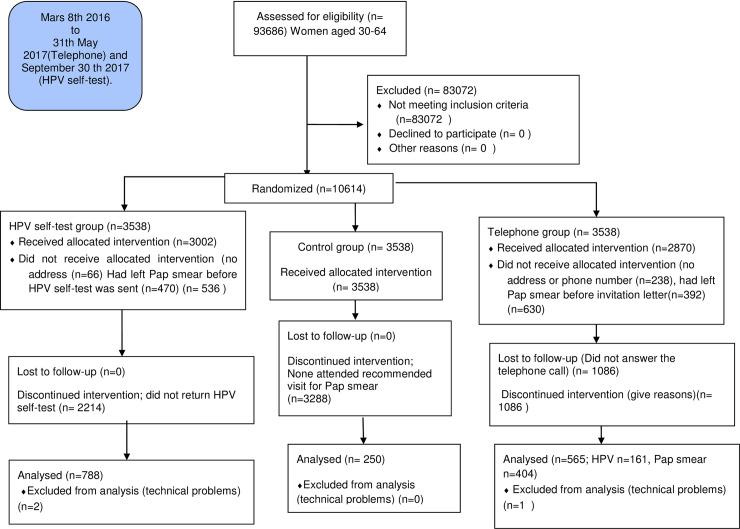
Population-based randomized control trial. It included10,614 women that had not participated in the cervical cancer screening programme during the last six years (ages 30-49) and the last eight years (ages 50-64) were randomised 1:1:1(telephone call from a midwife (offering the choice between a visit for a pap smear or an HPV self-sampling test); an HPV self-sampling test only; or the routine procedure with a yearly invitation).
RESULTS
In the intention to treat analysis the participation rates were 25.5% (N = 803/3146) vs 34.1% (N = 1047/3068) and 7.0% (N = 250/3538) (p<0.001) for telephone, HPV self-test and control groups respectively. In the by protocol analysis including women that answered the phone call the participation rates were 31.7% (N = 565/1784) vs 26.1% (N = 788/3002) and 7.0% (N = 250/3538) (p<0.001) for telephone, HPV self-test and control groups. The corresponding results in the by protocol analysis including women that did not answer the phone call was 19.7% (N = 565/2870) vs 26.1% (N = 788/3002) and 7.0% (N = 250/3538) (p< 0.001). The majority of the women 63,4% (1131/1784) who answered the telephone wanted to participate either by booking a visit for pap smear (38,5%) or to be sent a HPV self- sampling test (24,9%) (p<0.001). Women who chose an HPV self-test were older and gave anxiety/ fear as a reason to decline participation, and they were also less likely to participate in the follow-up if found to be HPV-positive compared to the women who chose a Pap smear. The attendance to the recommended follow-up after abnormality was in total 87%. The non-attendees had a three or eight times higher risk of having a cytology result of HSIL or suspected SCC respectively, in the index sample compared to women screened as recommended (OR 3.3 CI 95% 1.9-5.2, OR 8.6 CI 1.6-30). A total of ten SCC and one adenocarcinoma were found in the histopathology results from the non-attendee group with a study intervention, while there was only one SCC in the non-attendee group without any study intervention (p = 0.02, OR 8.1 CI 95% 1.2-350).
CONCLUSIONS
Our study suggests, according to intention to treat analysis, that the best intervention to get as many non-attendees as possible to participate is to send an HPV self-sampling test together with an invitation letter. Almost 90% of women in the study with an abnormal index sample attended follow-up. This is high enough to indicate that interventions to increase the participation among non-attendees are meaningful.
REGISTRY
International Standard Randomised Controlled Trial Number (ISRCTN) Registration number ISRCTN78719765.
背景
宫颈癌是一种高度可预防的疾病。不参加有组织的宫颈癌筛查计划会增加宫颈发育不良和宫颈癌的风险。本研究旨在调查参加瑞典国家宫颈癌筛查计划的三组非参与者的参与率。还检查了他们在推荐的随访中的参与情况以及发现的组织病理学结果。
方法
这是一项基于人群的随机对照试验。共纳入 10614 名过去六年(年龄 30-49 岁)和过去八年(年龄 50-64 岁)未参加宫颈癌筛查计划的女性,将其随机分为 1:1:1 三组(接受助产士的电话访问(提供巴氏涂片检查或 HPV 自我采样检测的选择);仅接受 HPV 自我采样检测;或接受常规程序和每年邀请)。
结果
意向治疗分析结果显示,电话组、HPV 自我检测组和对照组的参与率分别为 25.5%(N = 803/3146)、34.1%(N = 1047/3068)和 7.0%(N = 250/3538)(p<0.001)。包括接听电话的女性在内的按方案分析结果显示,电话组、HPV 自我检测组和对照组的参与率分别为 31.7%(N = 565/1784)、26.1%(N = 788/3002)和 7.0%(N = 250/3538)(p<0.001)。包括未接听电话的女性在内的按方案分析结果显示,电话组、HPV 自我检测组和对照组的参与率分别为 19.7%(N = 565/2870)、26.1%(N = 788/3002)和 7.0%(N = 250/3538)(p<0.001)。大多数接听电话的女性(1784 名中的 63.4%,即 1131 名)希望通过预约巴氏涂片检查(38.5%)或接受 HPV 自我采样检测(24.9%)来参与(p<0.001)。选择 HPV 自我检测的女性年龄较大,并且因焦虑/恐惧而拒绝参与,与选择巴氏涂片的女性相比,如果 HPV 检测阳性,她们参与随访的可能性也较低。异常标本的建议随访总参与率为 87%。与按建议筛查的女性相比,非参与者在索引样本中分别有 3 倍和 8 倍更高的风险出现 HSIL 或疑似 SCC 的细胞学结果(OR 3.3,95%CI 1.9-5.2,OR 8.6,95%CI 1.6-30)。在非参与者组中,共发现 10 例 SCC 和 1 例腺癌,其中有研究干预,而在没有任何研究干预的非参与者组中,仅发现 1 例 SCC(p = 0.02,OR 8.1,95%CI 1.2-350)。
结论
根据意向治疗分析,我们的研究表明,让尽可能多的非参与者参与的最佳干预措施是同时发送 HPV 自我采样检测和邀请信。研究中近 90%的异常索引样本女性参加了随访。这足以表明增加非参与者参与度的干预措施是有意义的。
登记
国际标准随机对照试验编号(ISRCTN)注册号 ISRCTN78719765。
 Zotero 插件