
文莱女性宫颈癌筛查未到场的原因和 HPV 自我采样的可接受性:一项横断面研究。
Reasons for non-attendance to cervical cancer screening and acceptability of HPV self-sampling among Bruneian women: A cross-sectional study.
机构信息
PAPRSB Institute of Health Sciences, Gadong, Brunei Darussalam.
Histopathology Department, RIPAS Hospital, Ministry of Health, Bandar Seri Begawan, Brunei Darussalam.
出版信息
PLoS One. 2022 Mar 14;17(3):e0262213. doi: 10.1371/journal.pone.0262213. eCollection 2022.
OBJECTIVE
Uptake for cervical cancer screening remains well below the 80% target as recommended by Brunei's National Cervical Cancer Prevention and Control plan. We conducted a pilot study to determine the reasons for non-attendance and explore their acceptance of human papillomavirus (HPV) self-sampling as an alternative to the Pap test.
METHODS
A cross-sectional study was conducted at a primary healthcare center in Brunei, from January to December 2019. We recruited screening non-attendees, defined as women who were eligible for Pap test but who either never, or did not have one within the recommended screening interval of 3 years. This recruitment was done conveniently among women attending outpatient care and/or child health services at the primary healthcare center. Participants were first asked to complete a self-administered paper-based questionnaire on their reasons for screening non-attendance, and then invited for HPV self-sampling. Among those who agreed to participate in HPV self-sampling, they were asked to complete a second questionnaire on the self-sampling procedure and their samples were tested for high-risk HPV (hr-HPV). Results were analyzed using descriptive and inferential statistics.
RESULT
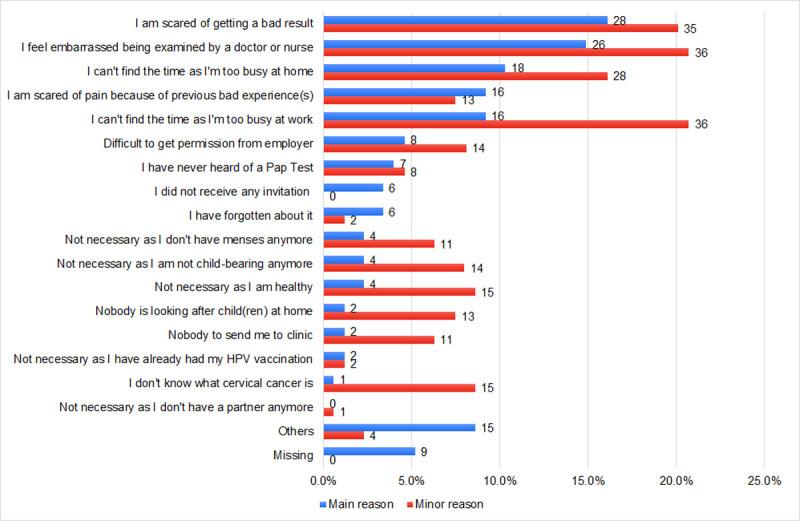
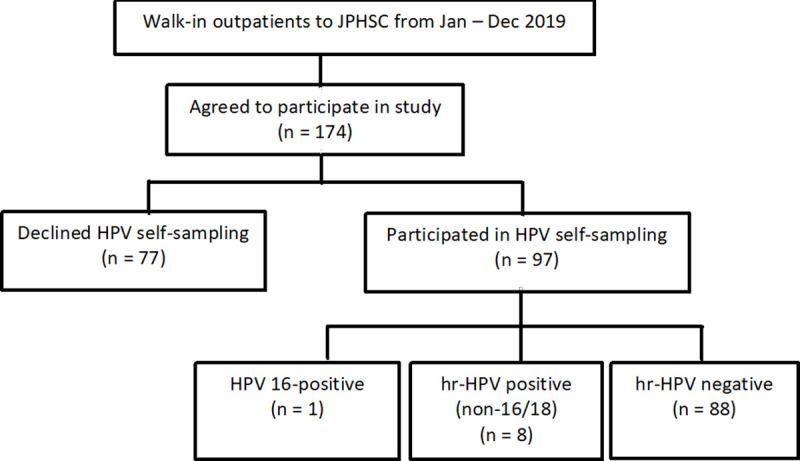
We enrolled 174 screening non-attendees, out of which 97 (55.7%) also participated in HPV self-sampling. The main reasons for not attending Pap test screening were fear of bad results (16.1%, n = 28); embarrassment (14.9%, n = 26) and lack of time due to home commitments (10.3%, n = 18). When compared to those who agreed to participate in HPV self-sampling, those who declined were significantly older (p = 0.002) and less likely to agree that they are susceptible to cervical cancer (p = 0.023). They preferred to receive Pap test-related information from healthcare workers (59.0%, n = 155), social messaging platforms (28.7%, n = 51) and social media (26.4%, n = 47). HPV self-sampling kits were positively received among the 97 participants, where > 90% agreed on its ease and convenience. Nine (9.3%) tested positive for hr-HPV, out of which eight were non-16/18 HPV genotypes.
CONCLUSION
Our findings suggest that promoting awareness on cervical cancer, clarifying any misconceptions of Pap test results, and highlighting that the disease is preventable and that early detection through screening can facilitate successful treatment would help increase screening uptake among Bruneian non-attendees. Response to HPV self-sampling was highly positive, suggesting the possibility of implementing this strategy in the local setting. Our high detection of non-16/18 HPV genotypes suggest high prevalence of other hr-HPV genotypes in Brunei. Larger studies should be conducted to further validate our findings.
目的
宫颈癌筛查的参与率远低于文莱国家宫颈癌预防和控制计划建议的 80%。我们进行了一项试点研究,以确定未参加的原因,并探讨他们对人乳头瘤病毒(HPV)自我采样作为巴氏试验替代方法的接受程度。
方法
2019 年 1 月至 12 月,在文莱的一家初级保健中心进行了一项横断面研究。我们招募了筛查未参与者,定义为符合巴氏试验条件但从未进行过检查或未在推荐的 3 年筛查间隔内进行检查的女性。这项招募是在初级保健中心接受门诊护理和/或儿童保健服务的女性中方便地进行的。首先,参与者被要求完成一份关于筛查未参与者的原因的自我管理纸质问卷,然后邀请他们进行 HPV 自我采样。对于同意参加 HPV 自我采样的参与者,他们被要求完成第二份关于自我采样过程的问卷,然后对他们的样本进行高危 HPV(hr-HPV)检测。使用描述性和推理统计方法分析结果。
结果
我们共招募了 174 名筛查未参与者,其中 97 名(55.7%)也参加了 HPV 自我采样。不参加巴氏试验筛查的主要原因是担心结果不好(16.1%,n=28)、尴尬(14.9%,n=26)和因家庭承诺而缺乏时间(10.3%,n=18)。与同意参加 HPV 自我采样的参与者相比,拒绝参加的参与者年龄明显更大(p=0.002),并且不太可能同意自己易患宫颈癌(p=0.023)。他们更喜欢从医疗保健工作者(59.0%,n=155)、社会信息平台(28.7%,n=51)和社交媒体(26.4%,n=47)获得与巴氏试验相关的信息。97 名参与者对 HPV 自我采样试剂盒的反应积极,其中超过 90%的人认为它简单方便。9 人(9.3%)hr-HPV 检测呈阳性,其中 8 人是非 16/18 HPV 基因型。
结论
我们的研究结果表明,提高对宫颈癌的认识、澄清对巴氏试验结果的任何误解,并强调该疾病是可预防的,通过筛查早期发现可以促进成功治疗,这将有助于提高文莱非参与者的筛查参与率。对 HPV 自我采样的反应非常积极,这表明在当地实施这一策略是可能的。我们检测到非 16/18 HPV 基因型的比例很高,这表明文莱存在其他高危 HPV 基因型的高流行率。应进行更大规模的研究进一步验证我们的发现。
 Zotero 插件