
人乳头瘤病毒(HPV)检测的自我采样:一项系统评价和荟萃分析。
Self-sampling for human papillomavirus (HPV) testing: a systematic review and meta-analysis.
作者信息
Yeh Ping Teresa, Kennedy Caitlin E, de Vuyst Hugo, Narasimhan Manjulaa
机构信息
Department of International Health, Johns Hopkins Bloomberg School of Public Health, Baltimore, Maryland, USA.
Infections and Cancer Epidemiology Group, International Agency for Research on Cancer, Lyon, France.
出版信息
BMJ Glob Health. 2019 May 14;4(3):e001351. doi: 10.1136/bmjgh-2018-001351. eCollection 2019.
INTRODUCTION
Human papillomavirus (HPV) self-sampling test kits may increase screening for and early detection of cervical cancer and reduce its burden globally. To inform WHO self-care guidelines, we conducted a systematic review and meta-analysis of HPV self-sampling among adult women on cervical (pre-)cancer screening uptake, screening frequency, social harms/adverse events and linkage to clinical assessment/treatment.
METHODS
The included studies compared women using cervical cancer screening services with HPV self-sampling with women using standard of care, measured at least one outcome, and were published in a peer-reviewed journal. We searched PubMed, the Cumulative Index to Nursing and Allied Health Literature (CNIAHL), Latin American and Caribbean Health Sciences Literature (LILACS) and Embase through October 2018. Risk of bias was assessed using the Cochrane tool for randomised controlled trials (RCTs) and the Evidence Project tool for non-randomised studies. Meta-analysis was conducted using random-effects models to generate pooled estimates of relative risk (RR).
RESULTS
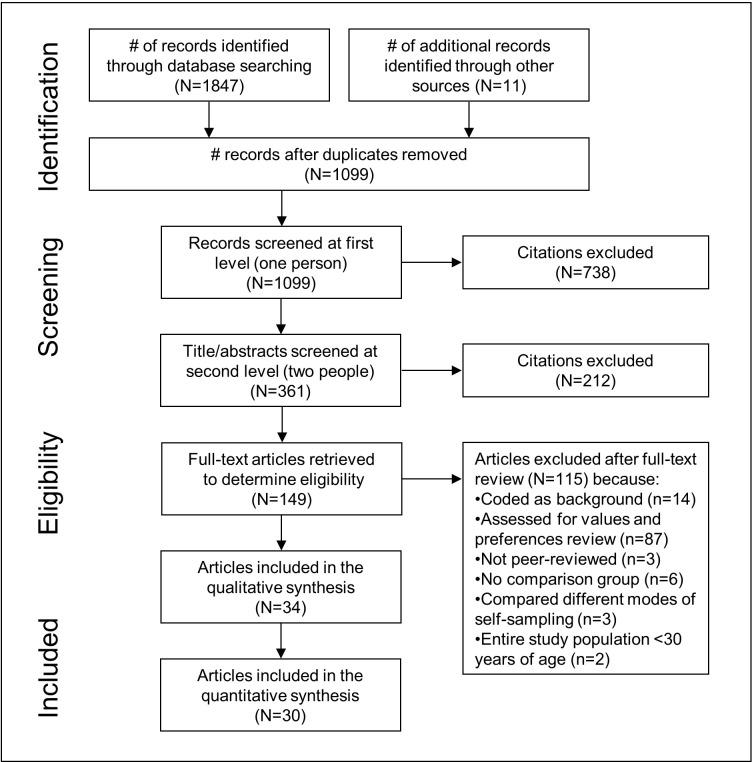
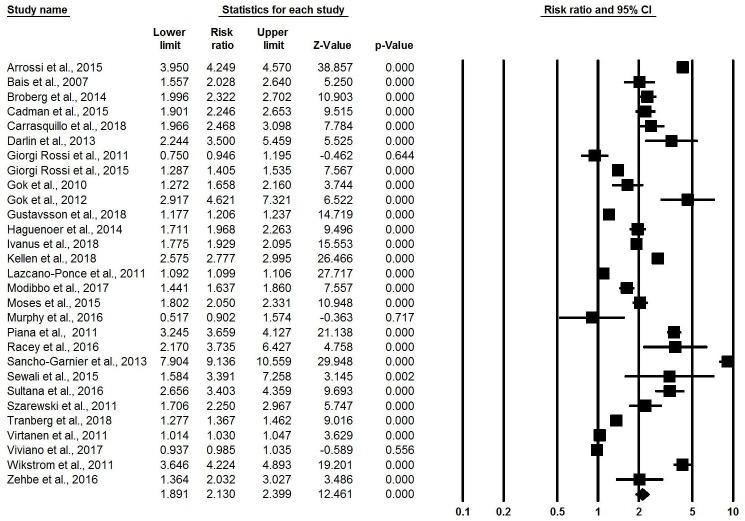
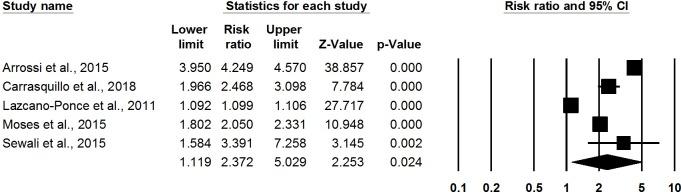
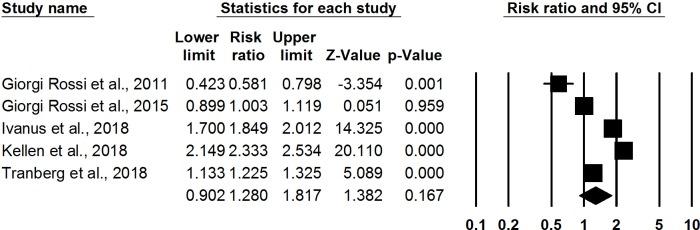
33 studies in 34 articles with 369 017 total participants met the inclusion criteria: 29 RCTs and 4 observational studies. All studies examined HPV self-sampling; comparison groups were standard of care (eg, Pap smear, visual inspection with acetic acid, clinician-collected HPV testing). 93% of participants were from high-income countries. All 33 studies measured cervical cancer screening uptake. Meta-analysis found greater screening uptake among HPV self-sampling participants compared with control (RR: 2.13, 95% CI 1.89 to 2.40). Effect size varied by HPV test kit dissemination method, whether mailed directly to home (RR: 2.27, 95% CI 1.89 to 2.71), offered door-to-door (RR: 2.37, 95% CI 1.12 to 5.03) or requested on demand (RR: 1.28, 95% CI 0.90 to 1.82). Meta-analysis showed no statistically significant difference in linkage to clinical assessment/treatment between arms (RR: 1.12, 95% CI 0.80 to 1.57). No studies measured screening frequency or social harms/adverse events.
CONCLUSION
A growing evidence base, mainly from high-income countries and with significant heterogeneity, suggests HPV self-sampling can increase cervical cancer screening uptake compared with standard of care, with a marginal effect on linkage to clinical assessment/treatment.
SYSTEMATIC REVIEW REGISTRATION NUMBER
PROSPERO CRD42018114871.
引言
人乳头瘤病毒(HPV)自检试剂盒可能会增加宫颈癌的筛查和早期检测,并减轻全球范围内的宫颈癌负担。为了为世界卫生组织的自我保健指南提供信息,我们对成年女性进行HPV自检用于宫颈癌(癌前)筛查接受率、筛查频率、社会危害/不良事件以及与临床评估/治疗的关联进行了系统评价和荟萃分析。
方法
纳入的研究将使用HPV自检进行宫颈癌筛查服务的女性与采用标准护理的女性进行比较,测量了至少一项结果,并发表在同行评审期刊上。我们检索了截至2018年10月的PubMed、护理及相关健康文献累积索引(CNIAHL)、拉丁美洲和加勒比健康科学文献(LILACS)以及Embase。使用Cochrane随机对照试验(RCT)工具和非随机研究的证据项目工具评估偏倚风险。采用随机效应模型进行荟萃分析,以生成相对风险(RR)的汇总估计值。
结果
34篇文章中的33项研究共369017名参与者符合纳入标准:29项RCT和4项观察性研究。所有研究均检测了HPV自检情况;对照组为标准护理(如巴氏涂片、醋酸目视检查、临床医生采集的HPV检测)。93%的参与者来自高收入国家。所有33项研究均测量了宫颈癌筛查接受率。荟萃分析发现,与对照组相比,HPV自检参与者的筛查接受率更高(RR:2.13,95%CI 1.89至2.40)。效应大小因HPV检测试剂盒的传播方式而异,直接邮寄到家(RR:2.27,95%CI 1.89至2.71)、挨家挨户提供(RR:2.37,95%CI 1.12至5.03)或按需索取(RR:1.28,95%CI 0.90至1.82)。荟萃分析显示,两组在与临床评估/治疗的关联方面无统计学显著差异(RR:1.12,95%CI 0.80至1.57)。没有研究测量筛查频率或社会危害/不良事件。
结论
越来越多的证据主要来自高收入国家且存在显著异质性,表明与标准护理相比,HPV自检可提高宫颈癌筛查接受率,对与临床评估/治疗的关联影响较小。
系统评价注册号
PROSPERO CRD42018114871。


 Zotero 插件