
缺氧时内皮型一氧化氮合酶的转录后和转录调控:微小RNA的作用
Posttranscriptional and transcriptional regulation of endothelial nitric-oxide synthase during hypoxia: the role of microRNAs.
作者信息
Kalinowski Leszek, Janaszak-Jasiecka Anna, Siekierzycka Anna, Bartoszewska Sylwia, Woźniak Marcin, Lejnowski Dawid, Collawn James F, Bartoszewski Rafal
机构信息
Department of Medical Laboratory Diagnostics and Central Bank of Frozen Tissues & Genetic Specimens, Medical University of Gdansk, Debinki 7, 80-211 Gdansk, Poland.
Department of Biology and Pharmaceutical Botany, Medical University of Gdansk, Hallera 107, 80-416 Gdansk, Poland.
出版信息
Cell Mol Biol Lett. 2016 Sep 6;21:16. doi: 10.1186/s11658-016-0017-x. eCollection 2016.
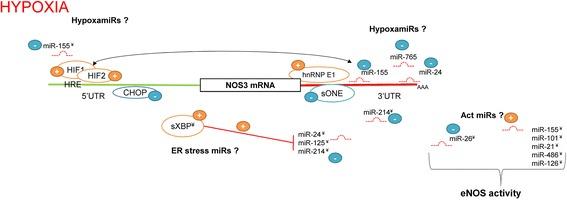
Understanding the cellular pathways that regulate endothelial nitric oxide (eNOS, ) expression and consequently nitric oxide (NO) bioavailability during hypoxia is a necessary aspect in the development of novel treatments for cardiovascular disorders. eNOS expression and eNOS-dependent NO cellular signaling during hypoxia promote an equilibrium of transcriptional and posttranscriptional molecular mechanisms that belong to both proapoptotic and survival pathways. Furthermore, NO bioavailability results not only from eNOS levels, but also relies on the presence of eNOS substrate and cofactors, the phosphorylation status of eNOS, and the presence of reactive oxygen species (ROS) that can inactivate eNOS. Since both levels and these signaling pathways can also be a subject of posttranscriptional modulation by microRNAs (miRNAs), this class of short noncoding RNAs contribute another level of regulation for NO bioavailability. As miRNA antagomirs or specific target protectors could be used in therapeutic approaches to regulate NO levels, either by changing mRNA stability or through factors governing eNOS activity, it is critical to understand their role in governing eNOS activity during hypoxa. In contrast to a large number of miRNAs reported to the change eNOS expression during hypoxia, only a few miRNAs modulate eNOS activity. Furthermore, impaired miRNA biogenesis leads to mRNA stabilization under hypoxia. Here we discuss the recent studies that define miRNAs' role in maintaining endothelial NO bioavailability emphasizing those miRNAs that directly modulate expression or eNOS activity.
了解在缺氧期间调节内皮型一氧化氮合酶(eNOS)表达并因此调节一氧化氮(NO)生物利用度的细胞途径,是开发心血管疾病新疗法的一个必要方面。缺氧期间eNOS表达和eNOS依赖的NO细胞信号传导促进了属于促凋亡和生存途径的转录和转录后分子机制的平衡。此外,NO生物利用度不仅取决于eNOS水平,还依赖于eNOS底物和辅因子的存在、eNOS的磷酸化状态以及可使eNOS失活的活性氧(ROS)的存在。由于这些水平和这些信号通路也可以是微小RNA(miRNA)转录后调节的对象,这类短的非编码RNA为NO生物利用度提供了另一层调节。由于miRNA拮抗剂或特异性靶标保护剂可用于通过改变mRNA稳定性或通过控制eNOS活性的因素来调节NO水平的治疗方法中,了解它们在缺氧期间控制eNOS活性中的作用至关重要。与大量报道的在缺氧期间改变eNOS表达的miRNA相反,只有少数miRNA调节eNOS活性。此外,受损的miRNA生物合成导致缺氧下mRNA的稳定。在这里,我们讨论了最近的研究,这些研究定义了miRNA在维持内皮NO生物利用度中的作用,重点是那些直接调节eNOS表达或eNOS活性的miRNA。

 Zotero 插件