
过氧化物酶体增殖物激活受体(PPAR)激动剂在体内激活乙型肝炎病毒复制。
Peroxisome Proliferators Activated Receptor (PPAR) agonists activate hepatitis B virus replication in vivo.
作者信息
Du Lingyao, Ma Yuanji, Liu Miao, Yan Libo, Tang Hong
机构信息
Center of Infectious Diseases, West China Hospital of Sichuan University, Chengdu, 610041, China.
出版信息
Virol J. 2017 May 25;14(1):96. doi: 10.1186/s12985-017-0765-x.
BACKGROUND
PPAR agonists are often used in HBV infected patients with metabolic disorders. However, as liver-enriched transcriptional factors, PPARs would activate HBV replication. Risks exsit in such patients. This study aimed to assess the influence of commonly used synthetic PPAR agonists on hepatitis B virus (HBV) transcription, replication and expression through HBV replicative mouse models, providing information for physicians to make necessary monitoring and therapeutic adjustment when HBV infected patients receive PPAR agonists treatment.
METHODS
The HBV replicative mouse model was established by hydrodynamic injection of HBV replicative plasmid and the mice were divided into four groups and treated daily for 3 days with saline, PPAR pan-agonist (bezafibrate), PPARα agonist (fenofibrate) and PPARγ agonist (rosiglitazone) respectively. Their serum samples were collected for ECLIA analysis of HBsAg and HBeAg and real-time PCR analysis of Serum HBV DNA. The liver samples were collected for DNA (Southern) filter hybridization of HBV replication intermediates, real-time PCR analysis of HBV mRNA and immunohistochemistry (IHC) analysis of hepatic HBcAg. The alternation of viral transcription, replication and expression were compared in these groups.
RESULT
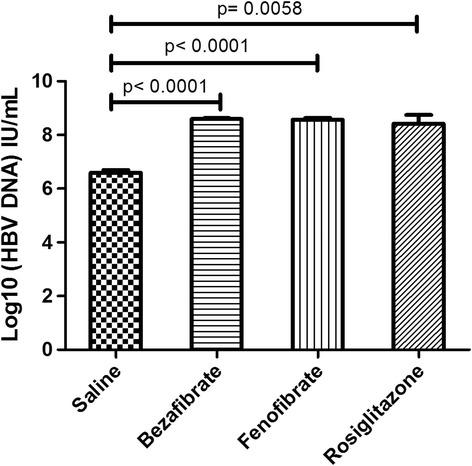
Serum HBsAg, HBeAg and HBV DNA were significantly elevated after PPAR agonist treatment. So did the viral replication intermediates in mouse livers. HBV mRNA was also significantly increased by these PPAR agonists, implying that PPAR agonists activate HBV replication at transcription level. Moreover, hepatic HBcAg expression in mouse livers with PPAR agonist treatment was elevated as well.
CONCLUSION
Our in vivo study proved that synthetic PPAR agonists bezafibrate, fenofibrate and rosiglitazone would increase HBV replication. It suggested that when HBV infected patients were treated with PPARs agonists because of metabolic diseases, HBV viral load should be monitored and regimens may need to be adjusted, an antiviral therapy may be added.
背景
PPAR激动剂常用于合并代谢紊乱的HBV感染患者。然而,作为肝脏富集转录因子,PPAR会激活HBV复制。这类患者存在风险。本研究旨在通过HBV复制小鼠模型评估常用合成PPAR激动剂对乙型肝炎病毒(HBV)转录、复制和表达的影响,为医生在HBV感染患者接受PPAR激动剂治疗时进行必要的监测和治疗调整提供信息。
方法
通过水动力注射HBV复制质粒建立HBV复制小鼠模型,将小鼠分为四组,分别用生理盐水、PPAR泛激动剂(苯扎贝特)、PPARα激动剂(非诺贝特)和PPARγ激动剂(罗格列酮)每日处理3天。收集它们的血清样本用于HBsAg和HBeAg的电化学发光免疫分析(ECLIA)以及血清HBV DNA的实时PCR分析。收集肝脏样本用于HBV复制中间体的DNA(Southern)滤膜杂交、HBV mRNA的实时PCR分析以及肝脏HBcAg的免疫组织化学(IHC)分析。比较这些组中病毒转录、复制和表达的变化。
结果
PPAR激动剂治疗后血清HBsAg、HBeAg和HBV DNA显著升高。小鼠肝脏中的病毒复制中间体也是如此。这些PPAR激动剂还显著增加了HBV mRNA,这意味着PPAR激动剂在转录水平激活HBV复制。此外,接受PPAR激动剂治疗的小鼠肝脏中肝HBcAg表达也升高。
结论
我们的体内研究证明,合成PPAR激动剂苯扎贝特、非诺贝特和罗格列酮会增加HBV复制。这表明,当HBV感染患者因代谢疾病接受PPAR激动剂治疗时,应监测HBV病毒载量,可能需要调整治疗方案,或许还应加用抗病毒治疗。




 Zotero 插件