
多模态神经影像学在创伤后应激障碍中的诊断潜力
Diagnostic potential of multimodal neuroimaging in posttraumatic stress disorder.
作者信息
Im Jooyeon Jamie, Kim Binna, Hwang Jaeuk, Kim Jieun E, Kim Jung Yoon, Rhie Sandy Jeong, Namgung Eun, Kang Ilhyang, Moon Sohyeon, Lyoo In Kyoon, Park Chang-Hyun, Yoon Sujung
机构信息
Ewha Brain Institute, Ewha Womans University, Seoul, South Korea.
Interdisciplinary Program in Neurosciences, College of Natural Sciences, Seoul National University, Seoul, South Korea.
出版信息
PLoS One. 2017 May 30;12(5):e0177847. doi: 10.1371/journal.pone.0177847. eCollection 2017.
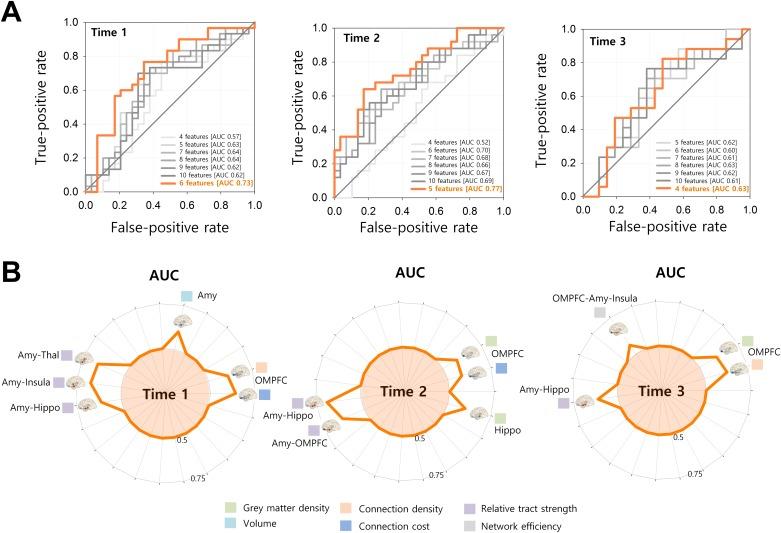
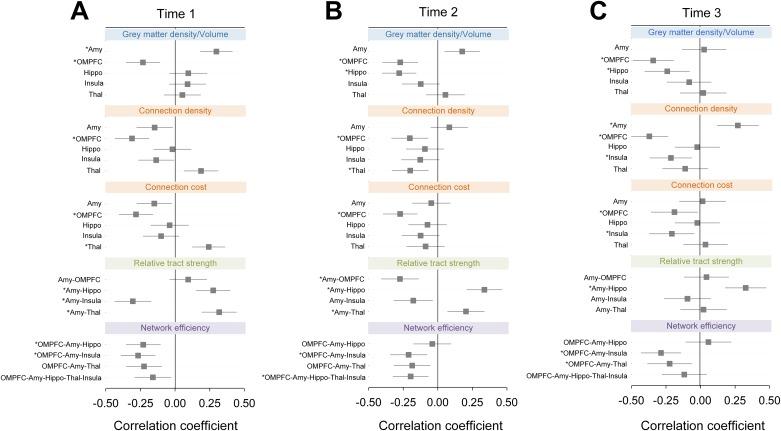
Despite accumulating evidence of physiological abnormalities related to posttraumatic stress disorder (PTSD), the current diagnostic criteria for PTSD still rely on clinical interviews. In this study, we investigated the diagnostic potential of multimodal neuroimaging for identifying posttraumatic symptom trajectory after trauma exposure. Thirty trauma-exposed individuals and 29 trauma-unexposed healthy individuals were followed up over a 5-year period. Three waves of assessments using multimodal neuroimaging, including structural magnetic resonance imaging (MRI) and diffusion-weighted MRI, were performed. Based on previous findings that the structural features of the fear circuitry-related brain regions may dynamically change during recovery from the trauma, we employed a machine learning approach to determine whether local, connectivity, and network features of brain regions of the fear circuitry including the amygdala, orbitofrontal and ventromedial prefrontal cortex (OMPFC), hippocampus, insula, and thalamus could distinguish trauma-exposed individuals from trauma-unexposed individuals at each recovery stage. Significant improvement in PTSD symptoms was observed in 23%, 52%, and 88% of trauma-exposed individuals at 1.43, 2.68, and 3.91 years after the trauma, respectively. The structural features of the amygdala were found as major classifiers for discriminating trauma-exposed individuals from trauma-unexposed individuals at 1.43 years after the trauma, but these features were nearly normalized at later phases when most of the trauma-exposed individuals showed clinical improvement in PTSD symptoms. Additionally, the structural features of the OMPFC showed consistent predictive values throughout the recovery period. In conclusion, the current study provides a promising step forward in the development of a clinically applicable predictive model for diagnosing PTSD and predicting recovery from PTSD.
尽管与创伤后应激障碍(PTSD)相关的生理异常证据不断积累,但目前PTSD的诊断标准仍依赖于临床访谈。在本研究中,我们调查了多模态神经成像在识别创伤暴露后创伤后症状轨迹方面的诊断潜力。30名创伤暴露个体和29名未暴露于创伤的健康个体在5年期间接受了随访。进行了三轮使用多模态神经成像的评估,包括结构磁共振成像(MRI)和扩散加权MRI。基于先前的研究结果,即与恐惧回路相关的脑区的结构特征在从创伤中恢复的过程中可能会动态变化,我们采用机器学习方法来确定恐惧回路脑区(包括杏仁核、眶额和腹内侧前额叶皮质(OMPFC)、海马体、岛叶和丘脑)的局部、连接性和网络特征是否能够在每个恢复阶段区分创伤暴露个体和未暴露个体。分别在创伤后1.43年、2.68年和3.91年,23%、52%和88%的创伤暴露个体的PTSD症状有显著改善。杏仁核的结构特征被发现是在创伤后1.43年区分创伤暴露个体和未暴露个体的主要分类器,但在后期阶段,当大多数创伤暴露个体的PTSD症状出现临床改善时,这些特征几乎恢复正常。此外,OMPFC的结构特征在整个恢复期间显示出一致的预测价值。总之,当前研究在开发用于诊断PTSD和预测从PTSD中恢复的临床适用预测模型方面向前迈出了有希望的一步。

 Zotero 插件