
葡萄膜黑色素瘤的系统基因组和转化效率研究
Systematic genomic and translational efficiency studies of uveal melanoma.
作者信息
Johnson Chelsea Place, Kim Ivana K, Esmaeli Bita, Amin-Mansour Ali, Treacy Daniel J, Carter Scott L, Hodis Eran, Wagle Nikhil, Seepo Sara, Yu Xiaoxing, Lane Anne Marie, Gragoudas Evangelos S, Vazquez Francisca, Nickerson Elizabeth, Cibulskis Kristian, McKenna Aaron, Gabriel Stacey B, Getz Gad, Van Allen Eliezer M, 't Hoen Peter A C, Garraway Levi A, Woodman Scott E
机构信息
Department of Medical Oncology, Dana-Farber Cancer Institute, Harvard Medical School, Boston, Massachusetts, United States of America.
The Broad Institute of Harvard and MIT, Cambridge, Massachusetts, United States of America.
出版信息
PLoS One. 2017 Jun 8;12(6):e0178189. doi: 10.1371/journal.pone.0178189. eCollection 2017.
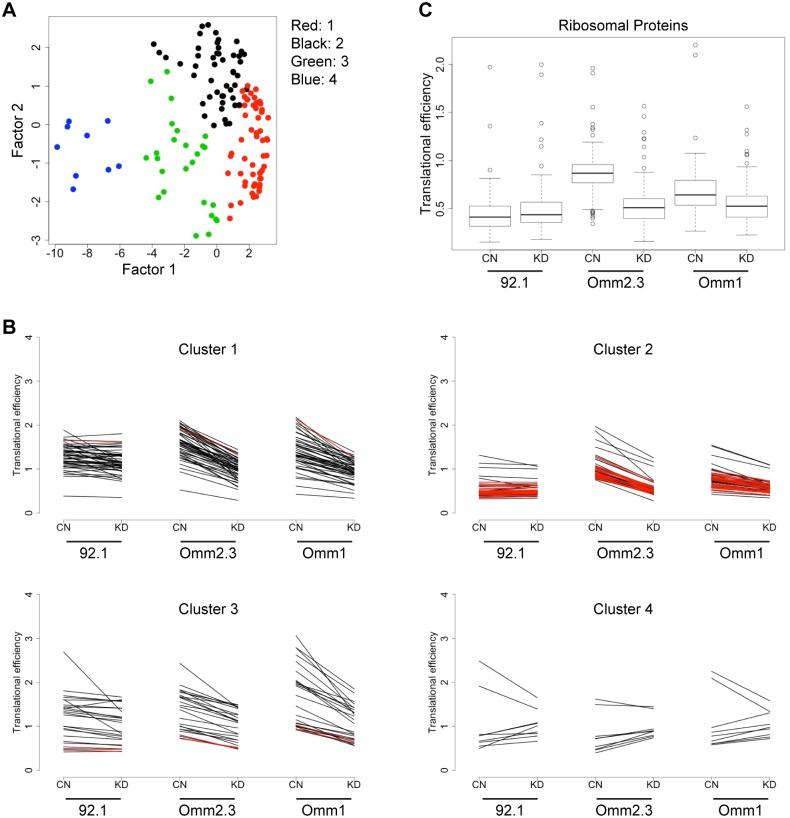
To further our understanding of the somatic genetic basis of uveal melanoma, we sequenced the protein-coding regions of 52 primary tumors and 3 liver metastases together with paired normal DNA. Known recurrent mutations were identified in GNAQ, GNA11, BAP1, EIF1AX, and SF3B1. The role of mutated EIF1AX was tested using loss of function approaches including viability and translational efficiency assays. Knockdown of both wild type and mutant EIF1AX was lethal to uveal melanoma cells. We probed the function of N-terminal tail EIF1AX mutations by performing RNA sequencing of polysome-associated transcripts in cells expressing endogenous wild type or mutant EIF1AX. Ribosome occupancy of the global translational apparatus was sensitive to suppression of wild type but not mutant EIF1AX. Together, these studies suggest that cells expressing mutant EIF1AX may exhibit aberrant translational regulation, which may provide clonal selective advantage in the subset of uveal melanoma that harbors this mutation.
为了进一步了解葡萄膜黑色素瘤的体细胞遗传基础,我们对52例原发性肿瘤和3例肝转移灶的蛋白质编码区以及配对的正常DNA进行了测序。在GNAQ、GNA11、BAP1、EIF1AX和SF3B1中鉴定出已知的复发性突变。使用包括活力和翻译效率测定在内的功能丧失方法测试了突变型EIF1AX的作用。敲低野生型和突变型EIF1AX对葡萄膜黑色素瘤细胞均具有致死性。我们通过对表达内源性野生型或突变型EIF1AX的细胞中多聚体相关转录本进行RNA测序,探究了N端尾部EIF1AX突变的功能。整体翻译装置的核糖体占有率对野生型EIF1AX的抑制敏感,但对突变型EIF1AX不敏感。这些研究共同表明,表达突变型EIF1AX的细胞可能表现出异常的翻译调控,这可能在携带该突变的葡萄膜黑色素瘤亚群中提供克隆选择优势。


 Zotero 插件