
地中海饮食与应激范式内的炎症衰老。
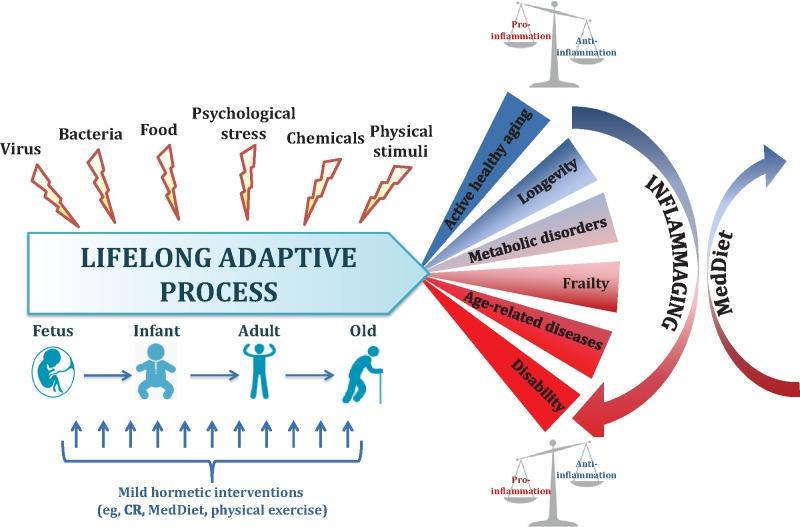
Mediterranean diet and inflammaging within the hormesis paradigm.
机构信息
Department of Experimental, Diagnostic and Specialty Medicine (DIMES), University of Bologna, Bologna, Italy.
Interdepartmental Center "L. Galvani" (CIG), University of Bologna, Bologna, Italy.
出版信息
Nutr Rev. 2017 Jun 1;75(6):442-455. doi: 10.1093/nutrit/nux013.
A coherent set of epidemiological data shows that the Mediterranean diet has beneficial effects capable of preventing a variety of age-related diseases in which low-grade, chronic inflammation/inflammaging plays a major role, but the underpinning mechanism(s) is/are still unclear. It is suggested here that the Mediterranean diet can be conceptualized as a form of chronic hormetic stress, similar to what has been proposed regarding calorie restriction, the most thoroughly studied nutritional intervention. Data on the presence in key Mediterranean foods of a variety of compounds capable of exerting hormetic effects are summarized, and the mechanistic role of the nuclear factor erythroid 2 pathway is highlighted. Within this conceptual framework, particular attention has been devoted to the neurohormetic and neuroprotective properties of the Mediterranean diet, as well as to its ability to maintain an optimal balance between pro- and anti-inflammaging. Finally, the European Commission-funded project NU-AGE is discussed because it addresses a number of variables not commonly taken into consideration, such as age, sex, and ethnicity/genetics, that can modulate the hormetic effect of the Mediterranean diet.
一系列连贯的流行病学数据表明,地中海饮食具有有益的作用,可以预防多种与年龄相关的疾病,而这些疾病的主要作用机制是低度、慢性炎症/衰老。这里提出的观点是,地中海饮食可以被视为一种慢性应激,类似于关于热量限制的观点,这是最深入研究的营养干预措施。本文总结了在地中海饮食的关键食物中存在的各种能够发挥应激作用的化合物,并强调了核因子红细胞 2 途径的机制作用。在这个概念框架内,特别关注了地中海饮食的神经应激和神经保护特性,以及它维持促炎和抗炎之间最佳平衡的能力。最后,讨论了欧盟委员会资助的 NU-AGE 项目,因为它涉及到一些通常不被考虑的变量,如年龄、性别和种族/遗传,这些变量可以调节地中海饮食的应激作用。



 Zotero 插件