
癌症与衰老中端粒损耗的综述:当前的分子见解及未来的治疗方法
A Review of Telomere Attrition in Cancer and Aging: Current Molecular Insights and Future Therapeutic Approaches.
作者信息
Iskandar Mina, Xiao Barbero Miguel, Jaber Muhamed, Chen Roy, Gomez-Guevara Romulo, Cruz Edwin, Westerheide Sandy
机构信息
Department of Molecular Biosciences, University of South Florida, 4202 East Fowler Avenue, ISA2015, Tampa, FL 33620, USA.
出版信息
Cancers (Basel). 2025 Jan 14;17(2):257. doi: 10.3390/cancers17020257.
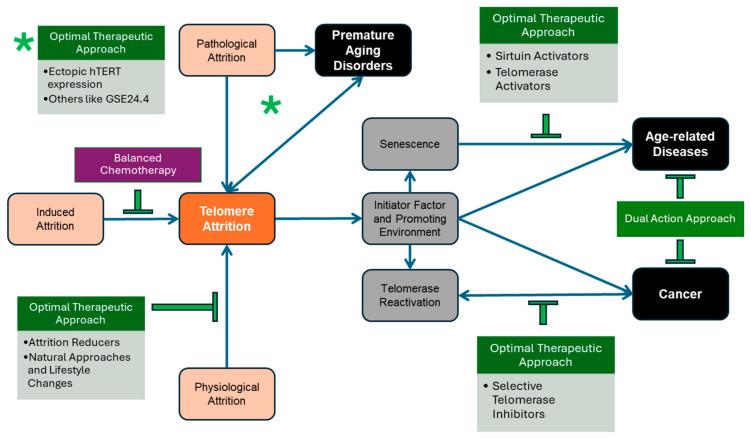
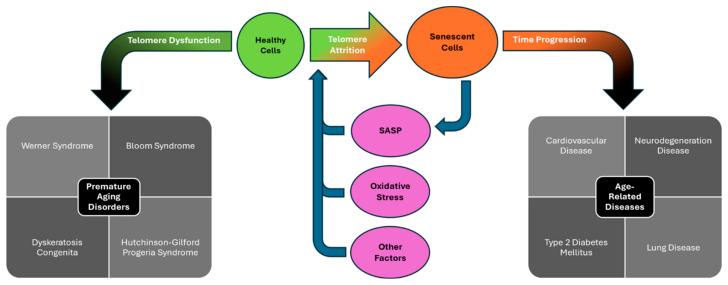
BACKGROUND/OBJECTIVES: As cells divide, telomeres shorten through a phenomenon known as telomere attrition, which leads to unavoidable senescence of cells. Unprotected DNA exponentially increases the odds of mutations, which can evolve into premature aging disorders and tumorigenesis. There has been growing academic and clinical interest in exploring this duality and developing optimal therapeutic strategies to combat telomere attrition in aging and cellular immortality in cancer. The purpose of this review is to provide an updated overview of telomere biology and therapeutic tactics to address aging and cancer.
METHODS
We used the Rayyan platform to review the PubMed database and examined the ClinicalTrial.gov registry to gain insight into clinical trials and their results.
RESULTS
Cancer cells activate telomerase or utilize alternative lengthening of telomeres to escape telomere shortening, leading to near immortality. Contrarily, normal cells experience telomeric erosion, contributing to premature aging disorders, such as Werner syndrome and Hutchinson-Gilford Progeria, and (2) aging-related diseases, such as neurodegenerative and cardiovascular diseases.
CONCLUSIONS
The literature presents several promising therapeutic approaches to potentially balance telomere maintenance in aging and shortening in cancer. This review highlights gaps in knowledge and points to the potential of these optimal interventions in preclinical and clinical studies to inform future research in cancer and aging.
背景/目的:随着细胞分裂,端粒通过一种称为端粒损耗的现象缩短,这会导致细胞不可避免地衰老。未受保护的DNA会使突变几率呈指数级增加,进而可能演变成早衰症和肿瘤发生。学术界和临床界对探索这种双重性以及制定最佳治疗策略以对抗衰老过程中的端粒损耗和癌症中的细胞永生的兴趣与日俱增。本综述的目的是提供端粒生物学以及应对衰老和癌症的治疗策略的最新概述。
方法
我们使用Rayyan平台检索了PubMed数据库,并查阅了ClinicalTrial.gov登记处,以深入了解临床试验及其结果。
结果
癌细胞激活端粒酶或利用端粒的替代延长机制来逃避端粒缩短,从而实现近乎永生。相反,正常细胞会经历端粒侵蚀,这会导致早衰症,如沃纳综合征和哈钦森-吉尔福德早衰症,以及(2)与衰老相关的疾病,如神经退行性疾病和心血管疾病。
结论
文献提出了几种有前景的治疗方法,有可能平衡衰老中端粒的维持和癌症中端粒的缩短。本综述强调了知识空白,并指出了这些最佳干预措施在临床前和临床研究中的潜力,以为未来癌症和衰老研究提供参考。


 Zotero 插件