
索拉非尼治疗日本局部晚期或转移性甲状腺髓样癌和间变性甲状腺癌患者。
Sorafenib in Japanese Patients with Locally Advanced or Metastatic Medullary Thyroid Carcinoma and Anaplastic Thyroid Carcinoma.
机构信息
1 Clinical Trial Management Center , Kuma Hospital, Kobe, Japan .
2 Department of Surgical Oncology, Osaka City University Graduate School of Medicine , Osaka, Japan .
出版信息
Thyroid. 2017 Sep;27(9):1142-1148. doi: 10.1089/thy.2016.0621. Epub 2017 Jul 24.
BACKGROUND
Therapeutic options for treating advanced or metastatic medullary thyroid carcinoma (MTC) and anaplastic thyroid carcinoma (ATC) are still limited in Japan, even though vandetanib for MTC and lenvatinib for MTC and ATC have been approved. Sorafenib is an oral multikinase inhibitor approved for the treatment of patients with radioactive iodine-refractory differentiated thyroid cancer (DTC). An uncontrolled, open-label, multicenter, single-arm, Phase 2 clinical study was conducted to evaluate the safety and efficacy of sorafenib in Japanese patients with MTC and ATC.
METHODS
Japanese patients with histologically confirmed ATC and locally advanced or metastatic MTC were enrolled from April to September 2014. The primary endpoint was to evaluate the safety of sorafenib. Treatment efficacy variables including progression-free survival (PFS), overall survival (OS), objective response rate (ORR), disease control rate (DCR), and maximum reduction in tumor size were evaluated as secondary endpoints. Patients received sorafenib 400 mg orally twice daily on a continuous basis and then continued treatment until the occurrence of disease progression, unacceptable toxicity, or withdrawal of consent.
RESULTS
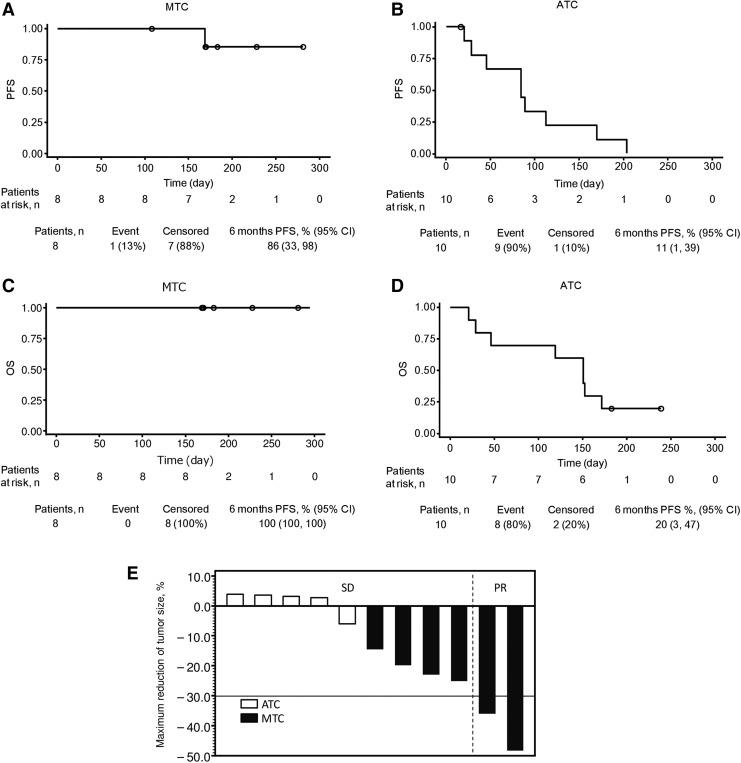
A total of 20 patients were screened, and 18 (8 with MTC and 10 with ATC) were enrolled. The most common drug-related adverse events were palmar-plantar erythrodysesthesia (72%), alopecia (56%), hypertension (56%), and diarrhea (44%). In the ATC patients, median PFS was 2.8 months [confidence interval 0.7-5.6], and median OS was 5.0 months [confidence interval 0.7-5.7]; ORR and DCR were 0% and 40%, respectively. In the MTC population, neither median PFS nor OS had been reached at the time of this analysis; ORR was 25% and DCR was 75%.
CONCLUSIONS
The toxicities reported in this study were consistent with the known safety profile of sorafenib. Sorafenib seems to be effective in the treatment of advanced MTC but not ATC, and could be a new treatment option for locally advanced or metastatic MTC and radioactive iodine-refractory DTC.
背景
在日本,治疗晚期或转移性甲状腺髓样癌(MTC)和间变性甲状腺癌(ATC)的治疗选择仍然有限,尽管已经批准了凡德他尼治疗 MTC 和仑伐替尼治疗 MTC 和 ATC。索拉非尼是一种口服多激酶抑制剂,被批准用于治疗放射性碘难治性分化型甲状腺癌(DTC)患者。一项非对照、开放标签、多中心、单臂、II 期临床研究评估了索拉非尼在日本 MTC 和 ATC 患者中的安全性和疗效。
方法
2014 年 4 月至 9 月期间,入组了经组织学证实的 ATC 和局部晚期或转移性 MTC 的日本患者。主要终点是评估索拉非尼的安全性。无进展生存期(PFS)、总生存期(OS)、客观缓解率(ORR)、疾病控制率(DCR)和肿瘤最大缩小率等治疗效果变量被评估为次要终点。患者接受索拉非尼 400mg 口服,每日两次,连续给药,直至疾病进展、无法耐受的毒性或撤回同意。
结果
共筛选了 20 例患者,其中 18 例(8 例 MTC,10 例 ATC)入组。最常见的药物相关不良事件为掌跖红斑感觉迟钝(72%)、脱发(56%)、高血压(56%)和腹泻(44%)。在 ATC 患者中,中位 PFS 为 2.8 个月(95%CI 0.7-5.6),中位 OS 为 5.0 个月(95%CI 0.7-5.7);ORR 和 DCR 分别为 0%和 40%。在 MTC 人群中,分析时中位 PFS 和 OS 均未达到;ORR 为 25%,DCR 为 75%。
结论
本研究报告的毒性与索拉非尼已知的安全性特征一致。索拉非尼似乎对晚期 MTC 有效,但对 ATC 无效,可能成为局部晚期或转移性 MTC 和放射性碘难治性 DTC 的新治疗选择。
 Zotero 插件