
采用多参数流式细胞术检测,单倍体同种异体移植优于匹配的同胞供体移植,可根除 AML 患者移植前微小残留病:回顾性和前瞻性分析。
Haploidentical allograft is superior to matched sibling donor allograft in eradicating pre-transplantation minimal residual disease of AML patients as determined by multiparameter flow cytometry: a retrospective and prospective analysis.
机构信息
Beijing Key Laboratory of Hematopoietic Stem Cell Transplantation, Peking University People's Hospital & Peking University Institute of Hematology, No. 11 South Street of Xizhimen, Xicheng District, Beijing, 100044, People's Republic of China.
Peking-Tsinghua Center for Life Sciences, Beijing, 100871, China.
出版信息
J Hematol Oncol. 2017 Jul 4;10(1):134. doi: 10.1186/s13045-017-0502-3.
BACKGROUND
This study compared the effects of pre-transplantation minimal residual disease (pre-MRD) on outcomes in AML patients who underwent human leukocyte antigen-matched sibling donor transplantation (MSDT) or who received unmanipulated haploidentical allografts.
METHODS
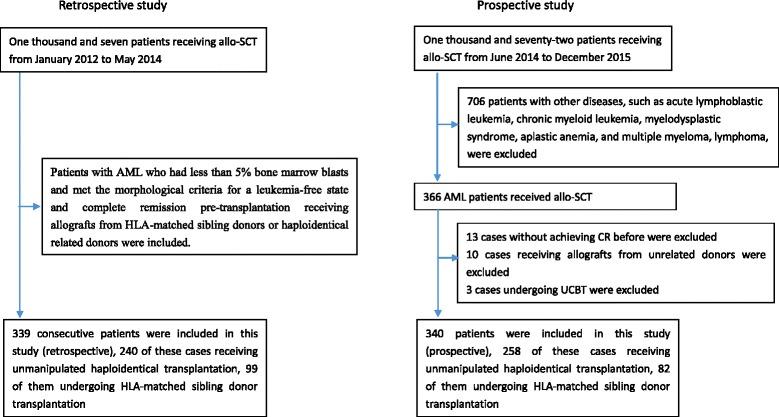
A retrospective study (n = 339) and a prospective study (n = 340) were performed. MRD was determined using multiparameter flow cytometry.
RESULTS
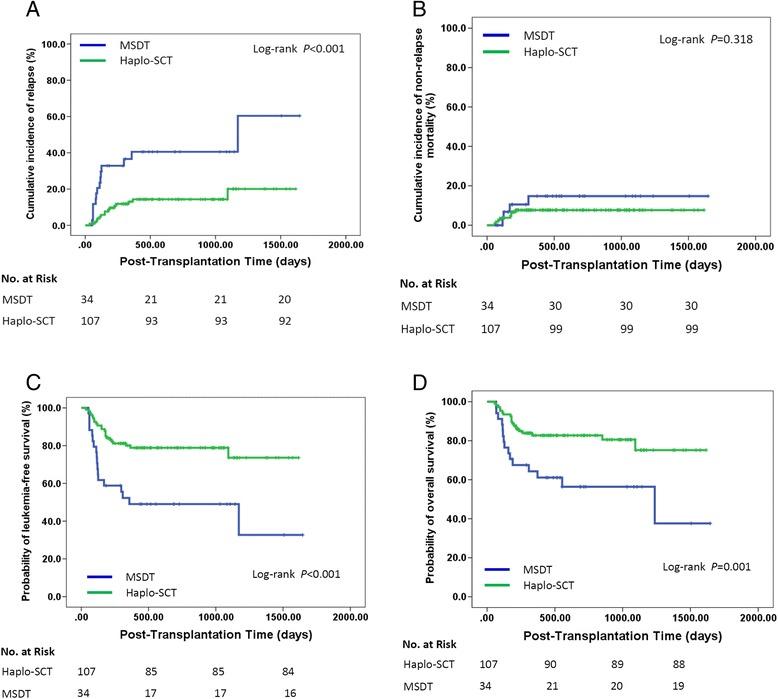
Either after retrospective or prospective analysis, patients with negative pre-MRD (pre-MRDneg) had a lower incidence of relapse than those with positive pre-MRD (pre-MRDpos) in MSDT settings (P < 0.001 for all), but relapse was comparable in Haplo-SCT settings for patients with pre-MRDneg versus pre-MRDpos (P = 0.866 and 0.161, respectively). In either the retrospective (n = 65) or the prospective study (n = 76), pre-MRDpos subjects receiving Haplo-SCT experienced a lower incidence of relapse than those who underwent MSDT (P < 0.001 and p = 0.017, respectively). Of the patients with pre-MRDpos in either the total (n = 141) or the subgroup excluding cases which received donor lymphocyte infusion (DLI; n = 105), those who underwent MSDT had a higher incidence of relapse than those receiving haplo-SCT (P < 0.01 for all). Multivariate analysis showed that, for pre-MRDpos cases, haplo-SCT was associated with a low incidence of relapse and with better LFS and OS in either retrospective group, prospective group, combination groups, or subgroup not including cases which received DLI.
CONCLUSIONS
The results indicated that, for pre-MRD-positive AML patients, haplo-SCT was associated with lower incidence of relapse and better survival, suggesting a stronger anti-leukemia effect.
背景
本研究比较了在接受人类白细胞抗原匹配的同胞供者移植(MSDT)或接受未经处理的单倍体相合同种异体移植的 AML 患者中,移植前微小残留病(pre-MRD)对结局的影响。
方法
进行了回顾性研究(n=339)和前瞻性研究(n=340)。采用多参数流式细胞术检测 MRD。
结果
在 MSDT 环境中,无论是回顾性分析还是前瞻性分析,pre-MRD 阴性(pre-MRDneg)患者的复发率均低于 pre-MRD 阳性(pre-MRDpos)患者(所有 P<0.001),但在 Haplo-SCT 环境中,pre-MRDneg 与 pre-MRDpos 患者的复发率相当(分别为 P=0.866 和 0.161)。在回顾性研究(n=65)或前瞻性研究(n=76)中,接受 Haplo-SCT 的 pre-MRDpos 患者的复发率均低于接受 MSDT 的患者(分别为 P<0.001 和 P=0.017)。在总病例(n=141)或排除接受供者淋巴细胞输注(DLI)病例的亚组(n=105)中,pre-MRDpos 患者中,接受 MSDT 的患者的复发率高于接受 Haplo-SCT 的患者(所有 P<0.01)。多变量分析表明,对于 pre-MRDpos 病例,Haplo-SCT 与较低的复发率和较好的 LFS 和 OS 相关,无论是在回顾性组、前瞻性组、联合组还是不包括接受 DLI 病例的亚组中。
结论
这些结果表明,对于 pre-MRD 阳性的 AML 患者,Haplo-SCT 与较低的复发率和较好的生存相关,提示其具有更强的抗白血病效应。
 Zotero 插件