
阴离子封端的金属主体允许非常缓慢的客体摄取,并按需加速客体交换。
Anion-capped metallohost allows extremely slow guest uptake and on-demand acceleration of guest exchange.
机构信息
Graduate School of Natural Science and Technology, Kanazawa University, Kakuma-machi, Kanazawa 920-1192, Japan.
出版信息
Nat Commun. 2017 Jul 12;8:16005. doi: 10.1038/ncomms16005.
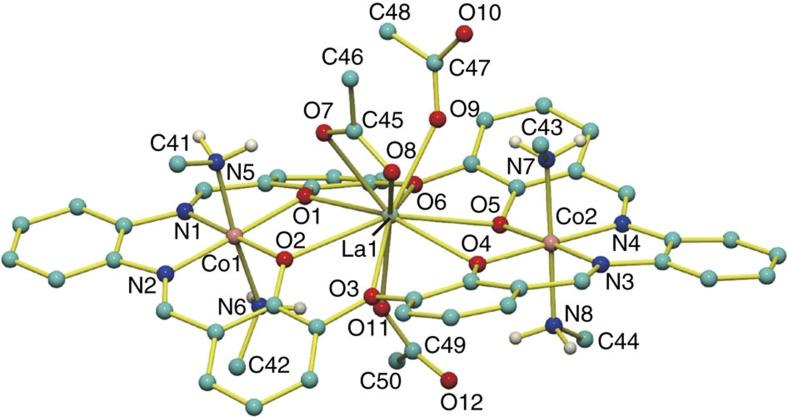
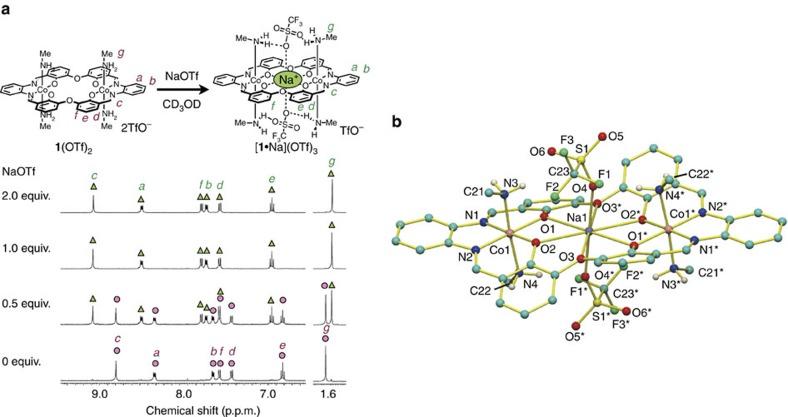
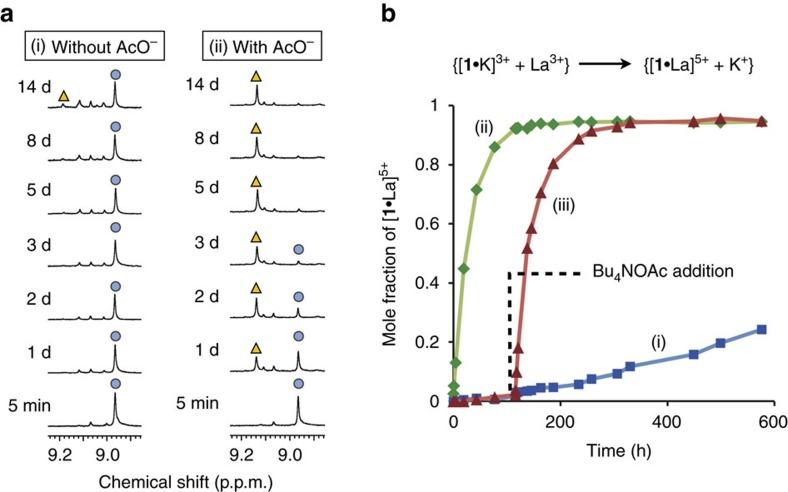
The switching of molecular recognition selectivity is important for tuning molecular functions based on host-guest binding. While the switching processes in artificial functional molecules are usually driven by changes of the thermodynamic stabilities, non-equilibrium phenomena also play an important role in biological systems. Thus, here we designed a host-guest system utilizing a non-equilibrium kinetically trapped state for on-demand and time-programmable control of molecular functions. We synthesized a bis(saloph) macrocyclic cobalt(III) metallohost 1(OTf), which has anion caps at both sides of the cation-binding site. The anion caps effectively retard the guest uptake/release so that we can easily make a non-equilibrium kinetically trapped state. Indeed, we can obtain a long-lived kinetically trapped state {[1·K]+La} prior to the formation of the thermodynamically more stable state {[1·La]+K}. The guest exchange to the more stable state from this kinetically trapped state is significantly accelerated by exchange of TfO anion caps by AcO in an on-demand manner.
分子识别选择性的切换对于基于主体-客体结合来调整分子功能非常重要。虽然人工功能分子中的切换过程通常是由热力学稳定性的变化驱动的,但非平衡现象在生物系统中也起着重要作用。因此,我们在这里设计了一个利用非平衡动力学捕获态的主客体体系,用于按需和时间可编程控制分子功能。我们合成了一种双(水杨醛缩乙二胺)大环钴(III)金属主体 1(OTf),其阳离子结合位点的两侧都有阴离子帽。阴离子帽有效地阻碍了客体的吸收/释放,因此我们可以很容易地形成非平衡动力学捕获态。事实上,我们可以获得一个长寿命的动力学捕获态{[1·K]+La},然后再形成热力学上更稳定的状态{[1·La]+K}。通过以按需的方式用 AcO 交换 TfO 阴离子帽,从动力学捕获态到更稳定状态的客体交换会显著加速。


 Zotero 插件