
因百日咳博德特氏菌感染而住院的婴儿通常会发生呼吸道病毒合并感染。
Infants hospitalized for Bordetella pertussis infection commonly have respiratory viral coinfections.
作者信息
Frassanito A, Nenna R, Nicolai A, Pierangeli A, Tozzi A E, Stefanelli P, Carsetti R, Concato C, Schiavoni I, Midulla F
机构信息
Department of Pediatrics, "Sapienza" University of Rome, V.le Regina Elena 324, 00161, Rome, Italy.
Molecular Medicine Department, "Sapienza" University of Rome, Rome, Italy.
出版信息
BMC Infect Dis. 2017 Jul 12;17(1):492. doi: 10.1186/s12879-017-2567-6.
BACKGROUND
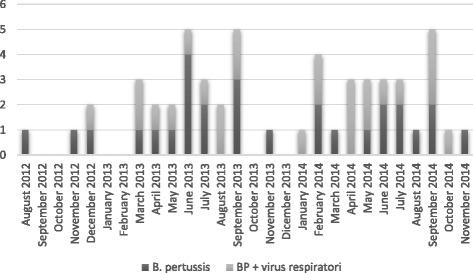
Whether viral coinfections cause more severe disease than Bordetella pertussis (B. pertussis) alone remains unclear. We compared clinical disease severity and sought clinical and demographic differences between infants with B. pertussis infection alone and those with respiratory viral coinfections. We also analyzed how respiratory infections were distributed during the 2 years study.
METHODS
We enrolled 53 infants with pertussis younger than 180 days (median age 58 days, range 17–109 days, 64. 1% boys), hospitalized in the Pediatric Departments at “Sapienza” University Rome and Bambino Gesù Children’s Hospital from August 2012 to November 2014. We tested in naso-pharyngeal washings B. pertussis and 14 respiratory viruses with real-time reverse-transcriptase-polymerase chain reaction. Clinical data were obtained from hospital records and demographic characteristics collected using a structured questionnaire.
RESULTS
28/53 infants had B. pertussis alone and 25 viral coinfection: 10 human rhinovirus (9 alone and 1 in coinfection with parainfluenza virus), 3 human coronavirus, 2 respiratory syncytial virus. No differences were observed in clinical disease severity between infants with B. pertussis infection alone and those with coinfections. Infants with B. pertussis alone were younger than infants with coinfections, and less often breastfeed at admission.
CONCLUSIONS
In this descriptive study, no associations between clinical severity and pertussis with or without co-infections were found.
TRIAL REGISTRATION
Policlinico Umberto I: protocol 213/14, 3085/13.02.2014, retrospectively registered. Bambino Gesù Children’s Hospital: protocol n. RF-2010-2317709.
背景
病毒合并感染是否会导致比单纯百日咳博德特氏菌(B. pertussis)感染更严重的疾病仍不清楚。我们比较了临床疾病的严重程度,并寻找单纯感染B. pertussis的婴儿与合并呼吸道病毒感染的婴儿之间的临床和人口统计学差异。我们还分析了在为期两年的研究中呼吸道感染是如何分布的。
方法
我们纳入了53名年龄小于180天的百日咳婴儿(中位年龄58天,范围17 - 109天,64.1%为男孩),这些婴儿于2012年8月至2014年11月在罗马“萨皮恩扎”大学儿科和 Bambino Gesù儿童医院住院。我们通过实时逆转录 - 聚合酶链反应在鼻咽冲洗液中检测B. pertussis和14种呼吸道病毒。临床数据来自医院记录,人口统计学特征通过结构化问卷收集。
结果
53名婴儿中,28名仅感染B. pertussis,25名合并病毒感染:10名感染人鼻病毒(9名单独感染,1名与副流感病毒合并感染),3名感染人冠状病毒,2名感染呼吸道合胞病毒。单纯感染B. pertussis的婴儿与合并感染的婴儿在临床疾病严重程度上未观察到差异。单纯感染B. pertussis的婴儿比合并感染的婴儿年龄更小,入院时母乳喂养的频率更低。
结论
在这项描述性研究中,未发现临床严重程度与百日咳合并或不合并感染之间存在关联。
试验注册
翁贝托一世综合医院:方案213/14,3085/13.02.2014,回顾性注册。Bambino Gesù儿童医院:方案编号RF - 2010 - 2317709。
 Zotero 插件