
中国西部未接种疫苗的急性百日咳婴儿的合并感染(2018 - 2019年):病原体分布及对疾病严重程度的影响
Co-infection in unvaccinated infants with acute pertussis in Western China (2018-2019): pathogen distribution and impact on disease severity.
作者信息
Gan Chuan, Wu Yuanyuan
机构信息
Department of Infectious Diseases, Children's Hospital of Chongqing Medical University, National Clinical Research Center for Child Health and Disorders, Ministry of Education Key Laboratory of Child Development and Disorders,Chongqing Key Laboratory of Child Rare Diseases in Infection and Immunity, The First Batch of Key Disciplines On Public Health in Chongqing, Chongqing, 400014, China.
Health Medicine Center, The Second Affiliated Hospital of Chongqing Medical University, Chongqing Medical University, 76 Linjiang Road, Yuzhong District, Chongqing, 400010, China.
出版信息
Ital J Pediatr. 2025 Apr 9;51(1):111. doi: 10.1186/s13052-025-01949-1.
BACKGROUND
Co-infections in pertussis patients are common, but there has been limited research on the distribution of co-infecting pathogens and their impact on disease severity in infant patients remaining unvaccinated against pertussis. This study aims to investigate the pathogen distribution in unvaccinated infants with acute pertussis and explore how the number and type of co-infecting pathogens influence disease severity.
METHOD
This cross-sectional study analyzed clinical data from 302 unvaccinated infants diagnosed with acute pertussis in western China. We compared clinical variables across different co-infection groups (bacteria, viruses, bacterial-viral combinations) and by the number of co-infecting pathogens (0, 1, ≥ 2).
RESULTS
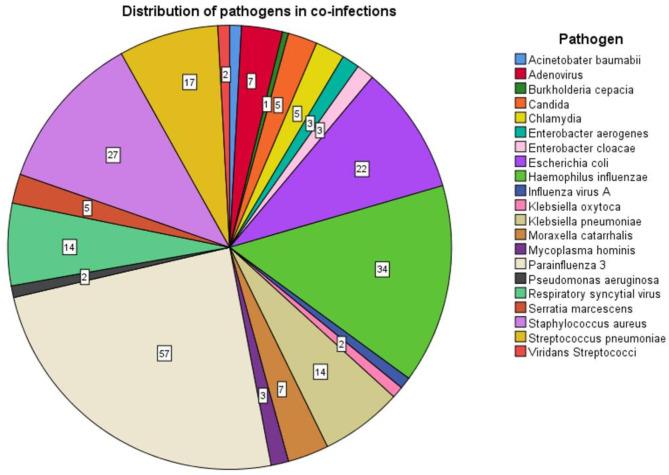
Of the 302 patients, 121 (40.1%) were infected solely with Bordetella pertussis, while 181 (59.9%) had co-infections with other pathogens. The most common co-infections were bacterial (93 of 139 cases), particularly Gram-negative bacteria, followed by viral co-infections, mainly parainfluenza virus type-3 (PIV-3), in 71.3% of viral cases. The number of co-infecting pathogens was positively associated with longer hospital stays, more severe pneumonia, and higher incidence of respiratory failure (P < 0.05). Notably, bacterial co-infections were associated with more severe clinical outcomes than viral co-infections, with significant differences in hospitalization duration, as well as in peak white blood cell and lymphocyte counts (P < 0.05). No significant differences were observed in co-infection types or pathogen numbers across different age groups.
CONCLUSION
Co-infections are prevalent among unvaccinated infants with acute pertussis in western China. Bacterial and viral pathogens are the most common co-infecting agents, and disease severity increases with the number of co-infecting pathogens. Bacterial co-infections may lead to more severe outcomes compared to viral co-infections, underscoring the need for targeted diagnostic and therapeutic strategies.
背景
百日咳患者合并感染很常见,但关于未接种百日咳疫苗的婴儿患者中合并感染病原体的分布及其对疾病严重程度的影响的研究有限。本研究旨在调查未接种疫苗的急性百日咳婴儿的病原体分布,并探讨合并感染病原体的数量和类型如何影响疾病严重程度。
方法
这项横断面研究分析了中国西部302例诊断为急性百日咳的未接种疫苗婴儿的临床数据。我们比较了不同合并感染组(细菌、病毒、细菌-病毒组合)以及合并感染病原体数量(0、1、≥2)之间的临床变量。
结果
在302例患者中,121例(40.1%)仅感染百日咳博德特氏菌,而181例(59.9%)合并感染其他病原体。最常见的合并感染是细菌感染(139例中的93例),尤其是革兰氏阴性菌,其次是病毒合并感染,主要是3型副流感病毒(PIV-3),在71.3%的病毒感染病例中出现。合并感染病原体的数量与住院时间延长、肺炎更严重以及呼吸衰竭发生率更高呈正相关(P<0.05)。值得注意的是,细菌合并感染比病毒合并感染导致更严重的临床结局,在住院时间以及白细胞和淋巴细胞计数峰值方面存在显著差异(P<0.05)。不同年龄组在合并感染类型或病原体数量方面未观察到显著差异。
结论
在中国西部未接种疫苗的急性百日咳婴儿中,合并感染很普遍。细菌和病毒病原体是最常见的合并感染病原体,疾病严重程度随着合并感染病原体数量的增加而增加。与病毒合并感染相比,细菌合并感染可能导致更严重的结局,这突出了针对性诊断和治疗策略的必要性。
 Zotero 插件