
通过在线测定摇瓶中粘度和氧传递速率研究聚(γ-谷氨酸)的生产
Investigation of poly(γ-glutamic acid) production via online determination of viscosity and oxygen transfer rate in shake flasks.
作者信息
Regestein Née Meissner Lena, Arndt Julia, Palmen Thomas G, Jestel Tim, Mitsunaga Hitoshi, Fukusaki Eiichiro, Büchs Jochen
机构信息
AVT - Biochemical Engineering, RWTH Aachen University, Forckenbeckstr. 51, 52074 Aachen, Germany.
AVT - Enzyme Process Technology, RWTH Aachen University, Forckenbeckstr. 51, 52074 Aachen, Germany.
出版信息
J Biol Eng. 2017 Jul 12;11:23. doi: 10.1186/s13036-017-0065-4. eCollection 2017.
BACKGROUND
Poly(γ-glutamic acid) (γ-PGA) is a biopolymer with many useful properties making it applicable for instance in food and skin care industries, in wastewater treatment, in biodegradable plastics or in the pharmaceutical industry. γ-PGA is usually produced microbially by different spp. The produced γ-PGA increases the viscosity of the fermentation broth. In case of shake flask fermentations, this results in an increase of the volumetric power input. The power input in shake flasks can be determined by measuring the torque of an orbitally rotating lab shaker. The online measurement of the volumetric power input enables to continuously monitor the formation or degradation of viscous products like γ-PGA. Combined with the online measurement of the oxygen transfer rate (OTR), the respiration activity of the organisms can be observed at the same time.
RESULTS
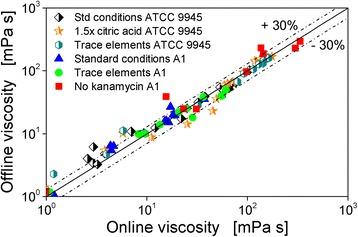
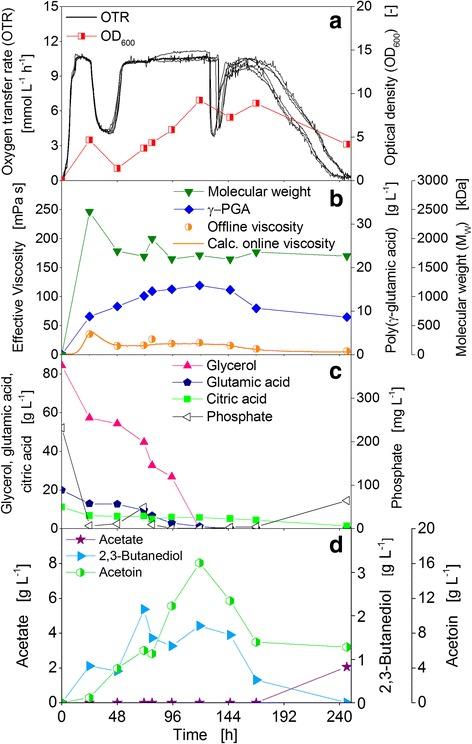
Two different strains and three medium compositions were investigated using online volumetric power input and OTR measurements as well as thorough offline analysis. The online volumetric power input measurement clearly depicted changes in γ-PGA formation due to different medium compositions as well as differences in the production behavior of the two investigated strains. A higher citric acid concentration and the addition of trace elements to the standard medium showed a positive influence on γ-PGA production. The online power input signal was used to derive an online viscosity signal which was validated with offline determined viscosity values. The online measurement of the OTR proved to be a valuable tool to follow the respiration activity of the cultivated strains and to determine its reproducibility under different cultivation conditions.
CONCLUSIONS
The combination of the volumetric power input and the OTR allows for an easy and reliable investigation of new strains, cultivation conditions and medium compositions for their potential in γ-PGA production. The power input signal and the derived online viscosity directly reflect changes in γ-PGA molecular weight and concentration, respectively, due to different cultivation conditions or production strains.
背景
聚(γ-谷氨酸)(γ-PGA)是一种具有多种有用特性的生物聚合物,使其可应用于例如食品和护肤品行业、废水处理、生物可降解塑料或制药行业。γ-PGA通常由不同的菌种通过微生物法生产。所产生的γ-PGA会增加发酵液的粘度。在摇瓶发酵中,这会导致单位体积功率输入增加。摇瓶中的功率输入可通过测量轨道旋转实验室摇床的扭矩来确定。单位体积功率输入的在线测量能够连续监测粘性产物(如γ-PGA)的形成或降解。结合氧气传递速率(OTR)的在线测量,可以同时观察生物体的呼吸活性。
结果
使用单位体积功率输入和OTR测量以及全面的离线分析,对两种不同的菌株和三种培养基组成进行了研究。单位体积功率输入的在线测量清楚地描绘了由于不同培养基组成以及两种研究菌株生产行为的差异而导致的γ-PGA形成的变化。较高的柠檬酸浓度以及向标准培养基中添加微量元素对γ-PGA的生产有积极影响。在线功率输入信号用于导出在线粘度信号,该信号已通过离线测定的粘度值进行了验证。OTR的在线测量被证明是跟踪培养菌株呼吸活性并确定其在不同培养条件下的可重复性的有价值工具。
结论
单位体积功率输入和OTR的结合使得能够轻松可靠地研究新菌株、培养条件和培养基组成在γ-PGA生产方面的潜力。功率输入信号和导出的在线粘度分别直接反映了由于不同培养条件或生产菌株导致的γ-PGA分子量和浓度的变化。



 Zotero 插件