
吸烟与端粒长度:84项研究的系统评价与荟萃分析
Cigarette smoking and telomere length: A systematic review of 84 studies and meta-analysis.
作者信息
Astuti Yuliana, Wardhana Ardyan, Watkins Johnathan, Wulaningsih Wahyu
机构信息
Department of Surgery and Cancer, Imperial College London, London, UK; Department of Obstetrics/Gynaecology, Faculty of Medicine, Universitas Gadjah Mada, Yogyakarta, Indonesia; PILAR Research and Education, Cambridge, UK.
PILAR Research and Education, Cambridge, UK; Department of Anaesthesiology, Faculty of Medicine, Universitas Gadjah Mada, Yogyakarta, Indonesia.
出版信息
Environ Res. 2017 Oct;158:480-489. doi: 10.1016/j.envres.2017.06.038. Epub 2017 Jul 10.
BACKGROUND
Cigarette smoking is a risk factor for ageing-related disease, but its association with biological ageing, indicated by telomere length, is unclear.
METHODS
We systematically reviewed evidence evaluating association between smoking status and telomere length. Searches were performed in MEDLINE (Ovid) and EMBASE (Ovid) databases, combining variation of keywords "smoking" and "telomere". Data was extracted for study characteristics and estimates for association between smoking and telomere length. Quality of studies was assessed with a risk of bias score, and publication bias was assessed with a funnel plot. I test was used to observe heterogeneity. Meta-analysis was carried out to compare mean difference in telomere length by smoking status, and a dose-response approach was carried out for pack-years of smoking and telomere length. A sensitivity analysis was carried out to examine sources of heterogeneity.
RESULTS
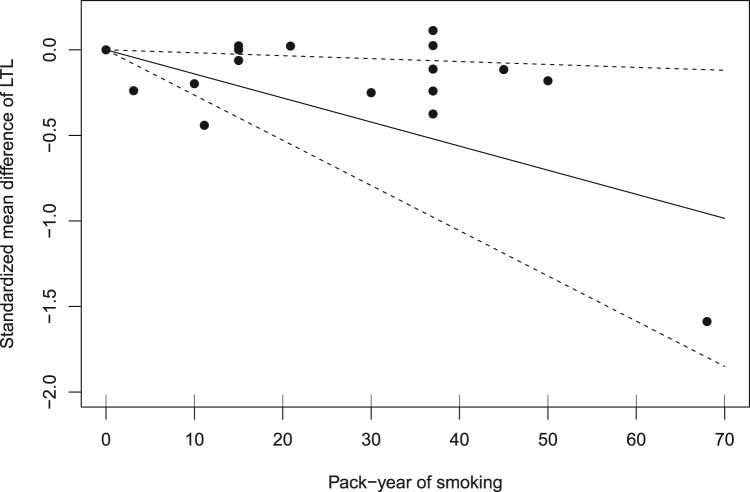
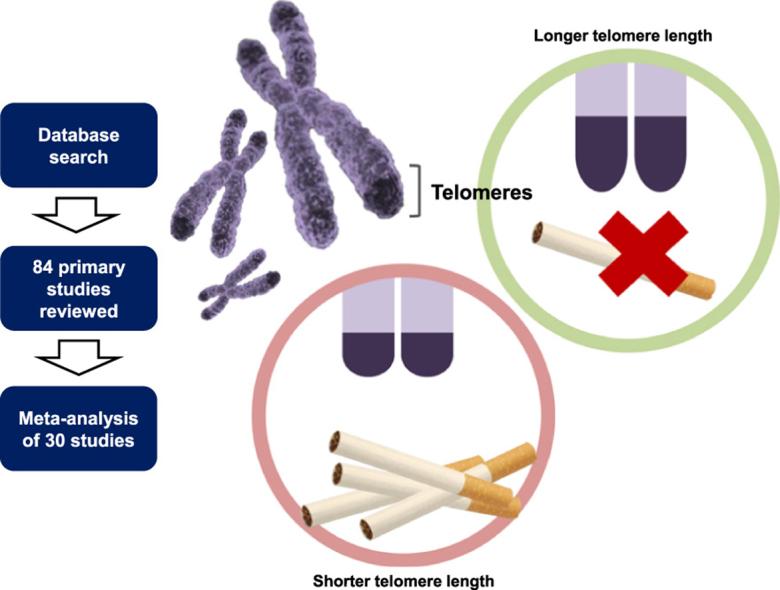
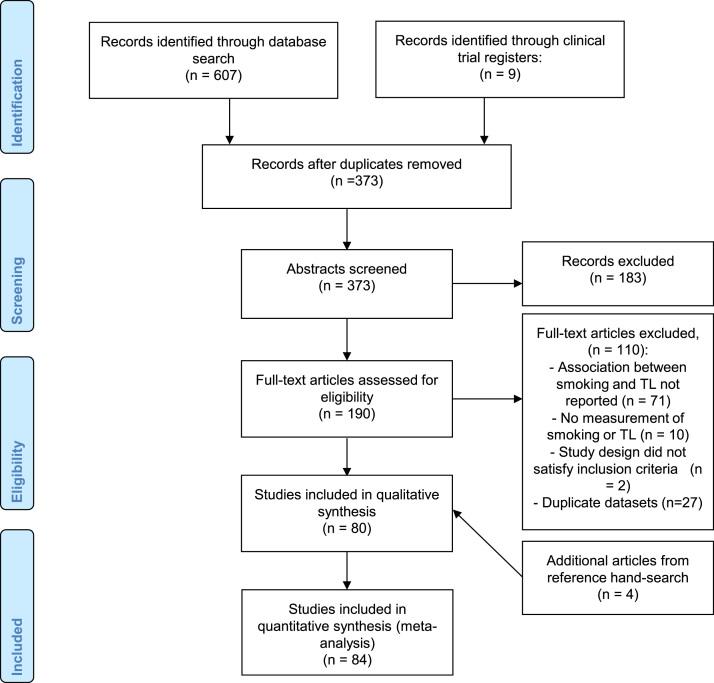
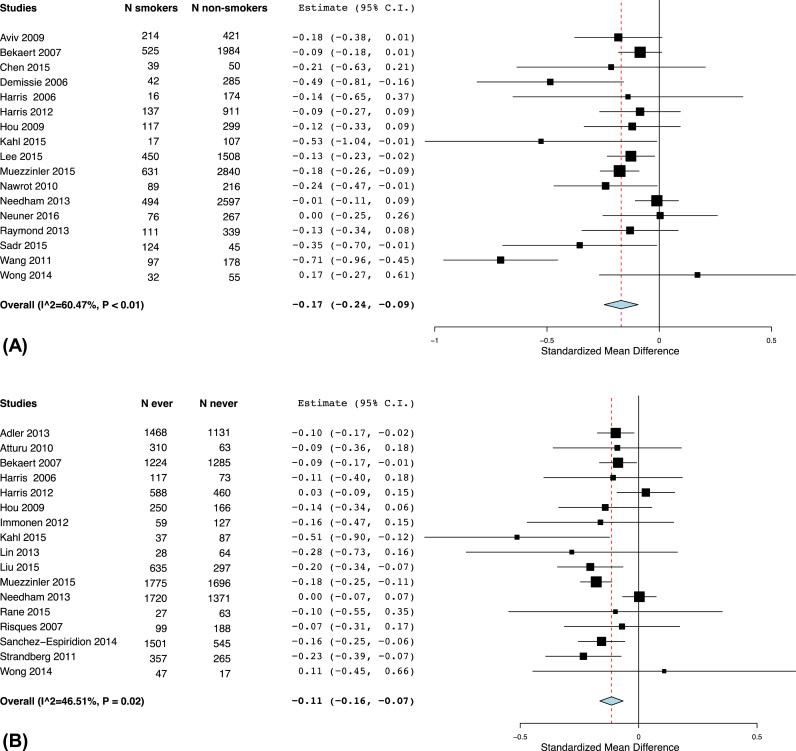
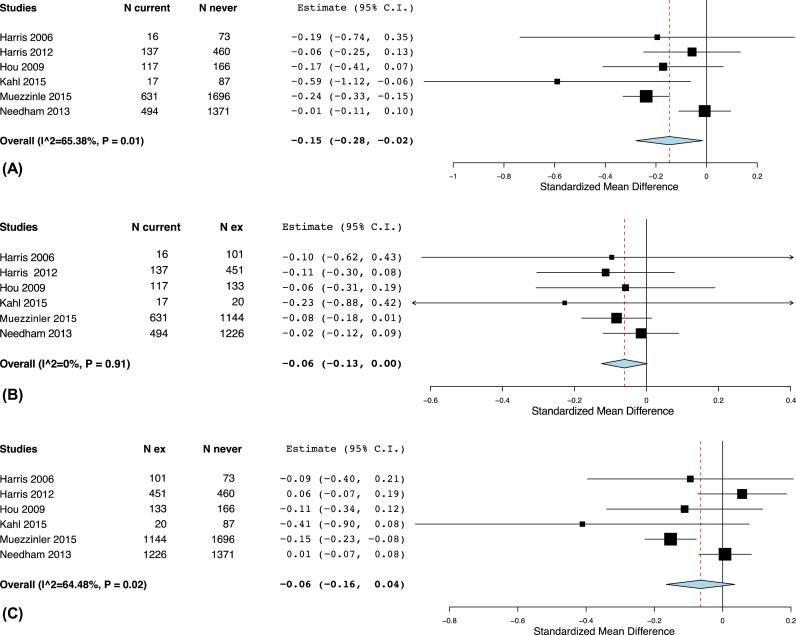
A total of 84 studies were included in the review, and 30 among them were included in our meta-analysis. Potential bias was addressed in half of included studies, and there was little evidence of small study bias. Telomere length was shorter among ever smokers compared to never smokers (summary standard mean difference [SMD]: -0.11 (95% CI -0.16 to -0.07)). Similarly, shorter telomere length was found among smokers compared to non-smokers, and among current smokers compared to never or former smokers. Dose-response meta-analysis suggested an inverse trend between pack-years of smoking and telomere length. However, heterogeneity among some analyses was observed.
CONCLUSION
Shorter telomeres among ever smokers compared to those who never smoked may imply mechanisms linking tobacco smoke exposure to ageing-related disease.
背景
吸烟是与衰老相关疾病的一个风险因素,但其与由端粒长度所指示的生物衰老之间的关联尚不清楚。
方法
我们系统地回顾了评估吸烟状况与端粒长度之间关联的证据。在MEDLINE(Ovid)和EMBASE(Ovid)数据库中进行检索,将关键词“吸烟”和“端粒”的变体相结合。提取研究特征数据以及吸烟与端粒长度之间关联的估计值。用偏倚风险评分评估研究质量,用漏斗图评估发表偏倚。采用I检验观察异质性。进行荟萃分析以比较不同吸烟状况下端粒长度的平均差异,并对吸烟包年数和端粒长度采用剂量反应方法。进行敏感性分析以检查异质性来源。
结果
该综述共纳入84项研究,其中30项纳入我们的荟萃分析。纳入研究中有一半解决了潜在偏倚问题,几乎没有证据表明存在小型研究偏倚。与从不吸烟者相比,曾经吸烟者的端粒长度较短(汇总标准平均差[SMD]:-0.11(95%CI -0.16至-0.07))。同样,与非吸烟者相比,吸烟者的端粒长度较短,与从不吸烟或曾经吸烟的人相比,当前吸烟者的端粒长度较短。剂量反应荟萃分析表明吸烟包年数与端粒长度之间呈反向趋势。然而,在一些分析中观察到了异质性。
结论
与从不吸烟的人相比,曾经吸烟者的端粒较短,这可能意味着存在将接触烟草烟雾与衰老相关疾病联系起来的机制。

 Zotero 插件