
阻断内皮素-1 受体/β-连环蛋白通路可增强结直肠癌对化疗的敏感性。
Blocking endothelin-1-receptor/β-catenin circuit sensitizes to chemotherapy in colorectal cancer.
机构信息
Preclinical Models and New Therapeutic Agents Unit, Regina Elena National Cancer Institute, Rome, Italy.
Institute of General Pathology, Catholic University, Rome, Italy.
出版信息
Cell Death Differ. 2017 Oct;24(10):1811-1820. doi: 10.1038/cdd.2017.121. Epub 2017 Jul 14.
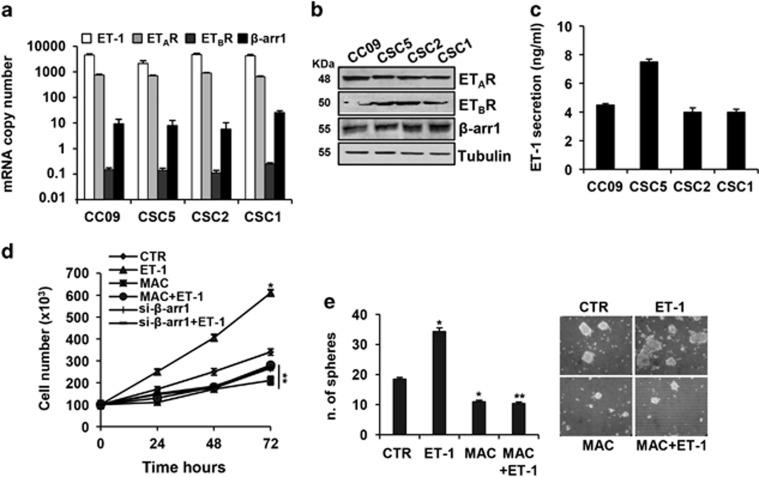
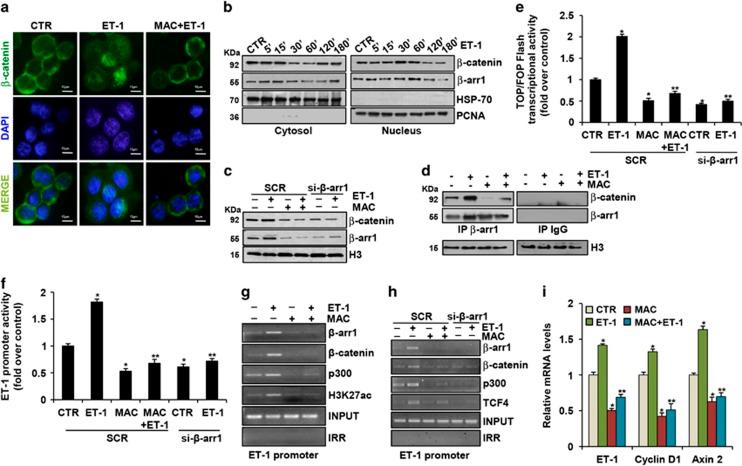
The limited clinical response to conventional chemotherapeutics observed in colorectal cancer (CRC) may be related to the connections between the hyperactivated β-catenin signaling and other pathways in CRC stem-like cells (CRC-SC). Here, we show the mechanistic link between the endothelin-1 (ET-1)/ET-1 receptor (ET-1R) signaling and β-catenin pathway through the specific interaction with the signal transducer β-arrestin1 (β-arr1), which initiates signaling cascades as part of the signaling complex. Using a panel of patient-derived CRC-SC, we show that these cells secrete ET-1 and express ETR and β-arr1, and that the activation of ETR/β-arr1 axis promotes the cross-talk with β-catenin signaling to sustain stemness, epithelial-to-mesenchymal transition (EMT) phenotype and response to chemotherapy. Upon ETR activation, β-arr1 acts as a transcription co-activator that binds β-catenin, thereby promoting nuclear complex with β-catenin/TFC4 and p300 and histone acetylation, inducing chromatin reorganization on target genes, such as ET-1. The enhanced transcription of ET-1 increases the self-sustained ET-1/β-catenin network. All these findings provide a strong rationale for targeting ET-1R to hamper downstream β-catenin/ET-1 autocrine circuit. Interestingly, treatment with macitentan, a dual ETR and ETR antagonist, able to interfere with tumor and microenvironment, disrupts the ET-1R/β-arr1-β-catenin interaction impairing pathways involved in cell survival, EMT, invasion, and enhancing sensitivity to oxaliplatin (OX) and 5-fluorouracil (5-FU). In CRC-SC xenografts, the combination of macitentan and OX or 5-FU enhances the therapeutic effects of cytotoxic drugs. Together, these results provide mechanistic insight into how ET-1R coopts β-catenin signaling and offer a novel therapeutic strategy to manage CRC based on the combination of macitentan and chemotherapy that might benefit patients whose tumors show high ETR and β-catenin expression.
在结直肠癌(CRC)中观察到的传统化疗的有限临床反应可能与过度激活的β-连环蛋白信号与 CRC 干细胞样细胞(CRC-SC)中的其他途径之间的联系有关。在这里,我们通过与信号转导β-抑制蛋白 1(β-arr1)的特异性相互作用,显示了内皮素-1(ET-1)/内皮素受体(ET-1R)信号与β-连环蛋白途径之间的机制联系,β-arr1 作为信号转导复合物的一部分启动信号级联。使用一组患者来源的 CRC-SC,我们表明这些细胞分泌 ET-1 并表达 ETR 和 β-arr1,并且 ETR/β-arr1 轴的激活促进与β-连环蛋白信号的串扰以维持干细胞特性、上皮-间质转化(EMT)表型和对化疗的反应。在 ETR 激活后,β-arr1 作为转录共激活子与β-连环蛋白结合,从而促进与β-catenin/TFC4 和 p300 的核复合物和组蛋白乙酰化,诱导靶基因上的染色质重排,如 ET-1。增强的 ET-1 转录增加了自我维持的 ET-1/β-连环蛋白网络。所有这些发现为靶向 ET-1R 以阻碍下游β-连环蛋白/ET-1 自分泌回路提供了强有力的依据。有趣的是,用 macitentan 治疗,一种双重 ETR 和 ETR 拮抗剂,能够干扰肿瘤和微环境,破坏 ET-1R/β-arr1-β-连环蛋白相互作用,损害涉及细胞存活、EMT、侵袭的途径,并增强对奥沙利铂(OX)和 5-氟尿嘧啶(5-FU)的敏感性。在 CRC-SC 异种移植物中,macitentan 和 OX 或 5-FU 的联合使用增强了细胞毒性药物的治疗效果。总之,这些结果深入了解了 ET-1R 如何招募β-连环蛋白信号,并提供了一种新的治疗策略,基于 macitentan 和化疗的联合治疗结直肠癌,可能使那些肿瘤表达高 ETR 和β-连环蛋白的患者受益。




 Zotero 插件