
细菌在三维菌落中的生长。
Growth of bacteria in 3-d colonies.
作者信息
Shao Xinxian, Mugler Andrew, Kim Justin, Jeong Ha Jun, Levin Bruce R, Nemenman Ilya
机构信息
Department of Physics, Emory University, Atlanta, GA 30322, USA.
Department of Physics and Astronomy, Purdue University, West Lafayette, IN 47907, USA.
出版信息
PLoS Comput Biol. 2017 Jul 27;13(7):e1005679. doi: 10.1371/journal.pcbi.1005679. eCollection 2017 Jul.
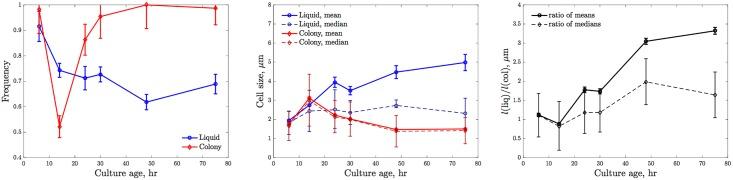
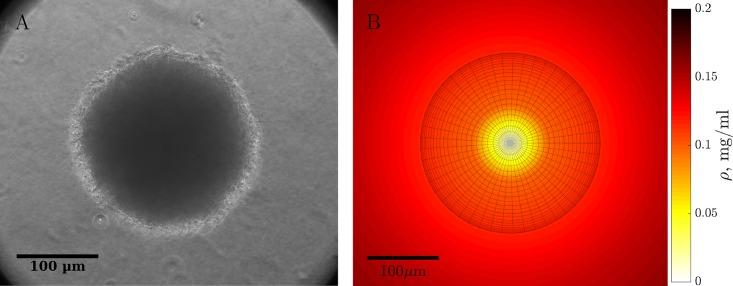
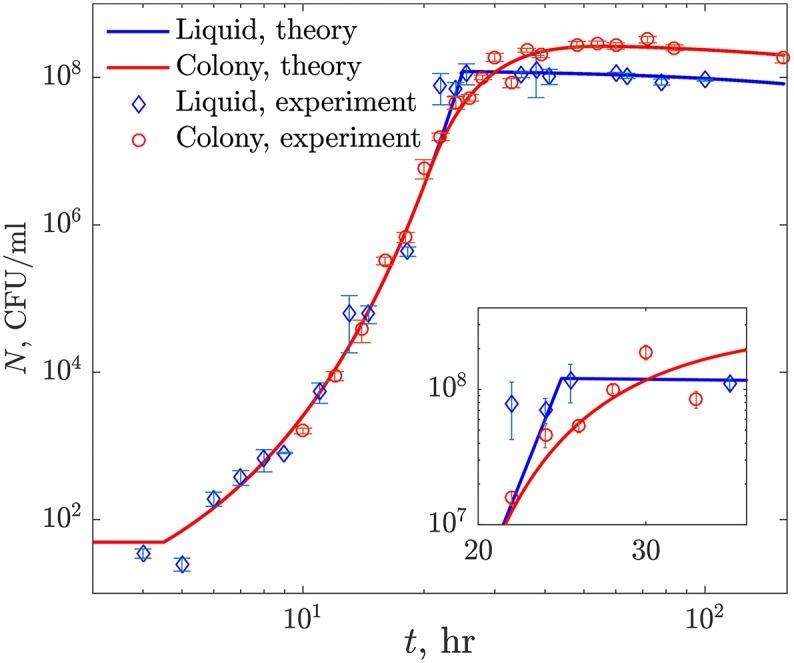
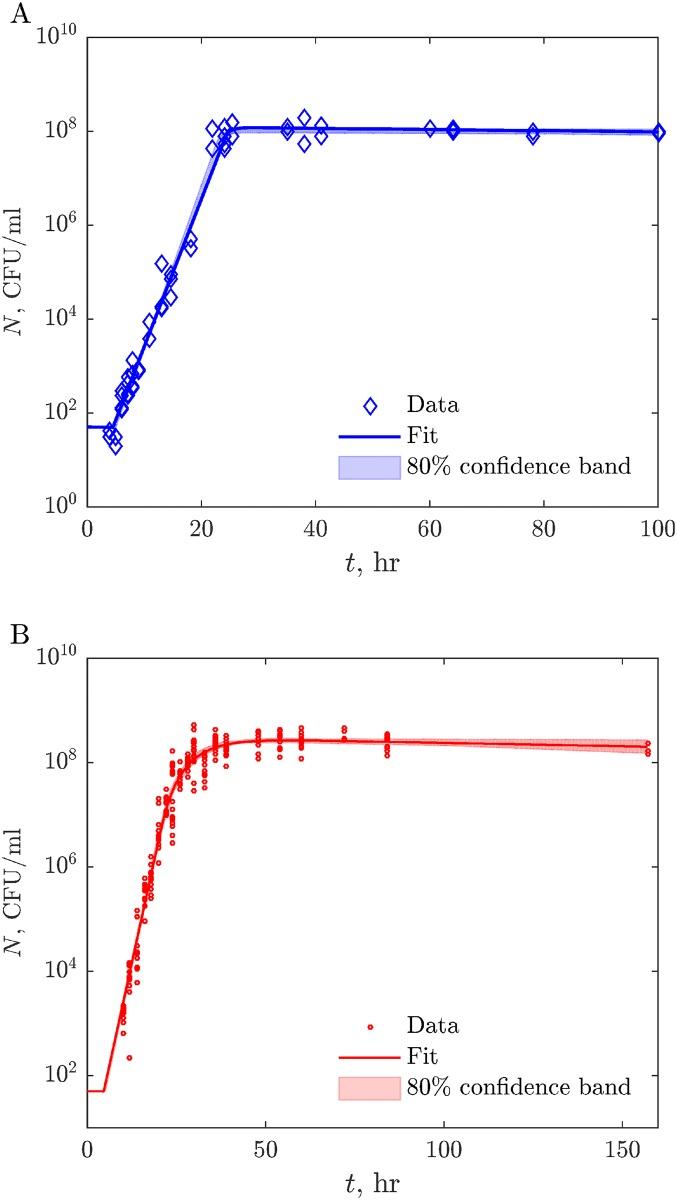
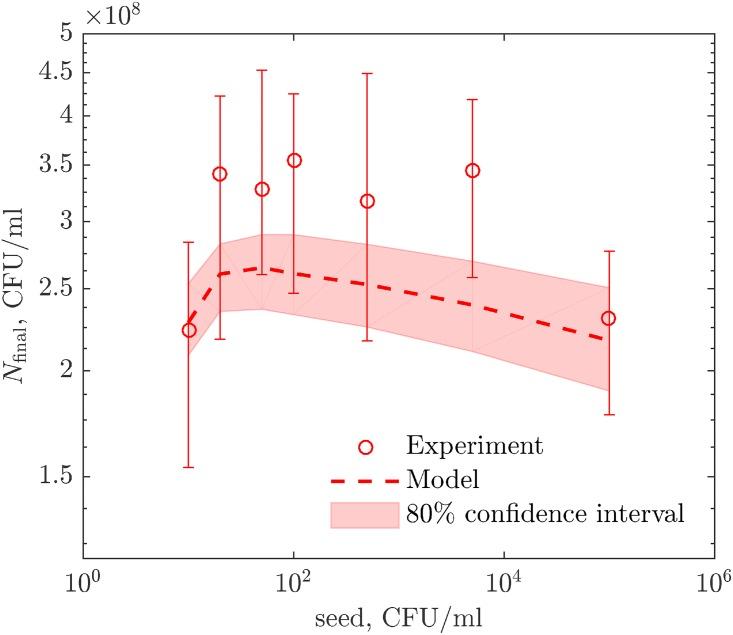
The dynamics of growth of bacterial populations has been extensively studied for planktonic cells in well-agitated liquid culture, in which all cells have equal access to nutrients. In the real world, bacteria are more likely to live in physically structured habitats as colonies, within which individual cells vary in their access to nutrients. The dynamics of bacterial growth in such conditions is poorly understood, and, unlike that for liquid culture, there is not a standard broadly used mathematical model for bacterial populations growing in colonies in three dimensions (3-d). By extending the classic Monod model of resource-limited population growth to allow for spatial heterogeneity in the bacterial access to nutrients, we develop a 3-d model of colonies, in which bacteria consume diffusing nutrients in their vicinity. By following the changes in density of E. coli in liquid and embedded in glucose-limited soft agar, we evaluate the fit of this model to experimental data. The model accounts for the experimentally observed presence of a sub-exponential, diffusion-limited growth regime in colonies, which is absent in liquid cultures. The model predicts and our experiments confirm that, as a consequence of inter-colony competition for the diffusing nutrients and of cell death, there is a non-monotonic relationship between total number of colonies within the habitat and the total number of individual cells in all of these colonies. This combined theoretical-experimental study reveals that, within 3-d colonies, E. coli cells are loosely packed, and colonies produce about 2.5 times as many cells as the liquid culture from the same amount of nutrients. We verify that this is because cells in liquid culture are larger than in colonies. Our model provides a baseline description of bacterial growth in 3-d, deviations from which can be used to identify phenotypic heterogeneities and inter-cellular interactions that further contribute to the structure of bacterial communities.
细菌群体的生长动力学在充分搅拌的液体培养中的浮游细胞方面已得到广泛研究,在这种培养中所有细胞获取营养的机会均等。在现实世界中,细菌更有可能以菌落的形式生活在物理结构的栖息地中,其中单个细胞获取营养的机会各不相同。在这种条件下细菌生长的动力学了解甚少,而且与液体培养不同,对于在三维(3 - D)菌落中生长的细菌群体,没有一个广泛使用的标准数学模型。通过扩展资源有限群体生长的经典莫诺德模型,以考虑细菌获取营养的空间异质性,我们开发了一个菌落的三维模型,其中细菌消耗其附近扩散的营养物质。通过跟踪液体中和嵌入葡萄糖限制软琼脂中的大肠杆菌密度变化,我们评估了该模型与实验数据的拟合情况。该模型解释了实验观察到的菌落中存在亚指数、扩散限制生长模式,而液体培养中不存在这种模式。该模型预测并且我们的实验证实,由于菌落间对扩散营养物质的竞争以及细胞死亡,栖息地内菌落总数与所有这些菌落中单个细胞总数之间存在非单调关系。这项理论与实验相结合的研究表明,在三维菌落中,大肠杆菌细胞排列松散,并且相同量营养物质条件下,菌落产生的细胞数量约为液体培养的2.5倍。我们证实这是因为液体培养中的细胞比菌落中的细胞大。我们的模型提供了细菌在三维中生长的基线描述,与之的偏差可用于识别进一步影响细菌群落结构的表型异质性和细胞间相互作用。

 Zotero 插件