
2013年至2017年中国浙江省五波甲型H7N9禽流感病毒人间感染的空间特征与流行病学
Spatial characteristics and the epidemiology of human infections with avian influenza A(H7N9) virus in five waves from 2013 to 2017 in Zhejiang Province, China.
作者信息
Wu Haocheng, Wang XinYi, Xue Ming, Xue Melanie, Wu Chen, Lu Qinbao, Ding Zheyuan, Xv Xiaoping, Lin Junfen
机构信息
Zhejiang Province Center for Disease Control and Prevention, Hangzhou, Zhejiang Province, China.
Key Laboratory for Vaccine, Prevention and Control of Infectious Disease of Zhejiang Province, Hangzhou, Zhejiang Province, China.
出版信息
PLoS One. 2017 Jul 27;12(7):e0180763. doi: 10.1371/journal.pone.0180763. eCollection 2017.
BACKGROUND
The five-wave epidemic of H7N9 in China emerged in the second half of 2016. This study aimed to compare the epidemiological characteristics among the five waves, estimating the possible infected cases and inferring the extent of the possible epidemic in the areas that have not reported cases before.
METHODS
The data for the H7N9 cases from Zhejiang Province between 2013 and 2017 was obtained from the China Information Network System of Disease Prevention and Control. The start date of each wave was 16 March 2013, 1 July 2013, 1 July 2014, 1 July 2015 and 1 July 2016. The F test or Pearson's chi-square test were used to compare the characteristics of the five waves. Global and local autocorrelation analysis was carried out to identify spatial autocorrelations. Ordinary kriging interpolation was analyzed to estimate the number of human infections with H7N9 virus and to infer the extent of infections in the areas with no cases reported before.
RESULT
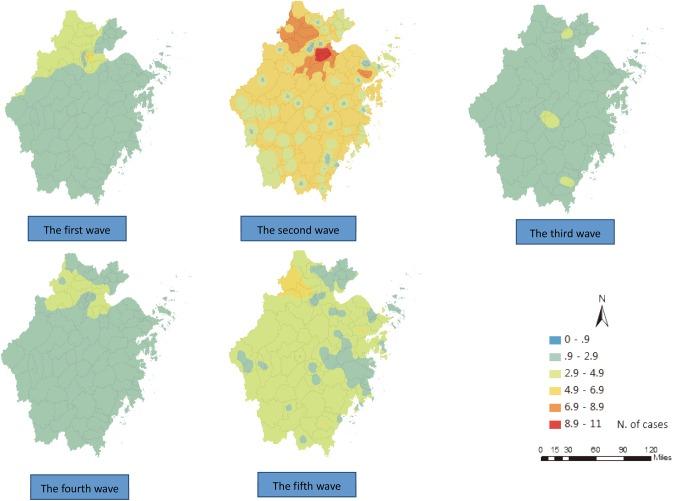
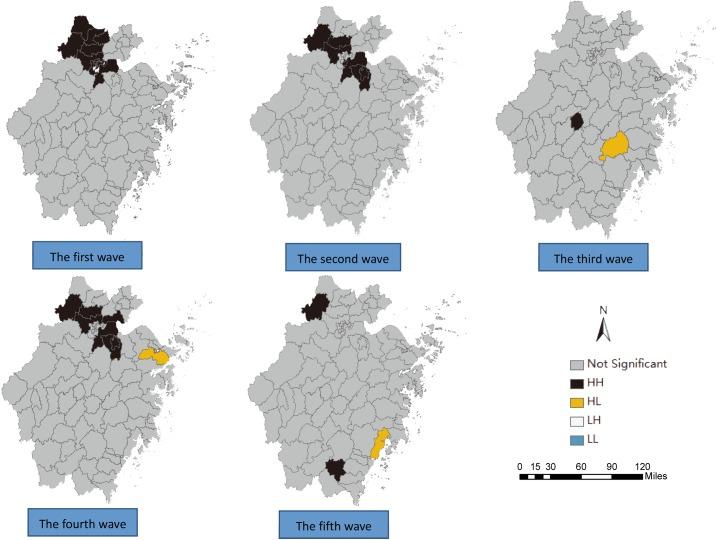
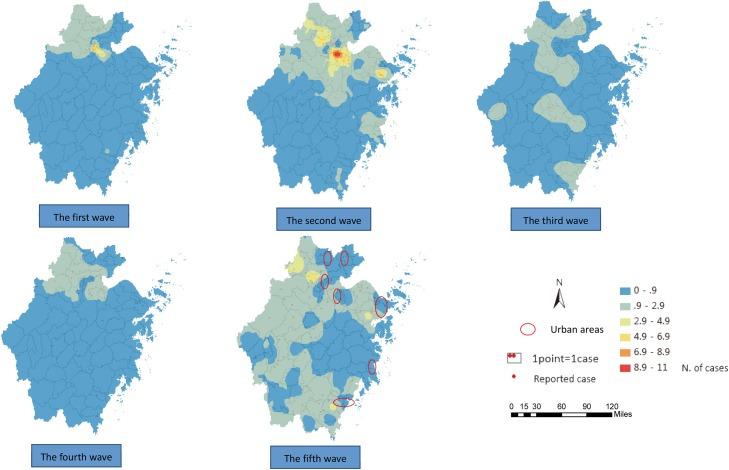
There were 45, 94, 45, 34 and 80 cases identified from the first wave to the fifth, respectively. The death rate was significantly different among the five waves of epidemics (χ2 = 10.784, P = 0.029). The age distribution (F = 0.903, P = 0.462), gender (χ2 = 2.674, P = 0.614) and occupation(χ2 = 19.764, P = 0.407) were similar in each period. Most of the cases were males and farmers. A significant trend (χ2 = 70.328, P<0.001) was identified that showed a growing proportion of rural cases. There were 31 high-high clusters and 3 high-low clusters at the county level among the five waves and 12, 8, 2, 9 and 3 clusters in each wave, respectively. The total cases infected with the H7N9 virus were far more than those that have been reported now, and the affected areas continue to expand. The epidemic in the north of Zhejiang Province persisted in all five waves. Since the second wave, the virus spread to the south areas and central areas. There was an obvious decline in the infected cases in the urban areas, and the epidemics mostly occurred in the rural areas after the fourth wave. The epidemic was relatively dispersed since the third wave had fewer than two cases in most of the areas and showed a reinforcing trend again in the fifth wave.
CONCLUSIONS
The study revealed that there were few differences in the epidemiologic characteristics among the five waves of the epidemic. However, the areas where the possible epidemic circulated was larger than reported. The epidemic cross-regional expansion continued and mostly occurred in rural areas. Continuous closure of the live poultry market (LPM) is strongly recommended in both rural and urban areas. Illegal and scattered live poultry trading, especially in rural areas, must be forbidden. It is suggested too that a more rigorous management be performed on live poultry trade and wholesale across the area. Health education, surveillance of cases and pathogenicity should also be strengthened.
背景
中国H7N9的五波疫情于2016年下半年出现。本研究旨在比较五波疫情的流行病学特征,估计可能的感染病例数,并推断此前未报告病例地区可能的疫情范围。
方法
从中国疾病预防控制信息网络系统获取2013年至2017年浙江省H7N9病例的数据。每波疫情的起始日期分别为2013年3月16日、2013年7月1日、2014年7月1日、2015年7月1日和2016年7月1日。采用F检验或Pearson卡方检验比较五波疫情的特征。进行全局和局部自相关分析以识别空间自相关。分析普通克里金插值法以估计H7N9病毒的人类感染数,并推断此前未报告病例地区的感染范围。
结果
从第一波到第五波分别确诊45例、94例、45例、34例和80例。五波疫情的死亡率有显著差异(χ2 = 10.784,P = 0.029)。各时期的年龄分布(F = 0.903,P = 0.462)、性别(χ2 = 2.674,P = 0.614)和职业(χ2 = 19.764,P = 0.407)相似。大多数病例为男性和农民。发现一个显著趋势(χ2 = 70.328,P<0.001),即农村病例的比例不断增加。五波疫情期间县级有31个高高聚集区和3个高低聚集区,每波分别有12个、8个、2个、9个和3个聚集区。感染H7N9病毒的总病例数远多于目前报告的病例数,且受影响地区不断扩大。浙江省北部的疫情在所有五波疫情中持续存在。自第二波疫情以来,病毒传播到南部地区和中部地区。城市地区的感染病例明显下降,第四波疫情后疫情大多发生在农村地区。自第三波疫情以来,疫情相对分散,大多数地区病例少于两例,第五波疫情再次呈现增强趋势。
结论
该研究表明,五波疫情的流行病学特征差异不大。然而,可能的疫情传播地区比报告的要大。疫情跨区域持续蔓延,且大多发生在农村地区。强烈建议在农村和城市地区持续关闭活禽市场。必须禁止非法和零散的活禽交易,特别是在农村地区。还建议对该地区的活禽交易和批发进行更严格的管理。同时也应加强健康教育、病例监测和致病性监测。


 Zotero 插件