
一项对十一项定性证据综合分析的大型民族志研究,探讨慢性非恶性疼痛患者的生活体验。
A mega-ethnography of eleven qualitative evidence syntheses exploring the experience of living with chronic non-malignant pain.
作者信息
Toye Fran, Seers Kate, Hannink Erin, Barker Karen
机构信息
Nuffield Orthopaedic Centre, Oxford University Hospitals NHS Foundation Trust, Oxford, UK.
Nuffield Department of Orthopaedics, Rheumatology and Musculoskeletal Sciences, University of Oxford, Oxford, UK.
出版信息
BMC Med Res Methodol. 2017 Aug 1;17(1):116. doi: 10.1186/s12874-017-0392-7.
BACKGROUND
Each year over five million people develop chronic non-malignant pain and can experience healthcare as an adversarial struggle. The aims of this study were: (1) to bring together qualitative evidence syntheses that explore patients' experience of living with chronic non-malignant pain and develop conceptual understanding of what it is like to live with chronic non-malignant pain for improved healthcare; (2) to undertake the first mega-ethnography of qualitative evidence syntheses using the methods of meta-ethnography.
METHODS
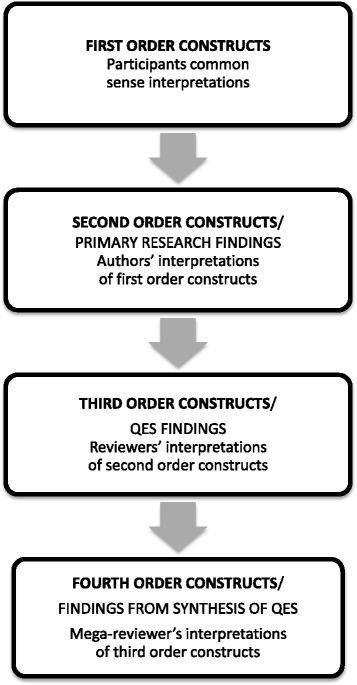
We used the seven stages of meta-ethnography refined for large studies. The innovation of mega-ethnography is to use conceptual findings from qualitative evidence syntheses as primary data. We searched 7 bibliographic databases from inception until February 2016 to identify qualitative evidence syntheses that explored patients' experience of living with chronic non-malignant pain.
RESULTS
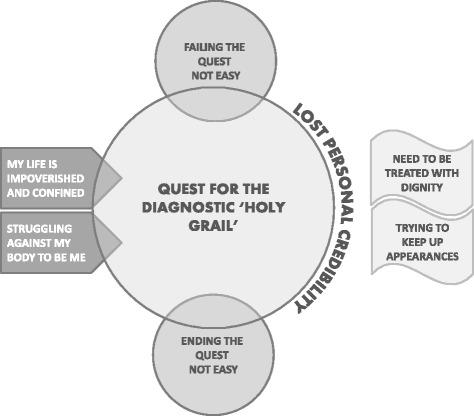
We identified 82 potential studies from 556 titles, screened 34 full text articles and included 11 qualitative evidence syntheses synthesising a total of 187 qualitative studies reporting more than 5000 international participants living with chronic pain. We abstracted concepts into 7 conceptual categories: (1) my life is impoverished and confined; (2) struggling against my body to be me; (3) the quest for the diagnostic 'holy grail'; (4) lost personal credibility; (5) trying to keep up appearances; (6) need to be treated with dignity; and (7) deciding to end the quest for the grail is not easy. Each conceptual category was supported by at least 7 of the 11 qualitative evidence syntheses.
CONCLUSIONS
This is the first mega-ethnography, or synthesis of qualitative evidence syntheses using the methods of meta-ethnography. Findings help us to understand that the decision to end the quest for a diagnosis can leave patients feeling vulnerable and this may contribute to the adversarial nature of the clinical encounter. This knowledge demonstrates that treating a patient with a sense that they are worthy of care and hearing their story is not an adjunct to, but integral to health care.
背景
每年有超过五百万人患上慢性非恶性疼痛,就医过程可能充满艰难。本研究的目的是:(1)整合定性证据综述,探究慢性非恶性疼痛患者的生活体验,并形成对慢性非恶性疼痛患者生活状况的概念性理解,以改善医疗服务;(2)运用元民族志方法开展首次关于定性证据综述的大型民族志研究。
方法
我们采用了为大型研究改进的元民族志七个阶段。大型民族志的创新之处在于将定性证据综述的概念性发现用作原始数据。我们检索了7个文献数据库,从建库至2016年2月,以识别探究慢性非恶性疼痛患者生活体验的定性证据综述。
结果
我们从556个标题中识别出82项潜在研究,筛选了34篇全文文章,纳入了11项定性证据综述,这些综述共综合了187项定性研究,报告了超过5000名患有慢性疼痛的国际参与者。我们将概念提炼为7个概念类别:(1)我的生活贫困且受限;(2)与身体抗争以做自己;(3)对诊断“圣杯”的探寻;(4)个人信誉丧失;(5)努力维持表象;(6)需要有尊严地接受治疗;(7)决定放弃对“圣杯”的探寻并非易事。11项定性证据综述中的至少7项支持了每个概念类别。
结论
这是首次运用元民族志方法进行的大型民族志研究,即对定性证据综述的综合。研究结果有助于我们理解,放弃寻求诊断的决定可能会让患者感到脆弱,这可能导致临床诊疗过程中的对抗性。这些知识表明,以患者值得关怀的意识对待他们并倾听他们的故事并非医疗保健的附属品,而是其不可或缺的一部分。

 Zotero 插件