
甲型流感病毒与不同禽类输卵管外植体的相互作用
Interaction of Influenza A Viruses with Oviduct Explants of Different Avian Species.
作者信息
Sid Hicham, Hartmann Sandra, Winter Christine, Rautenschlein Silke
机构信息
Clinic for Poultry, University of Veterinary Medicine HannoverHannover, Germany.
Institute of Virology, University of Veterinary Medicine HannoverHannover, Germany.
出版信息
Front Microbiol. 2017 Jul 20;8:1338. doi: 10.3389/fmicb.2017.01338. eCollection 2017.
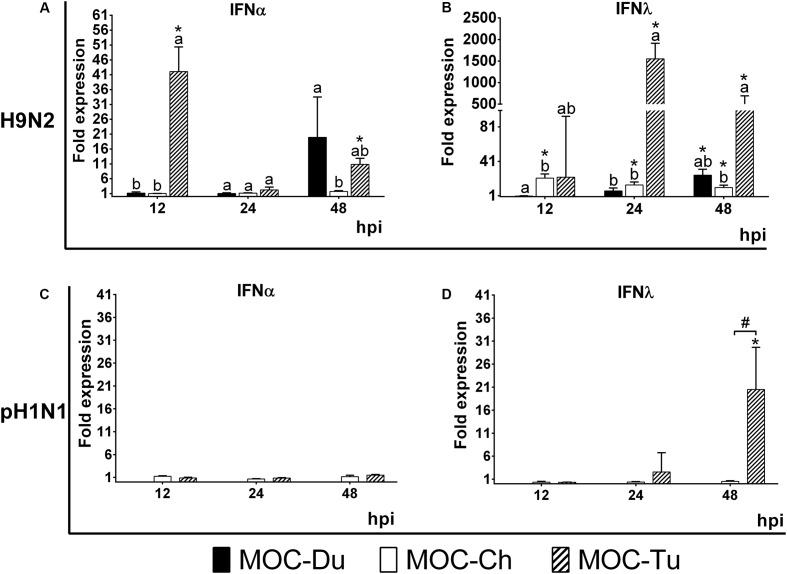
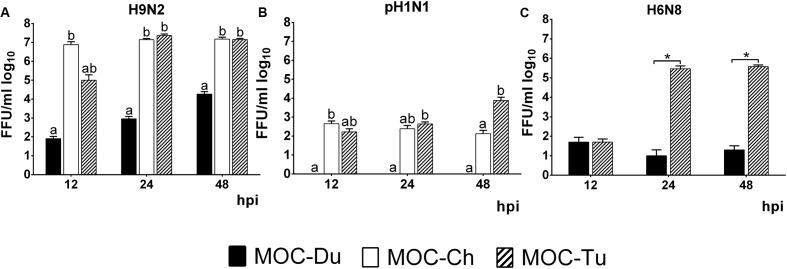
Infection of poultry with low pathogenic avian influenza viruses (LPAIV) is often associated with mild respiratory symptoms but may also lead to loss in egg production in laying birds. susceptibility of the reproductive tract for LPAIV infection was reported for turkeys and chickens, but virus-interaction with epithelial cells of the oviduct and possible stimulation of the local antiviral immune responses have not been characterized. In this study, we wanted to investigate the suitability of magnum organ cultures (MOC) as an model to study virus-host interactions. We compared the susceptibility of duck (Du), chicken (Ch), and turkey (Tu) MOC for three different influenza A viruses (IAV). Overall, the course of infection and the antiviral immune response varied between strains as well as host cell origin, but MOC gave reproducible results for all investigated parameters within each species. While pandemic (p) H1N1 and H9N2 efficiently replicated in MOC-Ch and MOC-Tu, MOC-Du were significantly less susceptible to infection as indicated by a reduced replication level for both viruses ( < 0.05). Overall, virus replication levels did not correlate with interferonα (IFNα) mRNA-expression levels in neither species. H9N2-infection led to a significant upregulation of interferonλ (IFNλ) mRNA expression in MOC of all species compared to the non-infected controls ( < 0.05), while a correlation with replication levels was only seen for MOC-Tu. pH1N1-infection induced only significant upregulation of IFNλ mRNA expression in MOC-Tu at 48 hours post infection ( < 0.05), but the expression pattern did not correlate with replication levels. Our results show that MOC are a suitable model to study IAV-interaction with the mucosal surface of the avian reproductive tract. The data suggest that the reproductive tract may play a role in the pathobiology of IAV in poultry.
低致病性禽流感病毒(LPAIV)感染家禽通常与轻微呼吸道症状相关,但也可能导致产蛋鸡产蛋量下降。据报道,火鸡和鸡的生殖道对LPAIV感染易感,但病毒与输卵管上皮细胞的相互作用以及对局部抗病毒免疫反应的可能刺激尚未得到明确表征。在本研究中,我们想调查输卵管大弯部器官培养物(MOC)作为研究病毒-宿主相互作用模型的适用性。我们比较了鸭(Du)、鸡(Ch)和火鸡(Tu)的MOC对三种不同甲型流感病毒(IAV)的易感性。总体而言,不同毒株以及宿主细胞来源之间的感染过程和抗病毒免疫反应各不相同,但MOC对每个物种内所有研究参数均给出了可重复的结果。虽然大流行(p)H1N1和H9N2能在MOC-Ch和MOC-Tu中有效复制,但MOC-Du对这两种病毒的复制水平均降低,表明其对感染的易感性显著较低(<0.05)。总体而言,两种物种中病毒复制水平均与干扰素α(IFNα)mRNA表达水平无关。与未感染对照相比,H9N2感染导致所有物种的MOC中干扰素λ(IFNλ)mRNA表达显著上调(<0.05),而仅在MOC-Tu中观察到其与复制水平相关。pH1N1感染仅在感染后48小时诱导MOC-Tu中IFNλ mRNA表达显著上调(<0.05),但其表达模式与复制水平无关。我们的结果表明,MOC是研究IAV与禽类生殖道黏膜表面相互作用的合适模型。数据表明,生殖道可能在IAV在家禽中的病理生物学中起作用。


 Zotero 插件